Chicken Burger
Buttermilk overnight, then a dredge pressed on hard and left to sit for ten minutes so the coating hydrates and stays on. Thigh, not breast.
- Prep
- 25 min
- Cook
- 20 min
- Resting
- 4 hr 10 min
- Total
- 4 hr 55 min
- Serves
- 4
- Revisions
- 1
Allergens
- Cereals containing gluten
- Eggs
- Milk
- Mustard
- Sesame
- Sulphites
Named from the ingredients as written, including those carried in from sub-recipes. This is not a guarantee — check the labels on what you actually buy, and note that a product’s recipe can change.
Ingredients
Serves
Brine
Dredge
Frying
To build
Method
Brine
Turn the thighs through the buttermilk, salt and paprika, cover and refrigerate for at least 4 hours and up to overnight.
Thighs rather than breast, because they hold moisture through frying and stay tender at the temperature the coating needs to go golden.
Dredge
Mix all the dredge ingredients in a wide bowl.
Spoon three tablespoons of the buttermilk marinade into the flour and rub it through with your fingers until it is full of small ragged lumps. Those lumps become the craggy bits of crust.
Lift each thigh out, letting the excess drip off, and press it into the flour, pushing hard so the coating grips rather than dusting it on.
Lay the coated pieces on a rack and leave them for 10 minutes. The flour hydrates and turns from powdery to slightly tacky in that time, which is what stops the crust sliding off in the oil.
Frying
Heat the oil in a deep pan to 170C, using a thermometer.
Fry two pieces at a time for 6 to 7 minutes, turning once, until deep golden and 74C/165F at the centre.
Two at a time keeps the oil temperature up. Four at once drops it, and coating that sits in cool oil absorbs it rather than crisping.
Drain on a rack, not on paper, which steams the underside soft.
To build
Mix the mayonnaise, sriracha and mustard, and toast the buns.
Build with sauce on both halves, a bed of shredded lettuce, the chicken, then gherkins.
Nobody has rated this recipe yet.
Sign in to rate this recipe. One rating per person, and you can change it.
What to expect
- Taste
Salty, savoury and paprika-warm, with the buttermilk giving a faint tang under it. The sauce brings heat and sweetness and the gherkin brings acid.
- Aroma
Frying chicken, which is one of the more persuasive smells in this collection and will fill a house for the rest of the evening.
- Texture
The entire dish. A crust that audibly shatters, then soft juicy thigh, then crisp shredded lettuce. Any softness in the crust is a failure.
- Sound
The fry itself, and then the first bite, which should be audible across a room.
- How the flavour moves
Crust and salt first, then the chicken, then heat from the sriracha building, then acid.
- Serve it
Hot chicken, cold lettuce, cold sauce.
- Goes with
Chips or slaw. A cold lager, or a milkshake.
Cook's notes
- Difficulty
Moderate. Deep frying at a controlled temperature is the only demanding part.
- Cost
Low.
- Equipment
A deep heavy pan, a thermometer, and a wire rack.
- When to make it
A weekend, with the marinade started the night before.
- Best season
None.
- You know it is done when
Deep golden brown all over with visible craggy pieces standing proud. Pale patches mean the coating was too thin or the oil too cool.
- And it feels like
A crust that shatters, and meat that gives. Thigh should be juicy rather than firm.
- Food safety
Chicken at 74C/165F instantaneous (USDA), or 70C for two minutes / 75C instantaneously (UK Food Standards Agency). Probe the thickest piece — the coating makes colour a useless guide. Hot oil is the other hazard: a deep pan no more than a third full, nothing wet going in, and a lid within reach.
- Where it goes wrong
- Frying immediately after dredging, so the coating slides off.
- Dusting the flour on instead of pressing it in.
- Four pieces at once, which drops the oil temperature.
- Guessing the oil temperature instead of measuring it.
- Draining on kitchen paper, which steams the underside soft.
- Breast instead of thigh, which is dry by the time the crust is right.
- If it does go wrong
Coating fell off: no rest, or not pressed on hard enough. Greasy: the oil was below about 160C. Dark outside and raw inside: the oil was too hot; drop it to 165C. Soggy after a few minutes: it was drained on paper.
- Making it ahead
The marinade overnight and the dredge mix indefinitely. The frying is à la minute.
- Keeping it
Best immediately. The chicken keeps a day and loses its crust.
- Reheating
An oven or air fryer at 190C for 8 minutes brings back most of the crispness. A microwave destroys it.
- Freezing
Not once fried. The marinated raw thighs freeze for a month.
- Leftovers
Sliced cold over a salad, or in a wrap.
- Scaling it
Fry in twos regardless of how many people are eating, and hold cooked pieces on a rack in a 140C oven.
- Substitutions
Buttermilk can be 300ml whole milk with 1 tbsp lemon juice, left 10 minutes. Chicken breast works if butterflied, and is drier. Gluten-free flour blends fry acceptably with the cornflour left in.
- Dietary swaps
Contains gluten, milk from the buttermilk, and eggs, mustard and sulphites from the mayonnaise, plus sesame from the bun. Nut free. Not easily made dairy free, since the buttermilk marinade is doing real tenderising work.
- Shopping for it
Nothing unusual. Buttermilk is in most supermarkets near the cream.
- Keeping the cost down
Thighs are cheaper than breast and better here. The litre of oil can be strained through a sieve and reused twice.
- Sustainability
Chicken has the lowest footprint of the common meats, and thighs are the part of the bird that is chronically less in demand than breast — cooking them is a small push against an imbalance that leads to waste. The litre of frying oil is the other consideration: strain it and reuse it rather than pouring it away, and when it is finished, dispose of it in the bin rather than the sink.
- Nutrition
Fried, and it is not pretending otherwise. Thigh carries more fat than breast and that is what keeps it tender.
- Worth it?
Ten minutes of doing nothing after the dredge, and the coating stays where you put it.
Where it comes from
- Origin
The American south for the technique, fast food for the sandwich.
- Also called
Fried chicken sandwich.
- Said out loud
Straightforward.
- What the name means
Called a burger in Britain and a sandwich in America, which is a small transatlantic disagreement about whether a burger requires beef.
- History
Fried chicken in the United States is inseparable from Black American cooking, where it was refined over generations and, in the era of segregation, was one of the few foods that travelled well enough for Black travellers to carry on journeys where restaurants would not serve them. The buttermilk soak is a genuine technique rather than folklore: its acidity and calcium help tenderise, and it carries seasoning into the meat. The sandwich form is commercial and recent by comparison.
- Why it matters
The fried chicken shop is a fixture of British high streets and the burger is one of the most-eaten things in the country.
- When it is eaten
A Friday. Not a weeknight, given the oil.
- The traditional way
Buttermilk marination, seasoned flour dredge, shallow or deep frying.
- How it changed
From bone-in pieces at a table to boneless fillets in a bun.
- Regional variations
Nashville hot chicken is coated in a cayenne and lard paste after frying. Korean fried chicken is double-fried with a thin starch coating and glazed.
- How this version differs
Thigh rather than breast, and the ten-minute rest after dredging written in as a step rather than left out.
- Sources and credit
No individual. The tradition's originators were overwhelmingly Black cooks whose names were not recorded, which is worth saying plainly.
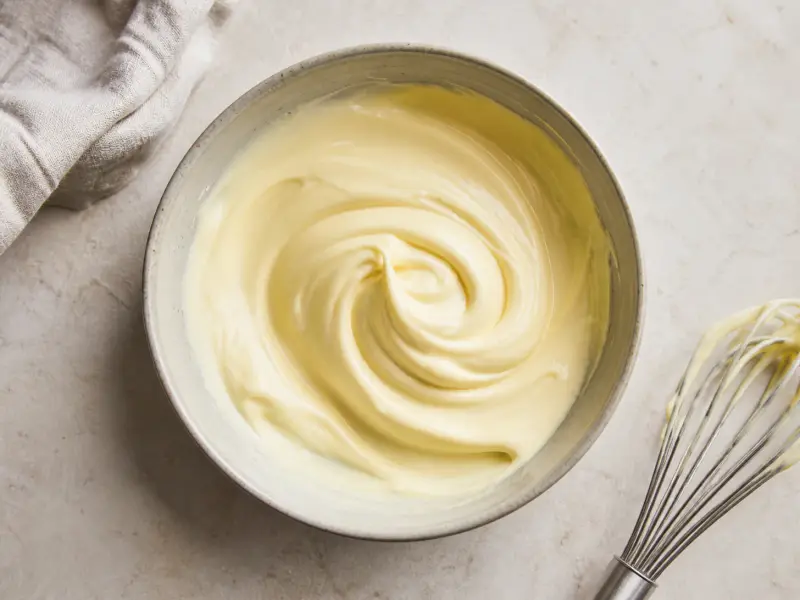 Mayonnaise
 Chicken à la King
 Chicken Caesar Salad
 Chicken Parmigiana
 Classic Beef Burger
 One-Pot Creamy Chicken and Rice
 Air Fryer Chicken Breast
 American
 Main courses
 Lunch
 Dinner
 Chicken