Mayonnaise
Mayonnaise
Egg yolk, oil and acid whisked by hand into a thick emulsion, with the drop-by-drop start that decides whether it holds or splits.
- Prep
- 15 min
- Total
- 15 min
- Serves
- 8
- Revisions
- 6
Allergens
- Eggs
- Mustard
- Sulphites
Named from the ingredients as written, including those carried in from sub-recipes. This is not a guarantee — check the labels on what you actually buy, and note that a product’s recipe can change.
Ingredients
Serves
Method
Take the yolks and both oils out an hour ahead, so everything is at room temperature.
Cold is the commonest reason a first mayonnaise splits. A fridge-cold yolk cannot take the oil fast enough and the emulsion never forms at all.
Twist a damp tea towel into a ring and sit the bowl in it, so the bowl stays put and both hands are free.
Whisk the egg yolks, mustard, the 3g of fine salt and the white wine vinegar together for about 30 seconds, until smooth and a shade paler.
Add the neutral oil a drop at a time to begin with, whisking constantly.
Give the first 50ml two or three full minutes and count the drops if you have to. This is the entire recipe. Each drop has to be broken small enough for the yolk to coat it before the next one arrives, and oil poured faster than that simply floats.
Watch for the change about a third of the way through: the mixture stiffens, turns opaque and starts holding the marks of the whisk.
Move to a thin steady trickle once it does, whisking all the while.
Beat in the olive oil last, in the same trickle.
Do not make it with olive oil alone, and do not make it with olive oil in a blender. Shearing olive oil releases bitter compounds, and a mayonnaise that has turned acrid that way cannot be sweetened back.
Loosen it with a spoonful of the warm water whenever it gets so thick that the whisk stands up in it.
Whisk in the lemon juice.
Taste it and add salt if it needs it, bearing in mind it will sit on something else rather than being eaten off a spoon.
If it splits — and you will know, because it goes from thick and pale to a loose greasy curdle in about two seconds — stop whisking at once.
Put the remaining tablespoon of warm water in a clean bowl.
Dribble the split mixture into it a few drops at a time, whisking hard, exactly as you added the oil in the first place.
It comes back. A split emulsion is broken rather than spoiled, and nothing has been wasted.
Scrape it into a clean jar.
Keep it in the fridge and use it within three days. Everything in it is raw and none of it is preserved, which is why it does not keep like a bought jar — that is made with pasteurised egg and enough acid to hold bacteria back.
Put it back in the fridge as soon as it has been served rather than leaving it standing on a warm table.
Treat it as a base rather than a finished thing. It takes garlic, herbs or lemon zest, and it is what turns cold chicken into lunch — the wet brine for chicken and pork in this collection is how to get chicken worth eating cold.
The everyday vinaigrette in this collection is the other emulsion here, held together by mustard rather than by egg yolk. That one is meant to split and be shaken back together; this one is not.
Nobody has rated this recipe yet.
Sign in to rate this recipe. One rating per person, and you can change it.
What to expect
- Taste
Rich first and then sharp, and the balance is the whole thing. Egg yolk is the flavour underneath everything — savoury, slightly sulphurous, distinctly eggy in a way that a commercial mayonnaise is not, because commercial versions use much less yolk in proportion. Mustard is the second flavour and gives the pungent heat at the front of the mouth. Vinegar and lemon are the acid, and there is more of both here than people expect — a homemade mayonnaise tasted off a spoon is sharper than a bought one and needs to be, because it is going onto something bland. Olive oil at 50ml contributes a fruity bitterness. Salt matters and should be judged against what it is going to sit on rather than off the spoon.
- Aroma
Egg and mustard, mostly, with vinegar sharp above it. It is not a strongly aromatic thing and a mayonnaise that smells strongly of oil has probably been made with too much olive.
- Texture
Thick, smooth, and clinging. What is happening is remarkable if you think about it: 300ml of oil and about 30g of yolk, and the result behaves like a solid. The droplets are packed so tightly against each other that they cannot flow past one another, which is why an emulsion this concentrated is stiff rather than liquid. Warm water loosens it by adding back some of the continuous phase.
- Sound
The whisk, and it is genuinely informative. The sound changes as the emulsion forms — from a thin wet slapping to a heavier, quieter, dragging sound as it thickens. If you are not looking at the bowl, the sound tells you when it turned.
- How the flavour moves
Fat first, coating. Then mustard heat at the front of the mouth, then acid cutting through it. The finish is eggy and slightly bitter from the olive oil. On something else — a chip, a piece of cold chicken — the arc is much gentler, which is why the recipe says to taste it with that in mind.
- Serve it
Made at room temperature, kept cold, served cold. It splits if warmed and stiffens unpleasantly if very cold.
- Goes with
Cold chicken, which is its highest calling. Chips. Boiled eggs. Cold salmon. Crab. Asparagus. Prawns. Any raw vegetable. It is the base of a dozen other sauces and it improves almost anything cold and plain. Where it fails is on anything hot enough to split it and anything already rich.
Cook's notes
- Difficulty
Easy once, and genuinely intimidating before you have done it. The technique is a single instruction — slowly at first — and the failure is dramatic and instantaneous, which is why it has a reputation it does not deserve.
- Cost
Very low. Two yolks and 300ml of oil.
- Equipment
A bowl, a whisk, and a damp tea towel twisted into a ring to hold the bowl still so both hands are free. That last one is the small trick that makes hand-whisking practical.
- When to make it
Whenever there is something cold and plain to eat. Summer, picnics, and any time there is leftover chicken.
- Best season
None.
- You know it is done when
The change is unmistakable and happens over a few seconds about a third of the way through the oil: the mixture stiffens, turns from translucent yellow to opaque pale cream, and starts holding the marks of the whisk. Before that moment it is a liquid; after it, a sauce.
- And it feels like
Thick enough that a whisk stands up in it, which is the point at which the recipe tells you to loosen it with warm water. A finished mayonnaise should hold a peak.
- Food safety
This contains raw egg yolk and that is worth being precise about. In the UK, eggs carrying the British Lion mark come from vaccinated flocks and the official advice is that they are safe to eat raw, including for pregnant women, infants and the elderly. Elsewhere, and with eggs of unknown provenance, use pasteurised yolks for anyone in a vulnerable group. Keep it refrigerated, use it within three days, and put it back in the fridge as soon as it has been served — a bought jar keeps for months because it is made with pasteurised egg and has enough acid to hold bacteria back, and this has neither.
- Where it goes wrong
Cold ingredients, which is the fault. Adding the oil too fast at the start — the first 50ml really does need two or three minutes. Using all olive oil, which makes something most people find unpleasantly strong. Making it in a blender with olive oil, which shears the oil, ruptures its cells and releases bitter polyphenols; the resulting acrid taste cannot be corrected. And panicking when it splits, when the rescue takes ninety seconds and works.
- If it does go wrong
Split — it goes from thick and pale to a loose greasy curdle in about two seconds. Stop whisking. Put a tablespoon of warm water in a clean bowl and dribble the split mixture into it a few drops at a time, whisking hard, exactly as you added the oil. It comes back every time, and a split emulsion is broken rather than spoiled. Too thick: a spoonful of warm water. Too thin: it did not emulsify properly; treat it as split and rescue it. Bitter: too much olive oil, or a blender was involved. Bland: salt, and remember it will be eaten on something.
- Making it ahead
Up to three days, refrigerated, and no longer. It does not keep like a bought jar and the reason is in the safety note.
- Keeping it
Three days in the fridge, in a clean jar, and no longer.
- Reheating
Never. Heat splits it instantly.
- Freezing
No. Freezing breaks the emulsion irreversibly.
- Leftovers
It is a leftover by design. Garlic makes it aioli, saffron and cayenne make it rouille, gherkins and capers make it tartare, ketchup and horseradish make cocktail sauce. It is the parent of a whole family.
- Scaling it
Freely. One yolk will hold far more oil than most recipes give it, so a single-yolk batch with 150ml of oil works perfectly well.
- Substitutions
Any neutral oil: groundnut, sunflower, rapeseed, grapeseed. Lemon juice can replace the vinegar entirely. What cannot be substituted is the yolk, which is the emulsifier, and what should not be attempted is all-olive-oil mayonnaise in a blender — see the note under sensory.
- Dietary swaps
Vegetarian. Not vegan, though aquafaba mayonnaise genuinely works and is one of the better vegan substitutions there is. Dairy-free, gluten-free and nut-free. Contains eggs, mustard and sulphites, all declared.
- Shopping for it
Fresh eggs, British Lion marked in the UK. A genuinely neutral oil. Real Dijon.
- Keeping the cost down
It is cheaper than a jar and far better. The economy is in the oil — use an ordinary neutral oil for the bulk and a small amount of good olive oil for flavour, which is exactly what the recipe does.
- Sustainability
Making it avoids a jar and eggs are among the lower-impact animal products. Unremarkable but positive.
- Nutrition
Around 320 calories a serving, essentially all fat. That is the honest figure and it is the point of the sauce. The yolk contributes choline, vitamin D and lecithin.
- Worth it?
Worth it, and worth learning properly rather than in a blender. Fifteen minutes produces something considerably better than any jar, it is the parent of a dozen other sauces, and the technique — slow at the start, everything at room temperature — is one of the genuinely useful things to know in a kitchen. If it splits, it is not ruined; read the rescue and try again in the same bowl.
Where it comes from
- Origin
Disputed. Menorca, Bayonne and a French verb are the three standing candidates.
- Also called
Mayonnaise, and in Spain salsa mahonesa, which is the same word claiming a different parent.
- Said out loud
MAY-uh-nayz in English, ma-yo-NEZ in French.
- What the name means
This is the whole dispute. The Menorcan account derives it from Mahón, the port the French captured in 1756, on the story that the sauce was brought back and named for the town. Others derive it from Bayonne, or from the French manier — to handle or work — or from the Old French moyeu, an obsolete word for egg yolk that would make mayonnaise simply 'yolk sauce'. That last one is the least romantic and possibly the most likely.
- History
Emulsified sauces of oil and egg predate any of the naming stories: alioli, an emulsion of garlic and oil, is Mediterranean and old, and the Catalan and Provençal traditions both had oil emulsions long before 1756. What the nineteenth century added was codification — Carême and later Escoffier fixed mayonnaise as one of the mother sauces of French cookery, and everything from tartare to rémoulade is officially a derivative. The science was only properly understood much later: the emulsifier is lecithin, a phospholipid concentrated in egg yolk, and each molecule has a water-loving end and a fat-loving end, which is what allows it to sit at the boundary of an oil droplet and stop it merging with its neighbours.
- Why it matters
It is the most-consumed sauce in several countries and the most-derided in others, largely because industrial versions are so far from this. It is also the standard test of whether somebody can cook, in the specific sense that it is the first thing where technique visibly matters and the failure is total rather than partial.
- When it is eaten
Any time. It is a component.
- The traditional way
By hand, in a bowl, with a whisk. A blender or a stick blender works and works differently — it is faster and less forgiving, and the shear it applies to olive oil is genuinely destructive.
- How it changed
Industrial production changed what most people think mayonnaise tastes like: commercial versions use whole egg rather than yolk alone, far more of it in proportion to oil, and enough acid and preservative to keep for months. That is a different product wearing the same name, and it is why a first homemade mayonnaise tastes so surprisingly eggy.
- Regional variations
Aioli in Provence and Catalonia, which in its strictest form is garlic and oil with no egg at all. Rouille with saffron and chilli. Japanese mayonnaise, which uses only yolks and rice vinegar and includes MSG, and is a genuinely distinct and excellent product. Rémoulade, tartare, Marie Rose and a dozen others are all mayonnaise plus something.
- How this version differs
It splits the oil between neutral and olive, which is a modern compromise, and it uses warm water to loosen rather than more acid. It is unusually explicit about temperature and about the rescue for a split batch, which are the two things that decide whether somebody ever makes it twice.
- Sources and credit
None settled. The Mahón story is the most repeated and is not evidenced.
Related recipes
Used in 3 recipes
Where this turns up as an ingredient.
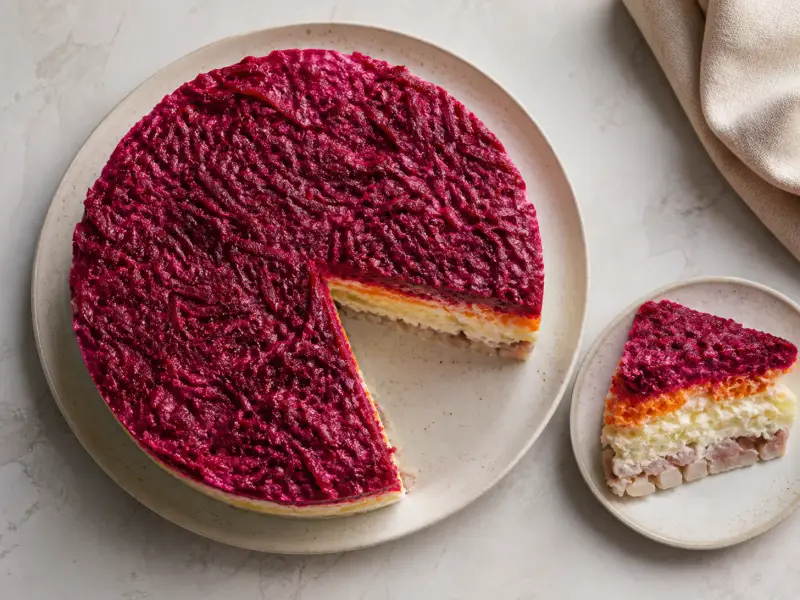 Herring Under a Fur Coat
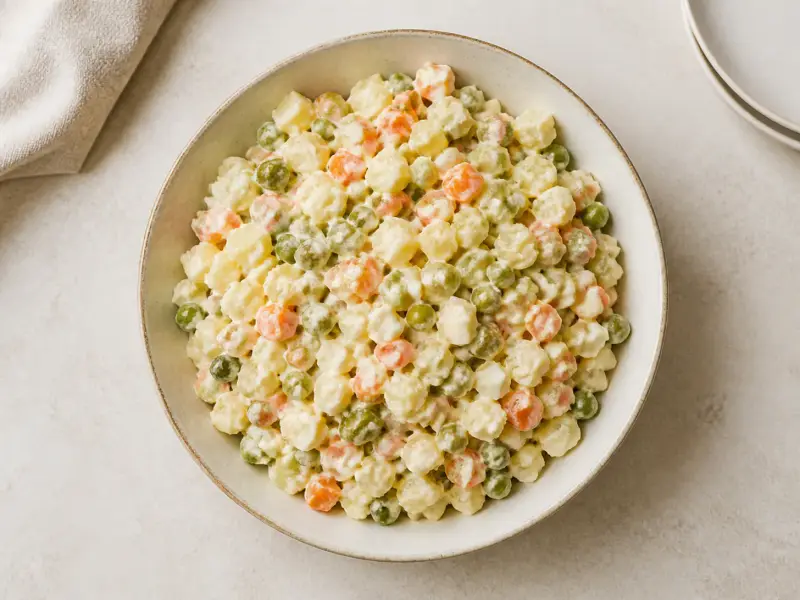 Olivier Salad
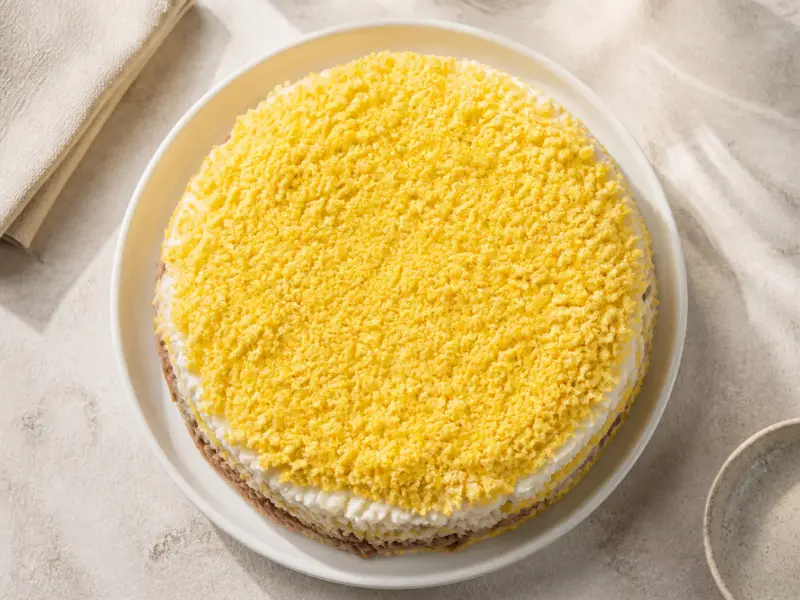 Salat Mimosa
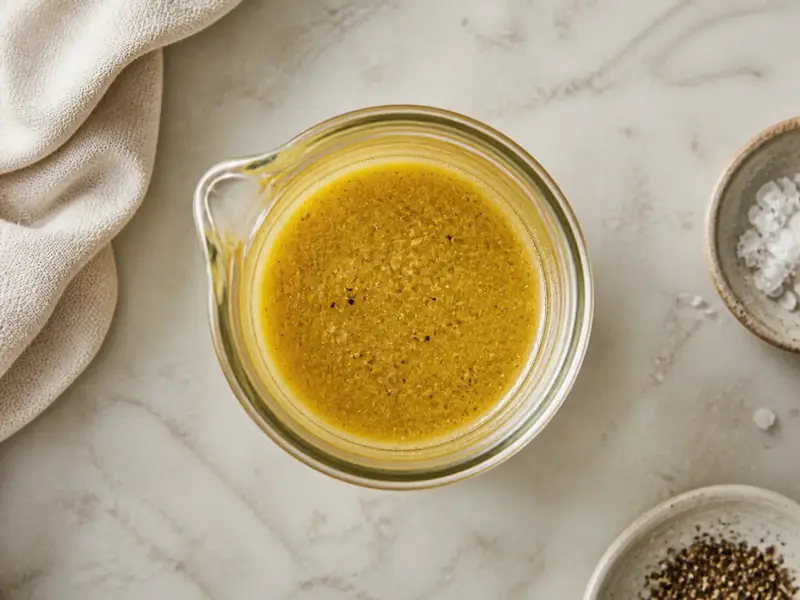 Everyday Vinaigrette
 Classic French Omelette
 Wet Brine for Chicken and Pork
 Basil Pesto
 Garlicky Greens
 Green Beans with Brown Butter and Almonds