Spaghetti Bolognese
The British version, made properly: soffritto cooked slowly, milk before the wine, and two hours at a bare simmer. Not what they eat in Bologna, and it is a good dish on its own terms.
- Prep
- 20 min
- Cook
- 2 hr 35 min
- Total
- 2 hr 55 min
- Serves
- 6
- Revisions
- 1
Allergens
- Celery
- Cereals containing gluten
- Milk
- Sulphites
Named from the ingredients as written, including those carried in from sub-recipes. This is not a guarantee — check the labels on what you actually buy, and note that a product’s recipe can change.
Ingredients
Serves
Ragù
To serve
Method
Ragù
Heat the oil and butter in a heavy casserole over medium-low heat and add the onion, carrot and celery with a pinch of salt.
Cook for 15 minutes, stirring now and then, until everything is soft and sweet and nothing has coloured. This is the base of the whole sauce and it is the step people cut to five minutes.
Add the bacon and cook for 5 minutes more, until its fat has run.
Turn the heat up, add both minces and break them up with a wooden spoon.
Cook for 10 to 12 minutes, until the water has boiled off and the meat is sizzling in fat rather than simmering in liquid. It should catch very lightly on the base.
Pour in the milk and simmer, stirring, until it has almost entirely disappeared — about 10 minutes. It goes in before the wine because acid sets the proteins, and milk added after it will curdle instead of being absorbed.
Add the wine and simmer until the sharp smell has gone and the pan is nearly dry again, about 10 minutes.
Stir in the tomato purée and cook for 2 minutes until it darkens.
Add the tomatoes, stock, salt and bay leaf, and bring to a bare simmer.
Cook uncovered on the lowest heat for 2 hours, stirring every 20 minutes. A bubble should break the surface every second or two and no faster.
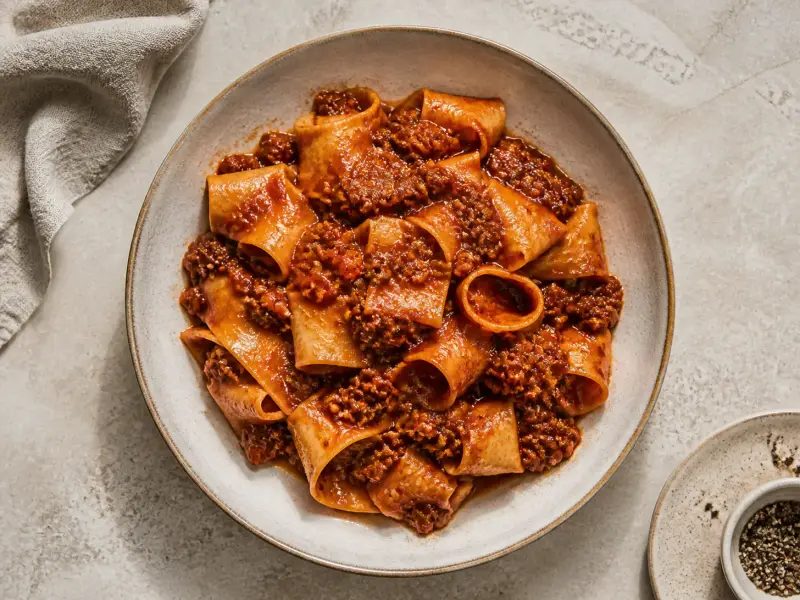
It is done when the fat has separated into an orange slick at the edges and the sauce holds its shape on a spoon.
Taste for salt, and fish out the bay leaf.
To serve
Boil the spaghetti in well-salted water until a minute short of the packet time, and save a mugful of the water before draining.
Turn the pasta through the sauce in the pan over low heat for a minute, loosening with the pasta water until every strand is coated and nothing is sitting in a puddle.
Take it off the heat, stir in the Parmesan and serve immediately.
Nobody has rated this recipe yet.
Sign in to rate this recipe. One rating per person, and you can change it.
What to expect
- Taste
Sweet and savoury in almost equal measure, and much less tomato-forward than expected. The sweetness comes from the carrot and the long-cooked onion, the depth from the browned meat and the bacon, and there is a faint dairy roundness from the milk that is hard to place if you do not know it is there.
- Aroma
Sweet vegetable and rendered pork for the first hour, settling into something warm and meaty. The wine reduction is the sharpest moment and passes quickly.
- Texture
Fine and soft, coating rather than chunky. Clinging to spaghetti rather than sliding off it, which is what the pasta water and the final minute in the pan are for.
- Sound
Very little once it settles — a single bubble every second or two. The loud part is the ten minutes of driving the water off the mince, which spits.
- How the flavour moves
Sweetness first, then savoury meat, then a long soft finish with no sharp edge at all. If it finishes sharp, the tomato has not had long enough.
- Serve it
Hot, and served immediately once the pasta is turned through. It cools on the plate faster than people expect because the pasta is thin.
- Goes with
Parmesan and black pepper, and nothing else on the plate. A green salad afterwards. A medium red — Sangiovese if you want to be on-theme.
Cook's notes
- Difficulty
Easy. Nothing in it is difficult and everything in it takes time.
- Cost
Low to mid. Two kinds of mince and a glass of wine.
- Equipment
A heavy casserole with a wide base, and a large pan for the pasta.
- When to make it
A Sunday, for the week ahead. Two hours of it needs nothing from you.
- Best season
None.
- You know it is done when
Orange fat separating at the edges of the pan and the sauce holding its shape when pushed with a spoon. The colour should be a dull brick rather than bright red — bright red means the tomato has not cooked.
- And it feels like
Soft and slightly unctuous, with the meat in fine separate grains. Nothing chewy and nothing pasty.
- Food safety
Nothing unusual. Mince is cooked far past any safe threshold here. Cool leftovers quickly in a shallow container rather than leaving the casserole out.
- Where it goes wrong
- Rushing the soffritto. Five minutes gives you raw onion in a sauce for two hours.
- Adding the milk after the wine, where it curdles instead of being absorbed.
- Not driving the water off the mince, so the meat boils and never browns.
- Too much tomato, which makes it sharp and thin and is the main difference from the restaurant version people are chasing.
- Ladling sauce onto bare pasta instead of turning the two together in the pan.
- If it does go wrong
Sharp or thin: it needs longer, uncovered. Curdled-looking after the milk: the pan was too hot or the wine went in first; keep simmering and it will come back together. Greasy: chill and lift the fat, or skim. Bland after two hours: salt, and check you used stock rather than water.
- Making it ahead
Made two days ahead it is better. Cook the pasta fresh.
- Keeping it
Four days in the fridge, covered. The sauce only; cooked pasta does not keep well in it.
- Reheating
Low heat with a splash of water. It will have set solid in the fridge and loosens as it warms.
- Freezing
Freezes very well for three months and thaws with no change worth mentioning.
- Leftovers
A lasagne, a baked pasta with béchamel, or on toast with cheese grilled over it.
- Scaling it
Doubles well. Use the widest pan you have so the reductions still happen at a sensible speed.
- Substitutions
All beef works if pork is awkward; add an extra 20g of butter. Milk can be whole milk only — semi-skimmed is noticeably thinner in the finished sauce. Passata can replace the tinned tomatoes at the same weight.
- Dietary swaps
Contains milk, gluten and celery, plus sulphites from the wine. Gluten-free pasta works perfectly well with this sauce. Egg free and nut free as written. It cannot sensibly be made dairy free without losing the step the recipe is built on.
- Shopping for it
Nothing unusual. Tinned plum tomatoes are better than chopped for this and cost the same.
- Keeping the cost down
Ordinary mince rather than lean, and the wine can be the cheapest drinkable white. Skip the bacon and add a little more salt if you must.
- Sustainability
Beef is the heaviest part of this by a long way. The useful thing about a ragù is that the meat is already a background texture rather than the thing you look at, so it takes reduction better than most dishes: 250g beef and 250g pork, with 200g of finely chopped mushrooms cooked down hard with the soffritto, gives a sauce most people would not identify as reduced. Pork alone has a materially lower footprint than beef and makes a perfectly good ragù.
- Nutrition
Substantial. The fat can be lifted off after chilling if that matters.
- Worth it?
The milk and the two hours are what make it taste like a restaurant version rather than a weeknight one, and neither of them is work.
Where it comes from
- Origin
Bologna by ancestry, Britain by adoption.
- Also called
Ragù alla bolognese, for the Italian dish it descends from.
- Said out loud
boll-oh-NAYZ in British English; the Italian is boll-oh-NYEH-zeh.
- What the name means
Bolognese means 'from Bologna'. Ragù is from the French ragoût, to revive the appetite.
- History
Ragù in Bologna was a sauce for fresh egg pasta, rich with soffritto and meat and using very little tomato — tomato being a late arrival and a small part of it. The dish reached Britain and the rest of the English-speaking world through restaurants and cookery writing in the middle of the twentieth century, where dried spaghetti was what was available and where more tomato suited both the ingredient supply and the palate. The 1982 Accademia recipe, and a revision in 2023, are attempts to fix the Bolognese version in place rather than descriptions of what the world cooks.
- Why it matters
One of the most-cooked dishes in British homes, and among the first things many people learn to cook. In Bologna it is also a point of civic identity, which is why the difference between the two is a live argument rather than a footnote.
- When it is eaten
Weeknight family cooking, and batch cooking for a freezer.
- The traditional way
Slow soffritto, milk before wine, minimal tomato, several hours at a bare simmer, and fresh tagliatelle rather than spaghetti.
- How it changed
More tomato, less time, dried spaghetti, and often garlic and herbs that the Bolognese version does not use.
- Regional variations
In Bologna, tagliatelle and sometimes a little cream. In Britain, spaghetti, more tomato and often mushrooms. In the United States, sweeter still and frequently with garlic bread beside it.
- How this version differs
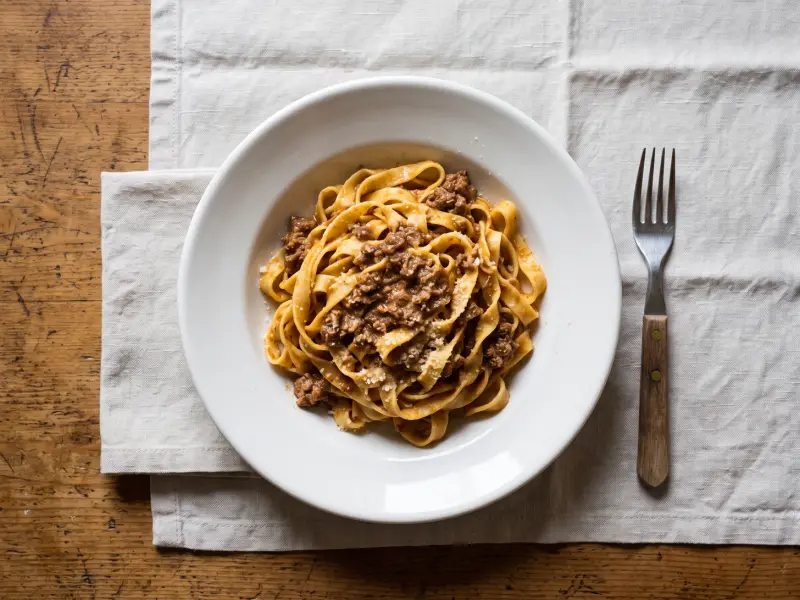
This site also has Tagliatelle al Ragù, which is the Bologna version and a genuinely different dish — less tomato, no bacon, fresh egg pasta, and longer. This one keeps the Bolognese technique that actually changes the result, the milk step and the long simmer, and is otherwise the British dish it says it is. If you want the Italian one, cook that recipe rather than this one with different pasta.
- Sources and credit
No individual. Pellegrino Artusi published an early ragù recipe in 1891; it is one point on a long line rather than an origin.
 Cottage Pie
 Macaroni Cheese
 Minced Beef and Onion Pie
 Tagliatelle al Ragù
 Tuna Pasta Bake
 Slow-Cooked Beef Ragu
 British
 Pasta
 Main courses
 Dinner
 Beef