Classic French Omelette
Omelette nature
Three eggs cooked in under a minute in a hot buttered pan, stirred hard then rolled, so the outside stays pale and the centre soft.
- Prep
- 5 min
- Cook
- 3 min
- Total
- 8 min
- Serves
- 1
- Revisions
- 5
Ten seconds, if you are in a hurry
The whole dish, carried in and set down, with the one thing worth knowing about it said out loud. No method, no measuring — just what it should look like when it arrives.
Watch on YouTubeAllergens
- Eggs
- Milk
Named from the ingredients as written, including those carried in from sub-recipes. This is not a guarantee — check the labels on what you actually buy, and note that a product’s recipe can change.
Ingredients
Serves
Method
Beat the eggs with a fork for 20-30 seconds, until the yolks and whites are one even colour and no thick ribbons of white are left in the bowl.
Stir in the fine salt.
Salt them now rather than at the end. These are in the pan within a minute of being beaten, far too fast for the salt to draw water out of the raw egg.
Have the chives and a warm plate beside the hob before the pan goes on the heat. The whole thing cooks in under a minute and there is none of that minute to spare.
Set a 20cm non-stick or well-seasoned steel pan over medium-high heat for about a minute.
Drop in the butter.
Watch the butter rather than the clock. It should foam up hard, hiss, and then begin to go quiet as the water boils out of it, which is the pan telling you it is hot enough.
Do not pour the eggs into a pan where the butter is only melting quietly. A cool pan sets the egg slowly and evenly all the way through, and what comes out is a flat rubbery disc rather than something layered around a soft middle.
Lift the pan off the heat for a few seconds if the butter colours past pale gold. Brown butter means the pan has gone too far, and the omelette takes colour the instant the egg lands.
Pour in the eggs all at once.
Shake the pan back and forth with one hand while you stir the eggs hard with the flat of a fork in the other, keeping everything moving for the first 20-25 seconds.
Keep that agitation constant. It is what breaks the setting egg into fine curds, and it keeps any one part of the mixture from sitting still on hot metal long enough to brown.
Stop as soon as the eggs look like small soft curds in a little loose liquid, with nothing yet set into a sheet.
Spread the curds level with the back of the fork and leave the pan still for 10-15 seconds, until the underside has set into one piece and the top is still wet and glossy.
Take the pan off the heat while the centre is plainly loose — baveuse. It goes on cooking in the pan and again inside the roll, and an omelette that looks finished before it leaves the heat is dry on the plate.
Scatter the chives down the middle.
Tilt the pan away from you at about 45 degrees and let the omelette slide down to the far edge.
Fold the near third over the middle with the fork.
Hold the warm plate against the far lip of the pan.
Turn the pan over in one movement, so the omelette rolls out with the far third folding under it and the seam ending up underneath.
Look at the surface. It should be an even pale yellow, since in this style any browning at all counts as a fault rather than as colour.
Press the roll into a neat oval with a clean tea towel if it landed untidily.
Finish with a pinch of flaky salt and the ground peppercorns.
Eat it straight away.
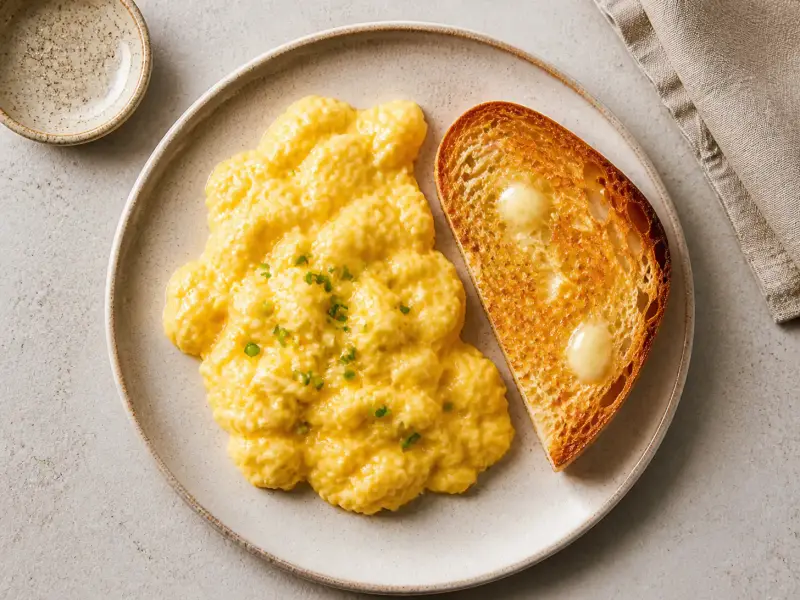
The soft scrambled eggs in this collection are the same protein handled the opposite way, slowly and over low heat, where this one lives on speed and a properly hot pan.
Nobody has rated this recipe yet.
Sign in to rate this recipe. One rating per person, and you can change it.
What to expect
- Taste
Plain, clean and purely eggy, carrying almost nothing beyond the eggs, butter and a little salt and pepper — the whole point of the style is restraint, letting the technique itself, rather than any additional flavour, be what is being judged.
- Aroma
A brief, clean smell of foaming butter as it hits the hot pan, then very little else once the eggs go in, since the whole cook happens too fast for much aroma to build.
- Texture
A very light, barely set outer layer giving way to a soft, still-loose, custardy centre — the contrast between the two, achieved entirely through timing rather than any difference in ingredients, is the whole technical point of the dish.
- Sound
A sharp hiss as the eggs hit the hot buttered pan, then a continuous, rapid scraping as the fork agitates them hard for the first 20-25 seconds, falling to silence as the pan is left still to set the underside.
- How the flavour moves
A light buttery note registers first from the outside of the roll, the plain egg flavour carries through evenly, and the soft, barely set centre delivers a slightly richer, more custardy finish than the firmer exterior around it.
- Serve it
Eaten immediately, hot from the pan — this dish does not hold its texture for more than a minute or two once plated.
- Goes with
A simple green salad, dressed sharply, which is a common and deliberately unfussy pairing that avoids competing with the omelette's own restrained flavour.
Cook's notes
- Difficulty
Moderate to advanced, despite the short ingredient list — the entire dish happens in under a minute of active cooking, leaving no room to correct a mistake partway through.
- Cost
Low. Three eggs, a little butter and some chives.
- Equipment
A 20cm non-stick or well-seasoned steel pan and a fork; nothing else.
- When to make it
Breakfast, or a quick light meal at any time of day.
- Best season
None; eggs and butter are available year round.
- You know it is done when
An even, pale yellow surface with no browning anywhere — any colour at all is a fault in this specific style, unlike a diner-style omelette, which is expected to brown.
- And it feels like
Baveuse — French for dribbling — meaning the centre should be plainly, visibly loose when the pan comes off the heat, since it continues cooking both in the pan during rolling and again briefly inside the finished roll.
- Food safety
The eggs are fully cooked by the time the dish is rolled and plated, even though the centre looks loose when it leaves the pan; the residual heat inside the roll finishes the process within moments.
- Where it goes wrong
- Starting with a pan that is not hot enough, which sets the egg slowly and evenly into a flat, rubbery disc rather than something layered around a soft centre.
- Not agitating constantly enough in the first 20-25 seconds, which lets part of the mixture sit still long enough to brown.
- Cooking until the centre looks fully set before taking the pan off the heat, since it goes on cooking afterwards and ends up dry on the plate.
- Salting the eggs too far ahead of cooking, which in a dish this quick is a smaller risk than in slower-cooked eggs but is still worth avoiding as habit.
- If it does go wrong
Omelette browned: the pan was too hot, or the eggs sat still too long during the agitation stage — reduce the heat slightly and keep the fork and pan moving continuously. Flat and rubbery rather than soft-centred: the pan was not hot enough at the start, cooking the egg slowly and evenly rather than layering it around a loose middle. Dry on the plate: it was left in the pan too long before rolling, since the centre continues cooking after it looks done.
- Making it ahead
Not a make-ahead dish in any sense; every stage happens immediately before serving.
- Keeping it
Not suitable for storing; this dish has no useful leftover form and firms considerably on cooling and reheating.
- Reheating
Not recommended; it is built to be eaten within moments of leaving the pan.
- Freezing
Not suitable in any form.
- Leftovers
None worth keeping.
- Scaling it
Not really scalable within a single pan — each omelette is an individual, fast-cooked portion, and a larger batch means cooking multiple omelettes in sequence rather than one larger one.
- Substitutions
Other fine, soft herbs can replace chives without affecting the technique; nothing should be added that needs real cooking time, since the whole dish is finished in under a minute.
- Dietary swaps
Contains eggs and milk. Dairy free with a neutral oil in place of the butter, though the flavour and the way the pan behaves both change slightly; vegetarian as written.
- Shopping for it
Fresh eggs, since their behaviour when beaten and cooked fast is more forgiving when they are genuinely fresh.
- Keeping the cost down
Three eggs and a little butter make this one of the least expensive dishes in the entire collection.
- Sustainability
Choosing free-range or higher-welfare eggs is a meaningful, low-cost decision given how few ingredients the dish otherwise contains.
- Nutrition
A good source of protein and fat from the three eggs and butter, with very little added beyond that.
- Worth it?
A short, exacting test of basic pan control, and a genuinely different dish in character from the soft scrambled eggs it shares its main ingredient with.
Where it comes from
- Origin
France.
- Also called
Omelette nature, or omelette baveuse for the specifically loose-centred style.
- What the name means
Baveuse, literally dribbling, is the French term specifically for the loose, barely set centre this style is served at.
- History
Escoffier's 1903 codification in Le Guide Culinaire set out both the method and numerous named variations, establishing the pale, rolled, unbrowned style as the professional French standard, in contrast to older and more casual ways of frying beaten eggs that predate any written record.
- Why it matters
A standing test of basic technique in professional kitchens, since its short cooking time and lack of any ingredient to hide behind mean a cook's control of heat and timing is immediately visible in the result.
- When it is eaten
Everyday eating in France at any meal, typically with nothing more added than herbs, in contrast to the more heavily filled omelettes common in British and American cafés.
- The traditional way
Constant, vigorous agitation for the first 20-25 seconds of cooking, which is what keeps the egg from sitting still on hot metal long enough to brown, followed by a brief still period to set the underside before rolling.
- How it changed
The heavily filled, folded and browned omelette common in British and American diners developed as a separate, distinct tradition rather than a variation on this French style, and the two are best understood as different dishes sharing a name rather than one evolving from the other.
- Regional variations
The omelette served at La Mère Poulard on Mont-Saint-Michel, trading since the 1880s, is a genuinely different dish rather than a regional variant of this one — its eggs are whisked to a foam and cooked over a wood fire, closer in technique to a soufflé than to the pale, rolled style described here.
- Sources and credit
Auguste Escoffier is the documented source for codifying this specific method; the dish itself long predates him and has no single named inventor.
 Soft Scrambled Eggs
 Everyday Vinaigrette
 Mayonnaise
 Creamy Oat Porridge
 French Toast
 Garlicky Greens