Chopped Salad
Everything cut to the same size, roughly a centimetre, so a single forkful carries all of it. That is the entire idea and it is the only rule.
- Prep
- 20 min
- Total
- 20 min
- Serves
- 4
- Revisions
- 1
Allergens
- Milk
- Mustard
- Sulphites
Named from the ingredients as written, including those carried in from sub-recipes. This is not a guarantee — check the labels on what you actually buy, and note that a product’s recipe can change.
Ingredients
Serves
Salad
Dressing
Method
Salad
Cut everything to roughly 1cm — the cucumber, pepper, radish and feta in dice, the tomatoes in quarters, the lettuce in ribbons.
That is the whole recipe. A chopped salad is not a salad that happens to be chopped; the uniform size is the point, because it means one forkful carries lettuce, tomato, cucumber, chickpea, feta and olive together instead of chasing a single leaf around the bowl.
Deseed the cucumber. The seeds are the wettest part of it and they are what makes a chopped salad go watery in the bowl.
Put everything except the feta and parsley into a wide bowl.
Dressing
Add the vinaigrette, salt and pepper and toss thoroughly — a chopped salad can take real tossing where a leaf salad cannot.
Fold in the feta and parsley last, gently, so the feta stays in cubes rather than smearing through the dressing.
Taste for salt and serve within ten minutes. Dressed and left, the salt draws water out of everything and it sits in a puddle.
Nobody has rated this recipe yet.
Sign in to rate this recipe. One rating per person, and you can change it.
What to expect
- Taste
Sharp and salty from the feta, olives and dressing, with sweetness from the tomato and pepper and pepperiness from the radish. Nothing is subtle and it is not meant to be.
- Aroma
Very little. Parsley and vinegar.
- Texture
The whole reason it exists. Uniform small pieces mean every forkful is the same and complete, which is a genuinely different eating experience from a leaf salad where you chase things around the bowl.
- Sound
The chopping, and then a lot of crunch.
- How the flavour moves
Acid and salt first, then sweetness, then the radish's peppery finish. Short and direct.
- Serve it
Cool.
- Goes with
Anything grilled, or bread and cheese. It is a foil for richer food.
Cook's notes
- Difficulty
Beginner. It is knife work and nothing else.
- Cost
Low.
- Equipment
A sharp knife and a large bowl.
- When to make it
Lunch, or alongside anything rich.
- Best season
Best in summer, but it adapts to whatever is good.
- You know it is done when
Uniform dice throughout, with nothing noticeably larger than anything else.
- And it feels like
Everything crunchy. If any component has gone soft, it has stood too long.
- Food safety
Nothing unusual. Wash the leaves and the raw vegetables.
- Where it goes wrong
- Uneven cutting, which loses the entire point.
- Not deseeding the cucumber, which waters the bowl.
- Dressing it and leaving it to stand.
- Mixing the feta in early, so it smears through the dressing instead of staying in cubes.
- Under-seasoning, which cold vegetables always need more of than you expect.
- If it does go wrong
Watery: the cucumber seeds, or it stood too long. Bland: salt, then more vinegar. Smeared and murky: the feta went in too early or was tossed too hard.
- Making it ahead
Chop everything up to a day ahead and keep it undressed in the fridge; dress at the table.
- Keeping it
None once dressed. The chopped vegetables keep undressed for a day.
- Reheating
No.
- Freezing
No.
- Leftovers
Undressed components in a lunchbox.
- Scaling it
Linear, and it is one of the easier salads to make for a crowd because it holds undressed.
- Substitutions
Any firm salad vegetable that dices. Avoid anything that will not hold a cube — a soft tomato, a ripe avocado stirred in early. Feta can be a hard cheese in small cubes, or nothing.
- Dietary swaps
Contains milk from the feta, and mustard and sulphites from the vinaigrette. Vegan without the feta. Naturally gluten free, egg free and nut free.
- Shopping for it
Nothing unusual.
- Keeping the cost down
Cheap, and a good use of odds and ends of vegetables that need using.
- Sustainability
Almost entirely raw vegetables and pulses, which puts it at the very bottom of this collection's footprint. Its real virtue is flexibility: the recipe is a cutting instruction rather than a shopping list, so it takes whatever is in the drawer and needs using, which makes it one of the better answers to household food waste. Chickpeas and other pulses fix nitrogen in the soil as they grow.
- Nutrition
A lot of raw vegetable, with the chickpeas adding protein and fibre and the feta the salt and fat.
- Worth it?
One centimetre, everything. It is the least interesting instruction in this collection and the one that changes the most.
Where it comes from
- Origin
The United States.
- Also called
Chopped salad.
- Said out loud
Straightforward.
- What the name means
Literal, and unusually the name describes the technique rather than the ingredients — which is right, because the technique is what defines it.
- History
The chopped salad belongs to twentieth-century American restaurant cooking, and its best-known example is the version served at La Scala in Beverly Hills from the 1950s onwards, made with salami, chickpeas and mozzarella. The form spread through American delis and restaurants and is now a menu category rather than a single recipe.
- Why it matters
A staple of American lunch culture and considerably less established in Britain, where it is usually met as a salad-bar option rather than a dish.
- When it is eaten
Lunch, a side, or something to put in front of people who will not eat a leaf salad.
- The traditional way
Uniform dicing, which sounds trivial and is the whole method.
- How it changed
It has become a template rather than a recipe — the ingredients vary endlessly and the cut does not.
- Regional variations
The La Scala version with salami and mozzarella; countless deli versions with different beans, cheeses and meats.
- How this version differs
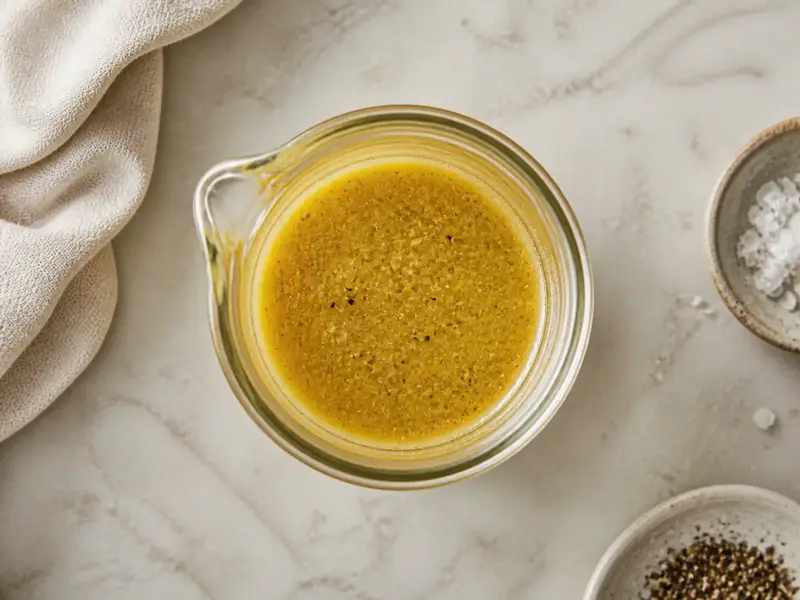
It uses the Everyday Vinaigrette already on this site rather than repeating a dressing, and it deseeds the cucumber, which most recipes do not mention and which is the difference between a crisp salad and a wet one.
- Sources and credit
La Scala in Beverly Hills is the usual reference point for the best-known version, not for the form itself.
Related recipes
 Everyday Vinaigrette
You might also like
 Waldorf Salad
 Air Fryer Halloumi
 Aviation
 Avocado Toast
 Blue Hawaii
 Bushwacker
Categories
Cuisines
 American
Courses & dish types
 Side dishes
Diets
 Vegetarian
Techniques & equipment
 No-cook
Time & effort
 15 minutes