Butter Chicken
मुर्ग़ मक्खनी
Murgh makhani
मुर्ग़ मक्खनी — buttery chicken.
Tandoori-marinated chicken grilled hard, then finished in a sieved tomato and butter gravy emulsified off the heat so it stays satin rather than splitting.
- Prep
- 30 min
- Cook
- 50 min
- Resting
- 4 hr 30 min
- Total
- 5 hr 50 min
- Serves
- 4
- Revisions
- 1
Allergens
- Milk
- Nuts
Named from the ingredients as written, including those carried in from sub-recipes. This is not a guarantee — check the labels on what you actually buy, and note that a product’s recipe can change.
Ingredients
Serves
Method
Toss the chicken with the lemon juice, 1 tsp Kashmiri chilli and 1 tsp salt and leave for 30 minutes.
Mix the yogurt, 20g grated ginger, 4 crushed garlic cloves, cumin, 1 tsp garam masala and 1 tbsp oil, turn the chicken through it, cover and refrigerate for at least 4 hours.
Heat the grill to its highest setting and lay the chicken on a foil-lined tray, not touching. A crowded tray steams the chicken in its own yogurt and you get no char at all.
Grill for 10-12 minutes, until the yogurt has dried to a matte crust and the edges are blackening in patches, then turn and grill 4 minutes more. It should still be underdone inside — it finishes in the sauce.
Melt 50g butter with 1 tbsp oil in a heavy pan and fry the cardamom, cinnamon and cloves for 30 seconds, until fragrant.
Add 25g ginger, 5 garlic cloves and the green chillies and cook for 2 minutes.
Add the tomatoes, cashews, 1 tsp Kashmiri chilli and 1 tsp salt with a splash of water and simmer for 20 minutes, until red fat beads at the edge of the pan.
Fish out the cardamom, cinnamon and cloves, then blend the sauce smooth and pass it through a sieve back into the pan. Skipping the sieve is the difference between satin makhani and a rough tomato curry.
Stir in the honey, add the grilled chicken and every blackened scraping from the foil, and simmer gently for 8 minutes, until the chicken reaches 74C at its thickest point.
Take the pan off the heat. Stir in the cream, then whisk in the cold butter a cube at a time until the sauce turns glossy. Do not let it boil again — once the butter is in, a hard boil splits it.
Crush the dried fenugreek between your palms over the pan, stir it in with the last teaspoon of garam masala, and serve.
Nobody has rated this recipe yet.
Sign in to rate this recipe. One rating per person, and you can change it.
What to expect
- Taste
Sweet first, and much sweeter than people expect from a curry: it comes from the tomatoes reduced hard, the honey and the cashews, and it lands before anything else does. Salt and a mild fruity chilli warmth arrive underneath it, and there is a low savoury depth from the browned yogurt crust that came off the grill with the chicken. The last thing is a faint, distinctly bitter, almost maple-savoury note from the dried fenugreek leaves, and it is the note that stops the whole thing reading as tomato soup with butter in it. Heat is present but low; this is a rich dish rather than a hot one.
- Aroma
Butter and toasted cardamom over cooked tomato, with the grill smoke from the chicken sitting on top of it. The fenugreek crushed between the palms at the end is the sharpest smell in the process and it fills a kitchen immediately, somewhere between celery leaf, burnt sugar and hay.
- Texture
The point of the dish. The sauce is completely smooth, with no shred of tomato skin or grain of spice, because it has been blended and then sieved, and it is thick enough to coat rather than to pour. Against that, the chicken is fibrous and slightly chewy at the charred edges. There is no crunch anywhere and there is not supposed to be.
- Sound
Very little. The loudest moment in the whole recipe is the grill spitting as fat drips off the chicken onto hot foil. The finished dish is silent food.
- How the flavour moves
Sweet, then rich, then warm, then bitter. Tomato sweetness arrives immediately and fills the front of the mouth. Butter and cream follow and coat everything, which is why the heat feels gentler than the quantity of chilli suggests. Warm spice comes through in the middle. The finish is the fenugreek, faintly bitter, and it is what makes you want the next mouthful rather than feeling you have had enough.
- Serve it
Hot but not scalding, and it must be served hot enough to stay loose: the butter emulsion stiffens noticeably as it cools, so a bowl left standing goes from satin to a heavy paste within about ten minutes.
- Goes with
Plain naan or a garlic naan to push it around with, and steamed basmati to absorb it. Something sharp on the side is worth having, because there is nothing acidic in the dish itself: raw red onion in lemon juice, or plain yogurt. Beer over wine.
Cook's notes
- Difficulty
Moderate. Nothing in it is technically hard, but the finish has to be done off the heat and in order, and that is where it is usually lost.
- Cost
Mid. Thighs are cheap, cashews and butter are not, and the quantity of butter is not a place to economise given what the dish is called.
- Equipment
A grill that gets genuinely hot, a blender, a sieve, a heavy pan and a probe thermometer.
- When to make it
A weekend, or a weeknight where the marinating was done the night before. The active cooking is under an hour.
- Best season
None. Tinned tomatoes make it a year-round dish.
- You know it is done when
Under the grill, look for the yogurt drying to a matte crust and the edges of the pieces blackening in patches, not browning evenly. In the pan, the sauce is ready when it is uniformly orange-red, opaque and glossy, and a spoon dragged across the surface leaves a channel that closes slowly.
- And it feels like
The finished sauce should coat the back of a spoon in an even film with no beads of oil sitting on it. Oil pooling on the surface after the butter has gone in means it was too hot and the emulsion has broken.
- Food safety
74C/165F at the thickest piece. The chicken deliberately comes out from under the grill underdone and is finished in the sauce, so the temperature check belongs at the end and not at the grill stage.
- Where it goes wrong
- Boiling the sauce after the cream and butter go in, which splits it irreversibly.
- Skipping the sieve, which is the difference between makhani and a rough tomato curry.
- Grilling the chicken through, so it has nothing left to give when it goes into the sauce and eats like rubber.
- Crowding the grill tray, which steams the chicken in its own yogurt and produces no char at all.
- Throwing away the blackened residue on the foil, which is a large part of the flavour.
- Blending the whole spices instead of fishing them out, which leaves a woody grit no sieve removes.
- If it does go wrong
Split, with oil on top: it boiled after the butter went in. Take it off the heat, let it cool a little and whisk in a tablespoon of cold cream, which will usually pull it back. Gritty: the whole spices were blended in, or the sieve was skipped. Tastes flat and sweet: it needs salt, and it needs the fenugreek. Pale and pink rather than red: the tomatoes were not reduced long enough, or ordinary chilli powder was used instead of Kashmiri.
- Making it ahead
The sauce can be made through the sieving stage up to two days ahead and refrigerated. Grill the chicken and finish it on the day.
- Keeping it
Three days covered in the fridge. The emulsion firms as it chills and the sauce sets almost solid.
- Reheating
Low heat, stirring, and stop before it bubbles. A reheat that boils will split what you carefully did not split the first time. A splash of water or cream helps it come back together.
- Freezing
Freezes acceptably for two months, but the butter emulsion breaks on thawing. Reheat very gently and whisk in a knob of fresh cold butter at the end to bring it back.
- Leftovers
Good with rice the next day, and better still in a wrap with red onion. The sauce alone, thinned, makes a fast base for paneer or roast cauliflower.
- Scaling it
Doubles cleanly. Grill in two trays rather than one crowded one.
- Substitutions
Cashews can be blanched almonds. Chicken breast works if it is cut into 4cm pieces and grilled for 6 to 7 minutes rather than 12, but thigh is a genuinely better fit here because the sauce is rich and the meat needs to hold its own. Dried fenugreek leaves have no substitute worth using; without them the sauce tastes sweet and slightly flat, and the faint bitter savoury note that makes it read as makhani is missing.
- Dietary swaps
Contains milk and tree nuts. Gluten free and egg free as written. A dairy-free version can be built on coconut cream and a plant butter, but it is a different dish and should be described as one.
- Shopping for it
Kashmiri chilli powder and dried fenugreek leaves both come from an Indian grocer and neither has a good supermarket substitute.
- Keeping the cost down
Thighs rather than breast, and tinned tomatoes rather than fresh, which are also better here.
- Nutrition
Rich. A hundred grams of butter and 150ml of cream across four servings, and that is what the dish is.
- Worth it?
The extra fifteen minutes of blending and sieving is the whole recipe. Skip it and you have made something else.
Where it comes from
- Origin
Delhi, in the middle of the twentieth century, in a restaurant kitchen.
- Also called
Murgh makhani.
- Said out loud
moorg mukh-KHA-nee.
- What the name means
Murgh is chicken and makhani means buttery, from makhan, butter. The name describes the sauce and not the bird.
- History
The dish belongs to the wave of Punjabi restaurant cooking that arrived in Delhi with people displaced by Partition in 1947, and it is bound up with the tandoor: butter chicken exists because tandoori chicken exists and dries out on standing. The account usually given is that leftover tandoori pieces were revived in a gravy of tomato, butter and cream. The restaurant most often named is Moti Mahal. Which of its founders actually devised it is genuinely contested, has been argued publicly by their descendants and taken to court in Delhi, and cannot be resolved from the record as it stands.
- Why it matters
One of the two or three dishes that represent Indian food abroad, and one of the very few restaurant inventions that has been absorbed back into home cooking in India rather than remaining a restaurant thing.
- When it is eaten
Restaurant food and party food rather than everyday cooking. It is what gets ordered for people who do not want to be challenged, which is both its appeal and the reason it is looked down on.
- The traditional way
Two-stage marination and a tandoor. The domestic substitute is a grill run at maximum with the chicken on foil, which gets the char but not the smoke.
- How it changed
Restaurant versions have got sweeter and redder over sixty years, and outside India they are often built with cream and tomato purée and no reduction at all. The version with a properly reduced and sieved tomato base is closer to the original idea and less sweet than most people expect butter chicken to be.
- Regional variations
In Britain and North America the sauce is usually thinner, sweeter and finished with far more cream. Some Indian versions use no cashew at all and rely entirely on butter for body.
- How this version differs
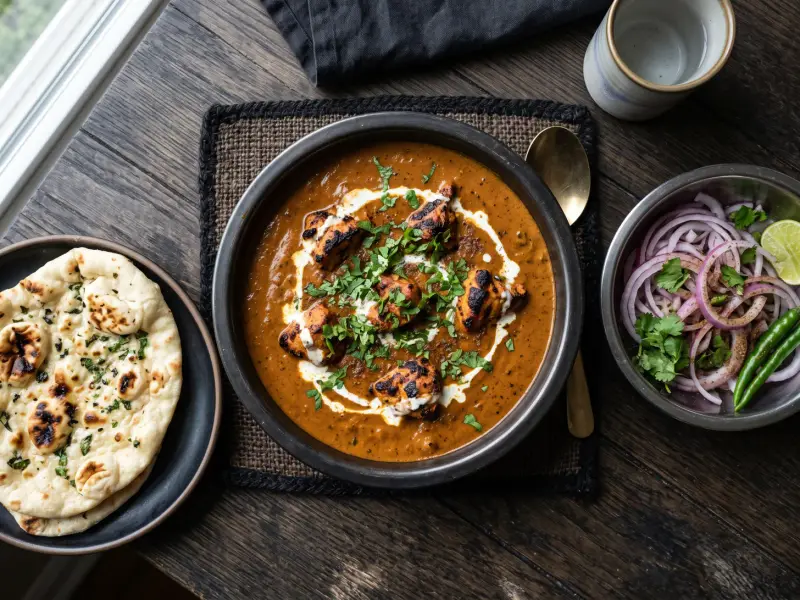
The relationship with chicken tikka masala, which is also in this collection, is the thing worth being straight about. The two dishes are unmistakably similar: marinated chicken cooked over fierce heat, then finished in a spiced tomato sauce enriched with dairy. Butter chicken has a documented association with mid-century Delhi. Tikka masala's origin is usually claimed for Britain in the 1970s and there is no documentation for it at all. Which came from which, or whether one is simply the other rebuilt from memory in a different kitchen, is not something the record can settle, and anyone who tells you confidently is guessing. What can be said is what is on the plate: our butter chicken has no onion in it, is built on tomato and butter alone and is passed through a sieve, while our tikka masala starts with a fried onion base, uses ground almonds and finishes with coriander. Cook them side by side and they do not taste alike.
- Sources and credit
Contested. Moti Mahal in Delhi is the restaurant almost always named; the individual is disputed among the founders' successors.
 Chicken Korma
 Chicken Tikka Masala
 Goan Fish Curry
 Lamb Rogan Josh
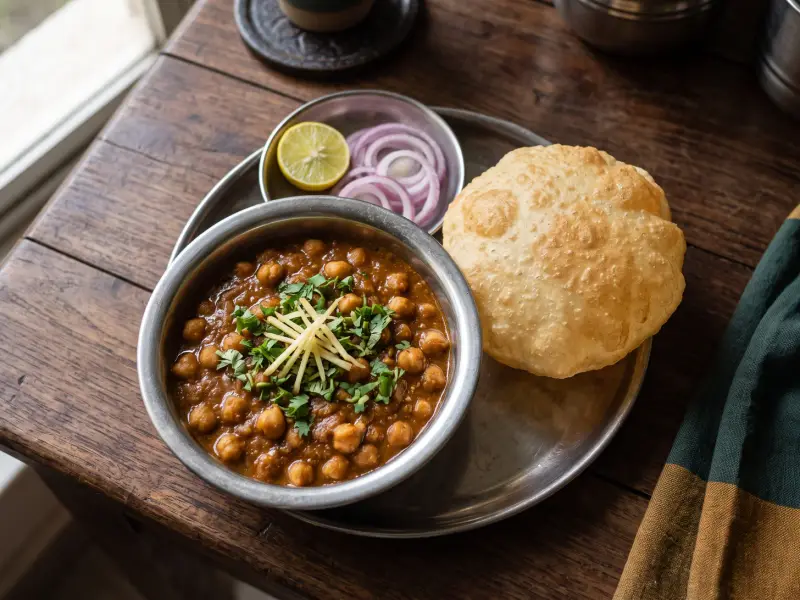 Chana Masala
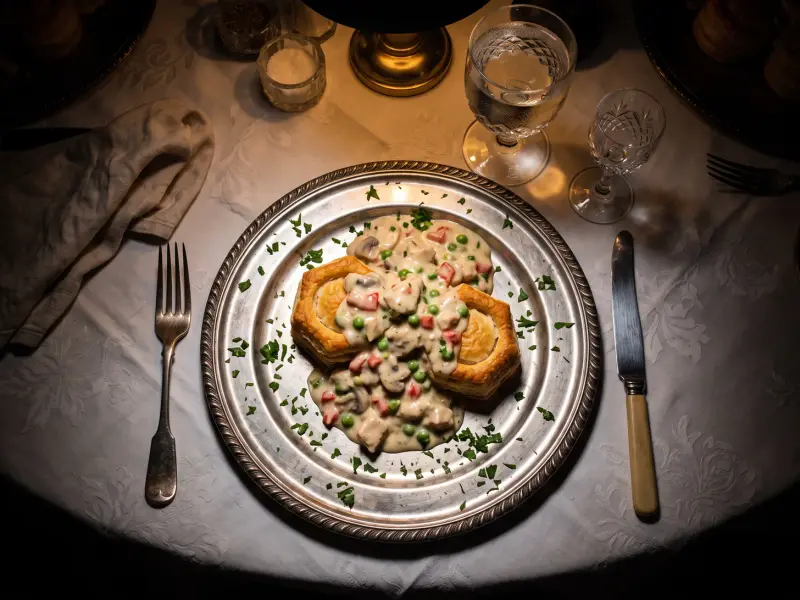 Chicken à la King
 Indian
 Curries
 Dinner
 Main courses
 Chicken