Chicken Korma
क़ोरमा
Korma
क़ोरमा — from Urdu qormā, to braise in a little liquid.
Bone-in chicken braised slowly in yogurt over deeply fried onions and cashew cream, pale and savoury rather than sweet, with no tomato and no sugar.
- Prep
- 25 min
- Cook
- 1 hr 20 min
- Resting
- 10 min
- Total
- 1 hr 55 min
- Serves
- 4
- Revisions
- 1
Allergens
- Milk
- Nuts
Named from the ingredients as written, including those carried in from sub-recipes. This is not a guarantee — check the labels on what you actually buy, and note that a product’s recipe can change.
Ingredients
Serves
Method
Fry the sliced onions in the oil over medium-high heat for 15-18 minutes, until deep brown rather than golden. Stopping at golden leaves the sauce thin and sweet with no depth; the colour is the cue, not the clock.
Lift out the onions with a slotted spoon, reserving the oil, and drain them on paper. Keep a handful back to crisp and scatter at the end.
Soak the cashews in hot water for 15 minutes, then blend to a smooth cream.
Blend two-thirds of the fried onions with a splash of water to a paste.
Brown the chicken in the reserved oil in two batches, then set aside. A crowded pan steams the meat instead of browning it.
In the same pan, fry the cardamom pods, cinnamon, cloves and bay for 30 seconds, then the garlic and ginger pastes for 1 minute, then the coriander, cumin, mace and chilli for 30 seconds.
Take the pan off the heat and whisk in the yogurt a spoonful at a time. Added cold and all at once it curdles instantly and permanently; off the heat and in stages it does not.
Return the chicken with the onion paste, salt and enough water to half-cover, and bring to the barest simmer.
Cover and braise on the lowest heat for 40-45 minutes, until the meat pulls from the bone and reads 74C at the thickest part of a thigh. If you can hear it bubbling, the heat is too high and the yogurt will split.
Stir in the cashew cream and simmer uncovered for 8 minutes to thicken.
Off the heat, stir in the double cream, garam masala and the kewra water if using, and rest for 10 minutes.
Scatter the reserved crisp fried onions over the top just before serving, so they are still crisp when it reaches the table.
Nobody has rated this recipe yet.
Sign in to rate this recipe. One rating per person, and you can change it.
What to expect
- Taste
Savoury and nutty rather than sweet, which is the first surprise for anyone who has only had the restaurant version. Fried onions give a deep caramelised sweetness that is closer to onion gravy than to sugar, cashews give richness and body, and the yogurt leaves a very faint sourness underneath that keeps the whole thing from being cloying. Warm spice is present throughout and none of it is sharp. Mace and cardamom sit at the top, floral and slightly perfumed. Chilli heat is genuinely low, but that is a consequence of the recipe rather than its purpose.
- Aroma
Fried onions above everything, then cardamom and cloves, then a warm milky background from the yogurt. If the kewra water goes in, it announces itself immediately and smells like nothing else in a kitchen: floral, slightly grassy, faintly like jasmine rice.
- Texture
Thick, coating and slightly grainy in a pleasant way from the cashew paste, and it should be heavy on the spoon. The chicken should be soft to the point of collapse without shredding. The reserved fried onions on top are the only crunch and they are essential for exactly that reason.
- Sound
Almost nothing during the braise, which is the point: if you can hear it bubbling the heat is too high. The audible part of this recipe is the first fifteen minutes, when three onions are frying hard in a lot of oil.
- How the flavour moves
Sweet onion first, then nut, then a long warm spiced middle that does not sharpen at any point, and a faintly sour dairy finish from the yogurt that makes it feel lighter than it is. There is no spike anywhere in it. That flatness of curve is the character of a braise and it is why korma reads as comforting rather than exciting.
- Serve it
Hot and served in warm bowls. It thickens considerably as it cools and a korma left standing sets to a paste.
- Goes with
Plain basmati rather than anything flavoured, since the sauce is doing enough. Naan. Something sharp alongside is worth having: a lime pickle, or raw onion in lemon. A drier dish on the table with it, because two rich curries at once is too much.
Cook's notes
- Difficulty
Moderate. The technique is simple and the yogurt is unforgiving.
- Cost
Mid. Bone-in thighs and drumsticks are cheap; the cashews and the volume of oil for the onions are the expense.
- Equipment
A heavy casserole with a well-fitting lid, a blender, and a probe thermometer.
- When to make it
A weekend afternoon, or any evening where the pot can be left alone for forty-five minutes.
- Best season
None.
- You know it is done when
The sauce is pale gold to ivory, never red or orange, and it should be thick enough that the chicken sits in it rather than under it. A little clear fat separating at the edges is a good sign; curdled white specks are not.
- And it feels like
The meat pulls back from the ends of the drumsticks and comes away from the bone cleanly under a fork.
- Food safety
74C/165F at the thickest part of the thigh. Bone-in pieces read low near the bone, so measure the meat and not the joint.
- Where it goes wrong
- Adding cold yogurt to a hot pan all at once, which curdles it instantly and permanently.
- Letting the braise bubble rather than shiver, which curdles it slowly instead.
- Using low-fat yogurt, which splits whatever you do.
- Stopping the onions at golden instead of brown, which leaves the sauce thin and sweet with no depth.
- Adding tomato, which many written recipes do and which makes it a different dish.
- Substituting ordinary chilli powder for Kashmiri at the same quantity.
- If it does go wrong
Grainy, split sauce: the yogurt went in too fast or the pan was too hot. Blending the sauce will hide it but not fix it. Thin sauce: the onions were not browned enough, or the final uncovered reduction was skipped. Tastes of raw dairy: it needed the five minutes of cooking after the yogurt went in and before the liquid did. Bitter: the onions went past brown to black.
- Making it ahead
Better made a day ahead, up to the point before the cream goes in, and finished on reheating.
- Keeping it
Three days in the fridge, and it is better on day two.
- Reheating
Gently, covered, with a splash of water. Do not let it boil or the yogurt that survived the first cook will split on the second.
- Freezing
Freezes for two months. Yogurt sauces can look grainy on thawing; reheating slowly and stirring usually brings them back.
- Leftovers
Pull the meat off the bones and fold it back into the sauce for a rice bowl, or thin it with stock into a soup with lentils.
- Scaling it
Doubles well, but fry the onions in two batches or they steam.
- Substitutions
Blanched almonds instead of cashews, soaked the same way. Bone-in chicken can be boneless thigh, in which case cut the braise to 25 minutes. Mace can be a quarter teaspoon of grated nutmeg, which is the same spice from the same seed and slightly sweeter.
- Dietary swaps
Contains milk and tree nuts. Gluten free and egg free as written. There is no honest dairy-free version, because the yogurt braise is the dish.
- Shopping for it
Black cardamom, mace and kewra water all come from an Indian grocer. Black cardamom is not a substitute for green and vice versa; they taste nothing alike.
- Keeping the cost down
Bone-in thighs and drumsticks are among the cheapest chicken there is and are the right cut here anyway.
- Nutrition
Rich but not extreme: most of the frying oil is poured off, and the body comes from onions and cashews rather than cream.
- Worth it?
Fry the onions properly and temper the yogurt properly and there is nothing else difficult in it.
Where it comes from
- Origin
Northern India, with roots in Mughal court cooking.
- Also called
Korma, also written qorma and kurma.
- Said out loud
KOR-ma.
- What the name means
Usually traced to an Urdu word meaning to braise, related to the Turkish kavurma. The name is a cooking method and not a flavour, and every part of the dish's reputation abroad follows from that having been forgotten.
- History
The technique belongs to the Mughlai kitchens of northern India: meat sealed in fat and then cooked long and slow in yogurt, cream or stock over a very low fire, often in a sealed pot so it braises in its own steam. Nuts, saffron and floral waters are characteristic of the courtly versions. Kormas exist across India and Pakistan in many forms, some white and delicate, some deeply spiced, some hot.
- Why it matters
A wedding and banquet dish in its richer forms, and a household braise in its plainer ones.
- When it is eaten
Celebrations, and Sunday cooking. It is not fast food and does not pretend to be.
- The traditional way
Dum, the sealed-pot braise, and the careful tempering of yogurt into a hot pan. The two together are the whole skill of the dish.
- How it changed
In Britain, korma became the mildest option on a standardised curry-house menu, thickened with coconut and sweetened with sugar or creamed coconut, and often built on a shared base gravy rather than braised at all. That version is a real thing that many people love and it is not this. Calling it inauthentic is less useful than saying plainly what happened to it: a braising method was sold as a spice level.
- Regional variations
Kashmiri and Lucknowi kormas are pale and delicate; some Hyderabadi versions are considerably hotter. Navratan and shahi kormas add fruit and more nuts. There is no single correct korma, which is exactly why the British menu meaning is so misleading.
- How this version differs
Cooked in an ordinary covered casserole rather than a sealed pot, and finished with a small amount of cream, which is closer to a household korma than a court one.
- Sources and credit
None. It is a technique with centuries behind it, not a recipe with an author.
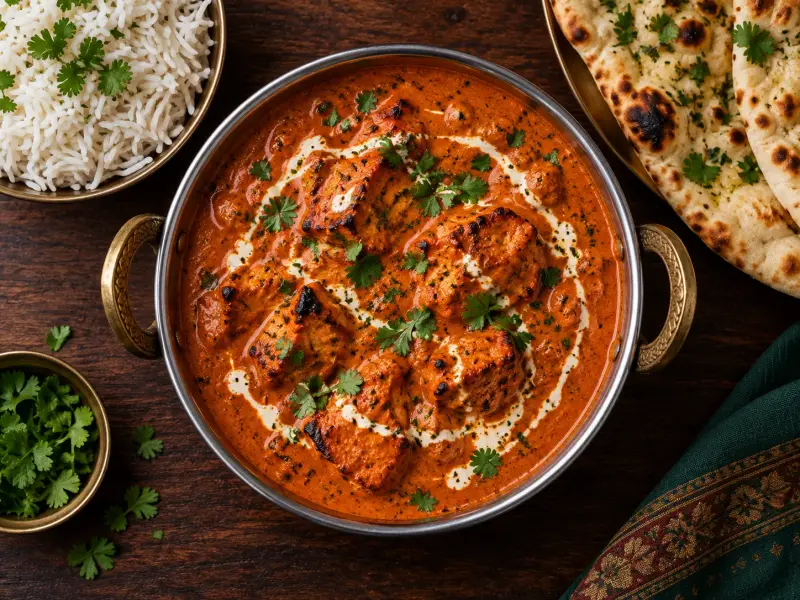 Butter Chicken
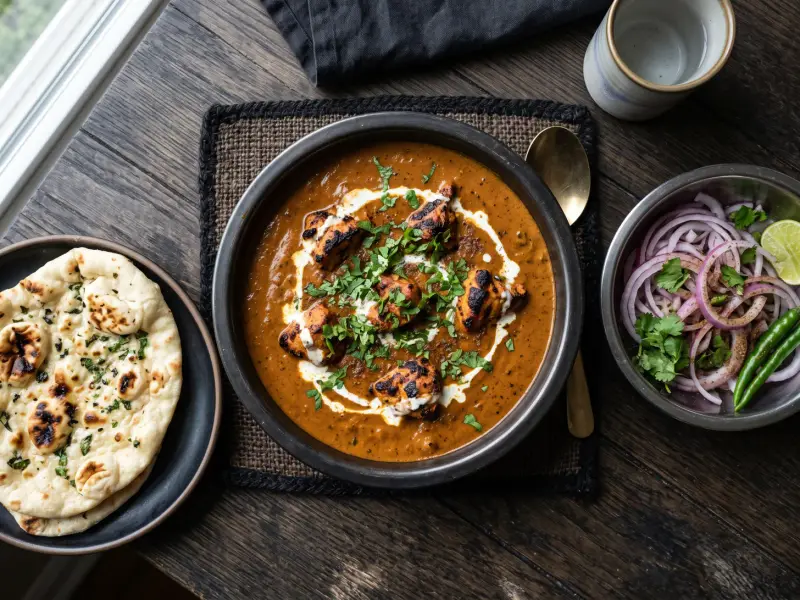 Chicken Tikka Masala
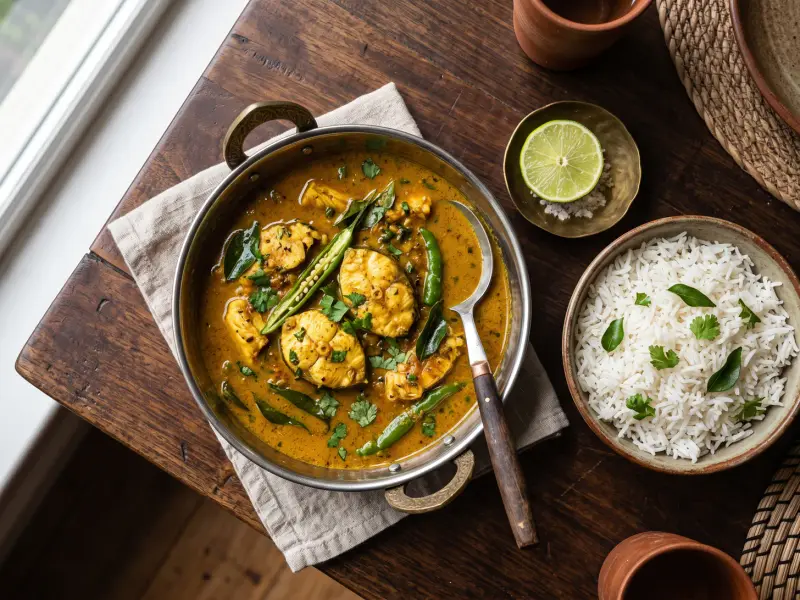 Goan Fish Curry
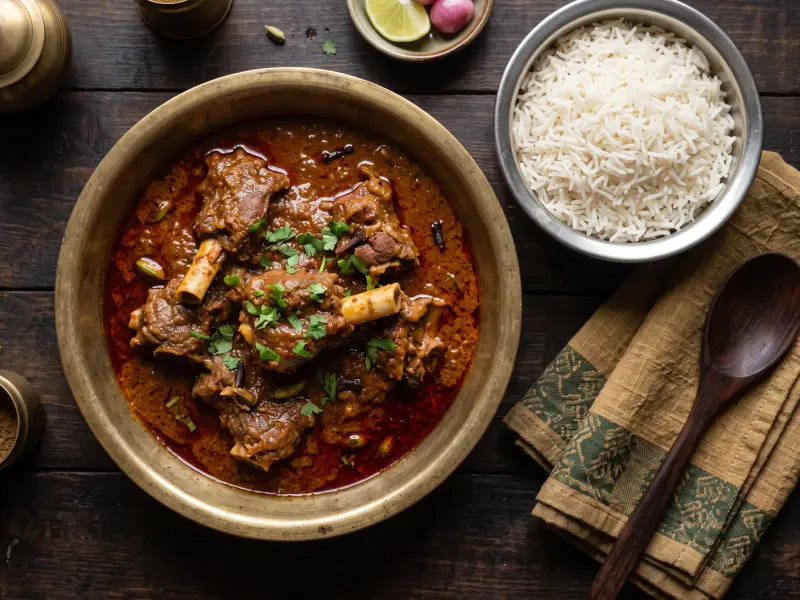 Lamb Rogan Josh
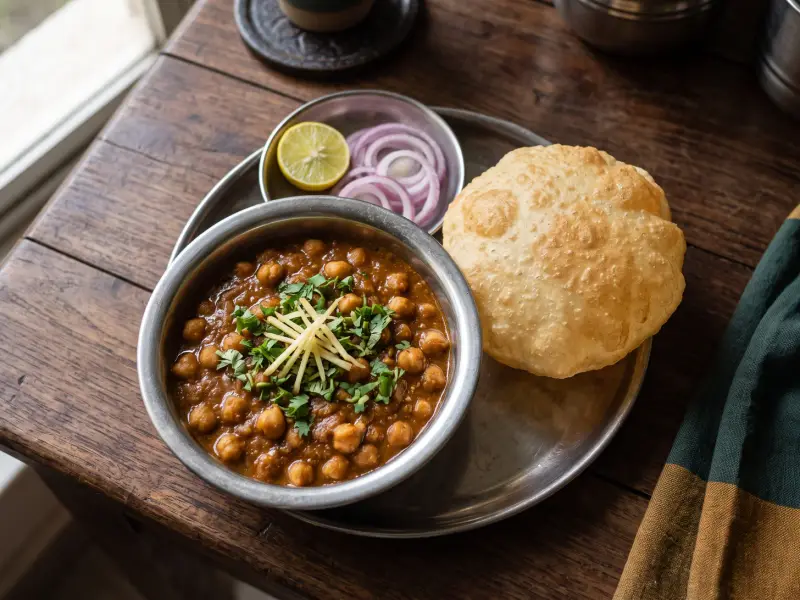 Chana Masala
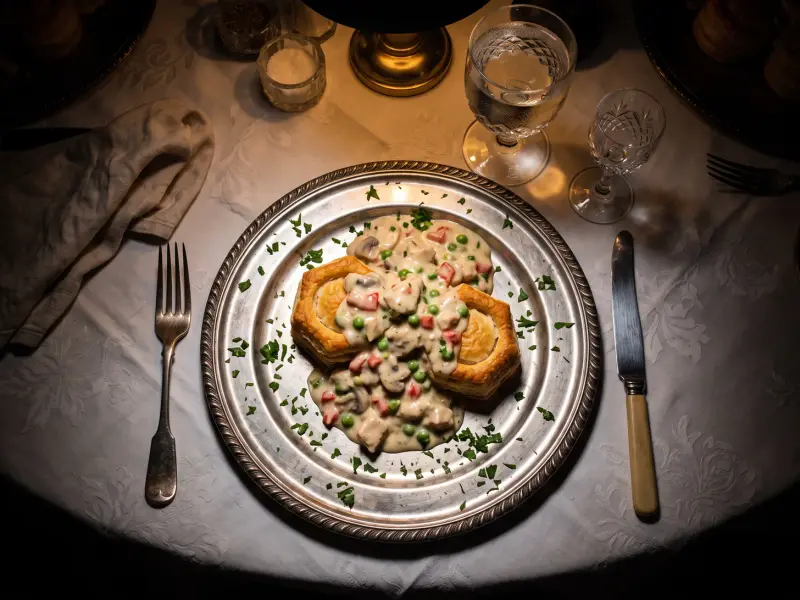 Chicken à la King
 Indian
 Curries
 Dinner
 Main courses
 Chicken