Smash Burgers
A ball of mince flattened onto a screaming hot surface and not touched again. All the flavour is in the lacy brown crust, and every rule here exists to protect it.
- Prep
- 15 min
- Cook
- 15 min
- Total
- 30 min
- Serves
- 4
- Revisions
- 1
Allergens
- Cereals containing gluten
- Eggs
- Milk
- Mustard
- Sesame
Named from the ingredients as written, including those carried in from sub-recipes. This is not a guarantee — check the labels on what you actually buy, and note that a product’s recipe can change.
Ingredients
Serves
Burgers
To build
Method
Burgers
Divide the mince into eight loose balls of about 75g and put them back in the fridge. Do not knead, squeeze or shape them — a compacted ball cooks like a meatball and will not spread.
To build
Mix the mayonnaise, mustard and ketchup and set aside.
Butter the cut faces of the buns and toast them face down in a dry pan until deep gold. Do this first; the burgers take ninety seconds each and will not wait.
Burgers
Put a heavy cast-iron pan or flat griddle over the highest heat you have and leave it for a full 5 minutes. It needs to be hotter than feels sensible, and a pan that is merely hot gives you grey mince.
Wipe the surface with the oil and lay on two balls, well apart.
Flatten each one hard with a stiff spatula, pressing until it is about 12cm across and thin enough to see the texture of the surface through it. Use a second spatula on top of the first if you need the leverage.
Season the top with salt and pepper and now leave it completely alone for 90 seconds.
Scrape underneath with the spatula held almost flat, getting right under the crust. The browned layer is welded to the pan and it is the entire point of the method; lift timidly and you leave it behind.
Flip, lay on a slice of cheese and cook for a further 30 seconds. That is all the second side needs.
To build
Stack two patties per bun straight out of the pan, so the cheese welds them together.
Wipe the pan out and repeat with the remaining balls, letting it come back up to temperature between batches.
Spread the sauce on both halves of each bun, add onion and gherkins, and put the stack in. Eat immediately — a smash burger is worse every minute it waits.
Nobody has rated this recipe yet.
Sign in to rate this recipe. One rating per person, and you can change it.
What to expect
- Taste
Overwhelmingly of browned beef — the crust is almost entirely Maillard flavour, closer to the outside of a roast than to a grilled burger. Salt, fat, the sharp sweetness of the sauce and the sourness of the gherkin behind it.
- Aroma
Searing beef and hot iron, and a great deal of it. This is a recipe that fills a kitchen and sets off a smoke alarm; open a window before you start.
- Texture
Crisp edges and soft centre, the cheese gluing the two patties into one thing, the bun soft and slightly steamed on the inside face and crisp where it was buttered.
- Sound
The loudest recipe on this site. The smash itself, the roar when the meat hits the pan, and the scrape of the spatula under the crust.
- How the flavour moves
Salt and crust first, then fat, then the sauce and the acid arriving to cut it, and a long roasted-beef finish.
- Serve it
Straight from the pan into the bun and into your hands. This is the only dish here where thirty seconds genuinely matters.
- Goes with
Chips or nothing. A cold lager, or a milkshake if you are committing.
Cook's notes
- Difficulty
Easy, and entirely about nerve: the pan needs to be hotter than feels sensible and the patty must not be touched.
- Cost
Low to mid.
- Equipment
A heavy cast-iron pan or flat griddle, and a stiff metal spatula with a thin edge. A flexible plastic one will not get under the crust.
- When to make it
Any time you can eat within a minute of cooking.
- Best season
None.
- You know it is done when
A dark brown, lacy, uneven crust on the first side with the thin edges almost black. Even, pale-brown colour means the pan was not hot enough.
- And it feels like
Crisp at the edges, just cooked through in the middle, with the cheese fully melted into the top.
- Food safety
Mince has surface bacteria distributed all the way through, so unlike a steak it must be cooked through. A patty this thin is cooked through by the time the crust has formed, which is one of the reasons the method works — there is no version of a correctly smashed burger that is rare in the middle. Wash hands and board after handling raw mince.
- Where it goes wrong
- A pan that is not hot enough, which is the single reason home smash burgers fail.
- Shaping the balls into patties beforehand, so they will not spread.
- Pressing after the first thirty seconds, when the meat has already set.
- Lifting timidly and leaving the crust welded to the pan.
- Cooking all four at once in a pan that then loses its heat.
- Salting the balls in advance, which draws out water and starts to cure the surface.
- If it does go wrong
Sticking badly: the pan was not hot enough, or the spatula is not thin enough — get a stiff one. Won't spread: over-handled or too warm; chill and use less pressure per press but more of it. No crust: heat, again, and possibly too lean a mince. Smoke alarm: expected, open a window and carry on.
- Making it ahead
The balls and the sauce, that is all. Everything else is à la minute by nature.
- Keeping it
None. This is not a dish that keeps and there is no polite version of that.
- Reheating
Do not.
- Freezing
The raw balls freeze for a month; thaw fully in the fridge before cooking, since a frozen centre defeats the ninety seconds.
- Leftovers
There should not be any. A cold spare patty is a decent sandwich the next day and is not the same thing.
- Scaling it
Poorly. Beyond four people the pan cannot recover its heat between batches and the last burgers are worse than the first. Two pans, or two sittings.
- Substitutions
Processed cheese is the right answer and not a compromise: it melts smoothly where Cheddar splits into oil and curd. If you want a real cheese, a young Emmental or Raclette melts acceptably. Brioche buns are sweeter and softer; potato rolls are better if you can find them.
- Dietary swaps
Contains gluten and sesame from the bun, milk from the cheese, and eggs and mustard from the sauce. The patty itself is nothing but beef, salt and pepper, so a gluten-free bun and a plain mayonnaise make the whole thing gluten free. Nut free as written.
- Shopping for it
Ask a butcher for coarsely minced chuck at 20% fat if you can; supermarket standard mince is fine.
- Keeping the cost down
Standard 20% mince is both cheaper and better than lean. The buns matter more than the cheese does.
- Sustainability
Beef, and there is no honest way to make this dish anything else — the entire recipe is a technique for browning beef, and a substitute patty does not behave the same way under a spatula. The one real lever is portion: 150g of beef per person is already less than a single thick pub patty, and going to one patty per bun rather than two makes a burger many people prefer anyway. That is a more useful thing to say than pretending a plant patty smashes.
- Nutrition
Rich, and honestly so.
- Worth it?
Five minutes of preheating and the nerve not to touch it. That is the whole technique and it is worth learning once.
Where it comes from
- Origin
The American midwest lunch counter.
- Also called
Smashburger, or in Kentucky and southern Indiana, a fried onion burger when onions are pressed into the patty.
- Said out loud
Straightforward.
- What the name means
The name is the method, which is unusual and useful.
- History
Pressing beef thin on a griddle is diner technique from at least the 1930s, and the closely related Oklahoma fried onion burger — a handful of shaved onion smashed into the patty — came out of the Depression, when onion was cheaper than beef. The technique was a way of stretching meat and speeding service, and it produces a better burger than the thick pub patty almost by accident, because thinness maximises the ratio of crust to interior.
- Why it matters
The dominant burger style of the last fifteen years, and a genuine reversal — the thick, pink-centred pub burger was the aspirational one for decades and the thin griddled one was what fast food did.
- When it is eaten
Fast, loud, hungry cooking. Not a dish to make for eight people.
- The traditional way
A ball of loose ground beef pressed flat on a flat-top griddle with a stiff spatula, seasoned after the press, flipped once.
- How it changed
From an economy measure to a technique people buy specific equipment for.
- Regional variations
Oklahoma fried onion burgers press a mound of shaved onion into the patty as it goes down. Some places smash through baking paper, which prevents sticking and also prevents some of the crust.
- How this version differs
Nothing unusual. The only opinionated choices are two thin patties rather than one thicker one, and processed cheese, which is the right ingredient here for a reason that is about emulsifiers and not about nostalgia.
- Sources and credit
No individual. Various American diners and, in the modern revival, a number of restaurants at once.
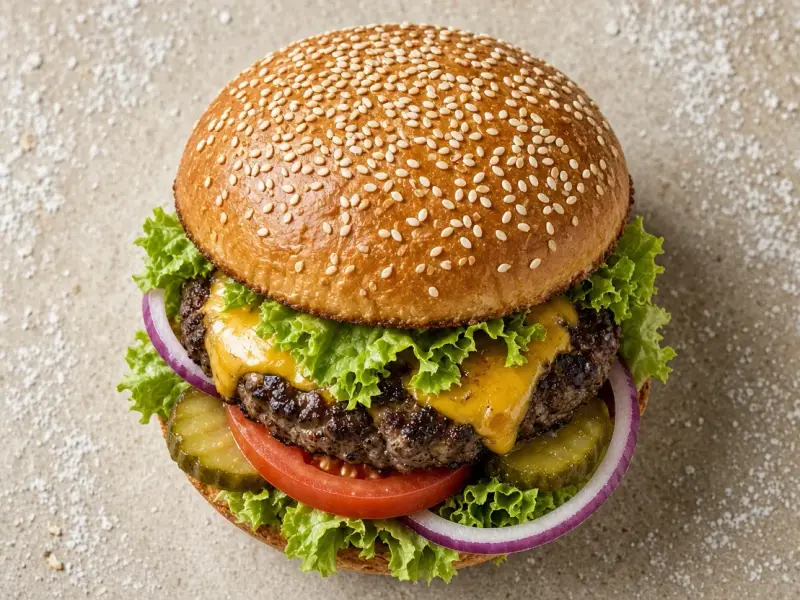 Classic Beef Burger
 Beef Tacos
 Chicken Burger
 Chicken Caesar Salad
 Chilli con Carne
 Meatloaf
 American
 Main courses
 Lunch
 Beef