Air Fryer Salmon
Nine minutes at 190C, skin side up so the fan is pointing at it. Two minutes past that and the flesh goes from silky to chalky, with no warning.
- Prep
- 5 min
- Cook
- 9 min
- Total
- 14 min
- Serves
- 2
- Revisions
- 1
Allergens
- Fish
Named from the ingredients as written, including those carried in from sub-recipes. This is not a guarantee — check the labels on what you actually buy, and note that a product’s recipe can change.
Ingredients
Serves
To serve
Method
Pat the fillets dry on both sides, and go over the skin twice. Damp skin steams, and nothing later in the recipe recovers it.
Rub the oil over the flesh and the skin.
Season the flesh with the salt and the pepper.
Heat the air fryer to 190C/375F for 3 minutes.
Lay the fillets in the basket skin side up, not touching each other.
Skin up is deliberate. The element and the fan sit above the basket, so whichever surface faces up is the one that crisps — laid the usual way round you get soft skin and a dried-out top.
Cook for 7 to 10 minutes. A 3cm fillet takes about 9; a thin tail piece can be done at 6.
It is ready when the flesh parts into flakes under light pressure from a fork and the centre still looks faintly translucent. A probe reads 50C/122F for just-set and silky, 60C/140F for opaque all the way through; UK guidance for cooking fish through is 63C/145F, and it is worth knowing both numbers before you choose.
A bead or two of white albumin at the edges is normal. A thick white crust across the top means it went about two minutes too far, and that fish will be dry.
Lift the fillets out with a fish slice rather than tongs, which crush them, and serve at once with the lemon wedges.
Nobody has rated this recipe yet.
Sign in to rate this recipe. One rating per person, and you can change it.
What to expect
- Taste
Rich and faintly sweet, with the fat carrying most of it — salmon is one of the few fish where the flavour is in the fat rather than the flesh. Salt sits on the surface and reads sharply because the flesh underneath is not seasoned through. The skin, done properly, is the most savoury part of the plate: salty, faintly bitter at the browned points, and quite different from the meat under it. Lemon is not decoration; the fat is high enough that the dish reads heavy without acid.
- Aroma
Almost nothing for the first four minutes, then a distinct warm oily smell as the fat starts to render, and finally a light toasted note off the skin. It never becomes strongly fishy, and if it does the fish was not fresh.
- Texture
Two textures with nothing in between. The skin should be thin, dry and brittle enough to crack under a fork; the flesh should be soft and moist and separate into broad flakes with barely any pressure. Overcooked, the flesh goes from soft to fibrous and slightly powdery on the tongue, and that change is abrupt rather than gradual — there is no warning.
- Sound
A quiet sizzle from about minute five, which is the surface fat rendering, and a faint crack when a fork goes through crisp skin. Neither is loud and neither is a reliable doneness cue; this dish is judged by eye and by probe.
- How the flavour moves
Salt and lemon at the front, then the fat filling the middle of the mouth, then a clean finish that fades quickly. There is no long tail — which is why the dish wants something sharp beside it to reset between mouthfuls, and why a squeeze of lemon changes the whole plate rather than just the first bite.
- Serve it
Hot, and served immediately — salmon cools fast because the fillets are thin and the fat sets. Warm salmon is noticeably greasier on the tongue than hot salmon, which is a real reason not to let it sit.
- Goes with
Anything green and sharp: garlicky greens, a lemony chickpea and herb salad, smashed cucumber salad. Boiled new potatoes. A dry white with real acidity, or nothing at all.
Cook's notes
- Difficulty
Easy, and short enough that the only real skill is knowing when to stop.
- Cost
Moderate to high — salmon is the expensive part and nothing else in the recipe costs anything.
- Equipment
An air fryer and a fish slice. A probe thermometer is genuinely useful here because the window between silky and chalky is about ten degrees wide.
- When to make it
Any evening with fifteen minutes in it.
- Best season
Farmed salmon is available year round. Wild salmon has a genuine season, is leaner, and cooks faster — take two minutes off.
- You know it is done when
The flesh turns from deep translucent orange to opaque pink from the outside inward, and it is ready while the very centre still looks slightly darker and glassier than the rest. A bead or two of white albumin at the edges is normal. A thick white crust across the surface means it went about two minutes too long, and that fillet will be dry whatever the probe says now.
- And it feels like
It parts into flakes under light pressure from a fork, and the flakes separate reluctantly rather than falling apart. Fish that shreds at a touch is overdone; fish that resists entirely needs another ninety seconds.
- Food safety
The UK Food Standards Agency figure for cooked fish is 63C/145F at the centre. A great deal of restaurant and home cooking deliberately serves salmon below that, around 50C, for texture, and the recipe gives both numbers rather than pretending only one exists. Anyone pregnant, very young, elderly or immunocompromised should take it to 63C. Farmed salmon carries a lower parasite risk than most wild fish but that is not a reason to treat the guidance as optional.
- Where it goes wrong
- Skin side down, which is what a pan wants and the opposite of what this machine wants.
- Not drying the skin, which is the other half of the same failure.
- Cooking by weight rather than by thickness. A 200g thin fillet and a 150g thick one need different times, and the thick one needs more.
- Leaving it two minutes 'to be safe', which is exactly the interval that ruins it.
- Lifting it out with tongs, which crush the fillet.
- Cooking straight from the fridge without accounting for it — a very cold fillet wants an extra minute.
- If it does go wrong
Soft skin: it went in wet, or skin down. Dry and chalky: overcooked, and there is no fix. White crust across the top: the same thing, visible. Cold in the middle: the fillet was thicker than 3cm or came straight out of the fridge. Stuck to the basket: the machine was not preheated.
- Making it ahead
Nothing to gain. Season and cook.
- Keeping it
Two days covered in the fridge. Cool within an hour.
- Reheating
Do not. It is already at the top of its range and a reheat takes it past. Eat it cold.
- Freezing
Freeze the raw fillets rather than the cooked ones. Cooked salmon thaws watery.
- Leftovers
Excellent cold — flaked into a salad, folded into scrambled eggs off the heat, or mashed with crème fraîche and lemon into a rough pâté.
- Scaling it
Four fillets fit most 5-litre baskets in one layer with a gap; more than that needs two runs and the timing does not change.
- Substitutions
Trout fillets behave almost identically and want a minute less. Thicker cuts from the head end of the fillet need eleven or twelve minutes; thin tail pieces six. Skinless fillets work but lose the best texture in the dish and want covering with a little more oil to stop the top drying.
- Dietary swaps
Contains fish. Dairy free, egg free, gluten free and nut free as written.
- Shopping for it
Look for firm flesh with no gaping between the flakes, and skin that is bright rather than dull. Frozen-at-sea fillets are often better than tired fresh ones and thaw well overnight in the fridge.
- Keeping the cost down
Buy a side of salmon and portion it yourself; it is usually cheaper per kilo than pre-cut fillets and lets you cut even thicknesses, which this recipe cares about.
- Sustainability
Salmon farming carries real and contested environmental costs, from sea lice and escapes to the fishmeal used in feed. Certification schemes exist and their effectiveness is debated. Worth reading the label rather than assuming.
- Nutrition
High in fat, most of it unsaturated, and a substantial protein portion. Two teaspoons of added oil across two servings.
- Worth it?
Nine minutes and almost no washing up, and the skin is better than most people get in a pan.
Where it comes from
- Origin
None. One ingredient, one appliance.
- History
Salmon was expensive and seasonal in Britain until farming scaled up in the late twentieth century, principally in Norway and Scotland, after which it became one of the most-eaten fish in the country. Cooking it as a fast, single-portion fillet rather than as a whole poached fish is a consequence of that shift, and the air fryer version is the most recent step in the same direction.
- Why it matters
Salmon is now the default weeknight fish across much of northern Europe and North America, which makes 'how long do I air fry salmon for' one of the higher-volume cooking questions there is.
- When it is eaten
A weeknight.
- The traditional way
Pan-frying skin side down in a hot dry pan, weighted, is the professional route to crisp salmon skin. The air fryer reverses the geometry, not the principle: the skin still needs to face the heat.
- How this version differs
Skin side up. Most published air fryer salmon recipes say skin side down, carried over from pan instructions without accounting for where the element is.
Related recipes
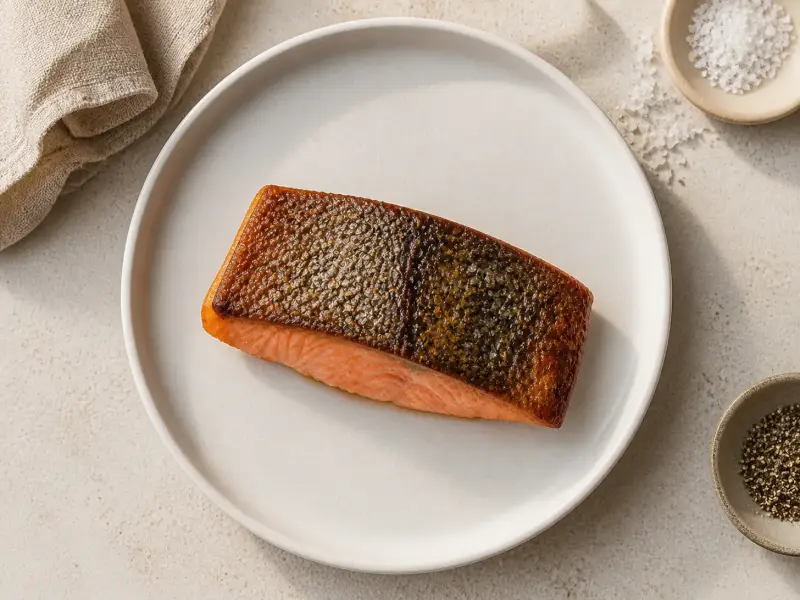 Crisp-Skinned Salmon
 Goan Fish Curry
 Air Fryer Chicken Breast
 Air Fryer Chicken Thighs
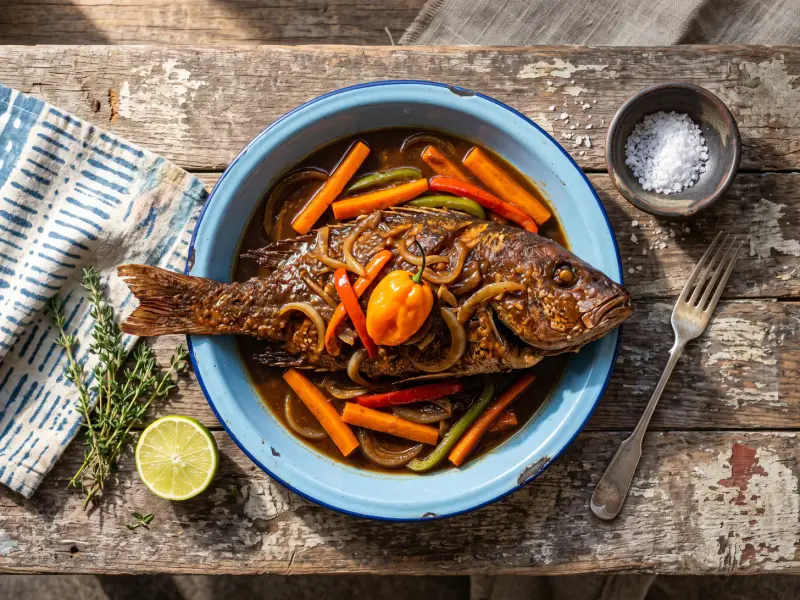 Brown Stew Fish
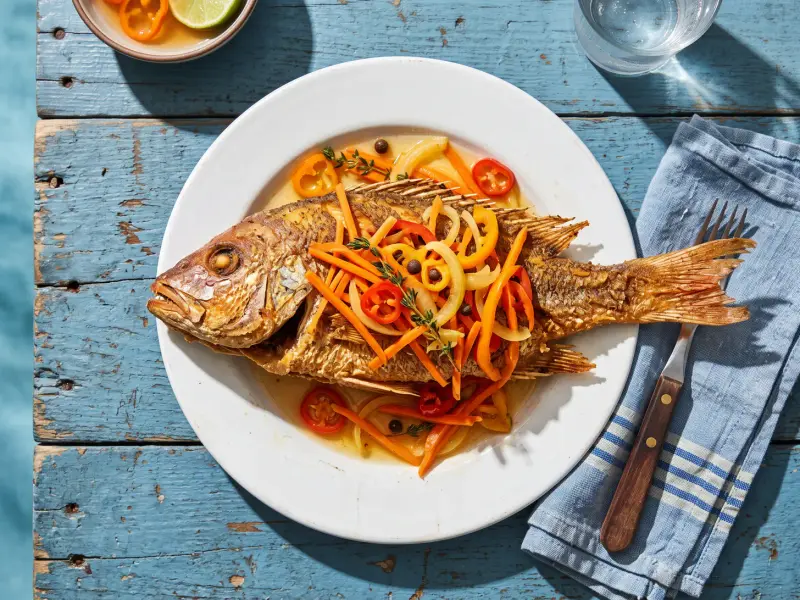 Escovitch Fish
Categories
Courses & dish types
 Dinner
 Main courses
Main ingredients
 Fish
Diets
 Pescatarian
Techniques & equipment
Time & effort
 15 minutes
 30 minutes