Sweet Potato Fries
A cornflour coating and a hot tray, because sweet potatoes have too much sugar and moisture and not enough starch to crisp on their own.
- Prep
- 15 min
- Cook
- 35 min
- Resting
- 30 min
- Total
- 1 hr 20 min
- Serves
- 4
- Revisions
- 1
Ingredients
Serves
Fries
To finish
Method
Fries
Cut the sweet potatoes into even 1cm batons, leaving the skin on.
Soak them in cold water for 30 minutes, then drain and dry them extremely thoroughly on a tea towel.
Heat the oven to 220C fan with two large trays inside.
Toss the dry batons with the cornflour until every surface is dusted and no wet patches remain.
The cornflour is doing what the potato cannot. An ordinary potato crisps because it is high in starch and low in sugar; a sweet potato is the reverse, so it browns and burns before it dries out. A thin starch coating gives the outside something that can actually go crisp.
Add the oil, paprika and garlic granules and toss again until evenly coated.
Do not salt them yet. Salt draws moisture to the surface and steams the coating you have just applied.
Spread them on the two hot trays in a single layer with space between every baton.
Two trays and real gaps. Crowded, they steam each other and you get soft orange fingers however long they cook.
Roast for 20 minutes, turn them, then roast for a further 10 to 15 minutes until the edges are dark and crisp.
To finish
Salt and pepper the moment they come out of the oven and serve immediately.
Nobody has rated this recipe yet.
Sign in to rate this recipe. One rating per person, and you can change it.
What to expect
- Taste
Sweet, obviously and unavoidably, with smoked paprika and salt pulling against it. The salt matters more here than in ordinary chips precisely because there is so much sugar to balance.
- Aroma
Caramelising sugar, closer to a roasting vegetable than to a chip.
- Texture
Crisp edges, soft middles. Honest about it: this is not a chip and does not become one.
- Sound
Little.
- How the flavour moves
Salt first, then sweetness, then smoke. Without enough salt it is just sweet.
- Serve it
Straight from the oven. They soften fast.
- Goes with
A burger, grilled chicken, or a soured cream and lime dip. Something salty and sharp to push against the sugar.
Cook's notes
- Difficulty
Beginner, and it is a recipe about what NOT to do.
- Cost
Low.
- Equipment
Two large baking trays.
- When to make it
Alongside anything grilled or in a bun.
- Best season
Imported year round; there is no useful British season.
- You know it is done when
The edges dark and slightly blackened at the corners, the flats deep orange-brown. Uniformly soft orange means they steamed.
- And it feels like
Crisp at the edges and soft inside. They will never be as rigid as a chip made from an ordinary potato and it is worth knowing that going in.
- Food safety
Nothing unusual.
- Where it goes wrong
- Not drying them, so the cornflour turns to paste.
- Salting before cooking, which draws moisture out and steams the coating.
- Crowding one tray, which is the commonest reason they steam.
- A cold tray.
- Cutting them thicker than 1cm, which never crisps.
- Expecting them to be as crisp as a chip, which they cannot be.
- If it does go wrong
Soft: crowded, or the oven too cool. Gluey skin: the cornflour went on wet. Burnt but soft inside: the batons were too thick. Bland: they need considerably more salt than ordinary chips.
- Making it ahead
Cut and soak them hours ahead in cold water in the fridge. Everything else is last minute.
- Keeping it
None worth having. They soften within twenty minutes.
- Reheating
An air fryer or a hot oven for 5 minutes recovers some crispness.
- Freezing
No.
- Leftovers
Mashed into a soup, or in a wrap.
- Scaling it
Always more trays, never a deeper layer.
- Substitutions
Ordinary potatoes need no cornflour and no soak-and-dry discipline, because they are already high in starch — the whole technique here exists to compensate for what a sweet potato lacks. Arrowroot or rice flour instead of cornflour.
- Dietary swaps
No allergens as written. Vegan, vegetarian, gluten free, dairy free, egg free and nut free, which makes this one of the most broadly usable side dishes in the collection.
- Shopping for it
Firm sweet potatoes with no soft spots. The orange-fleshed kind is what this recipe assumes; white and purple varieties are drier and behave slightly differently.
- Keeping the cost down
Cheap, and the skins stay on so nothing is wasted.
- Sustainability
Sweet potatoes have a low footprint, grow in poor soil and store well, though most sold in Britain are imported from Spain, Egypt or the United States, so they travel further than a British potato. Keeping the skins on is worth doing on both counts — it is where most of the fibre is and it means nothing is thrown away. Roasting rather than deep frying uses a fraction of the oil.
- Nutrition
High in vitamin A and fibre. Roasted rather than fried, so lighter than deep-fried chips.
- Worth it?
Dry them, dust them, give them room, and salt them last. Four small things and none of them is optional.
Where it comes from
- Origin
The sweet potato is Central and South American; the fries are recent and American.
- Also called
None.
- Said out loud
Straightforward.
- What the name means
The sweet potato is not a potato and is not closely related to one — it is in the bindweed family, while potatoes are nightshades. In some countries it is also confusingly called a yam, which is a different plant again.
- History
Sweet potatoes were domesticated in Central or South America several thousand years ago and had spread across the Pacific well before European contact, which is one of the more interesting puzzles in the history of crops. In the American south they are a long-established staple. The fry is a modern restaurant item, popularised over the last twenty-five years alongside the idea that it is a healthier chip.
- Why it matters
Modest as a dish, and interesting as a case study in how a health claim can carry a food onto every menu.
- When it is eaten
A side, mostly with something American.
- The traditional way
None.
- How it changed
Nothing to change.
- Regional variations
None.
- How this version differs
The cornflour coating and the salt withheld until after cooking, both of which have physical reasons that are worth knowing and are usually left unstated.
- Sources and credit
None.
 Air Fryer Chips
 Potato Salad
 Vinegret
 Air Fryer Roast Potatoes
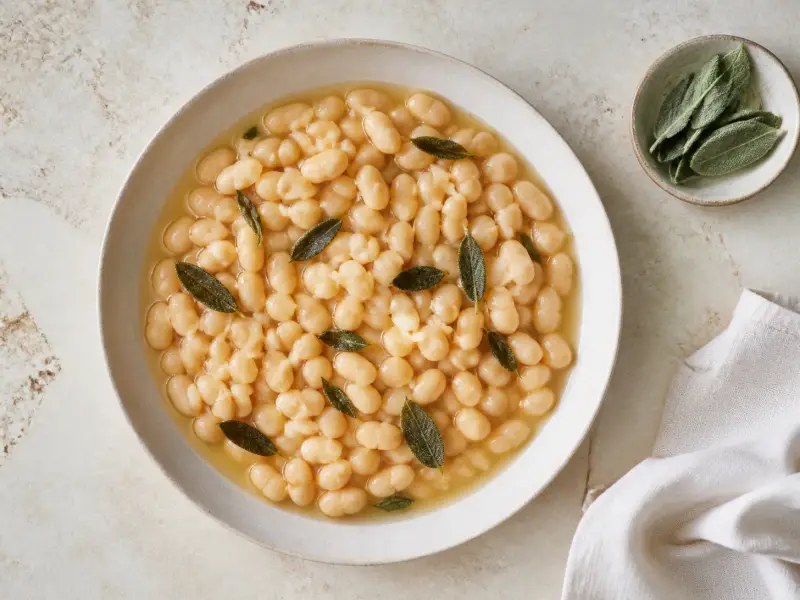 Braised White Beans with Sage
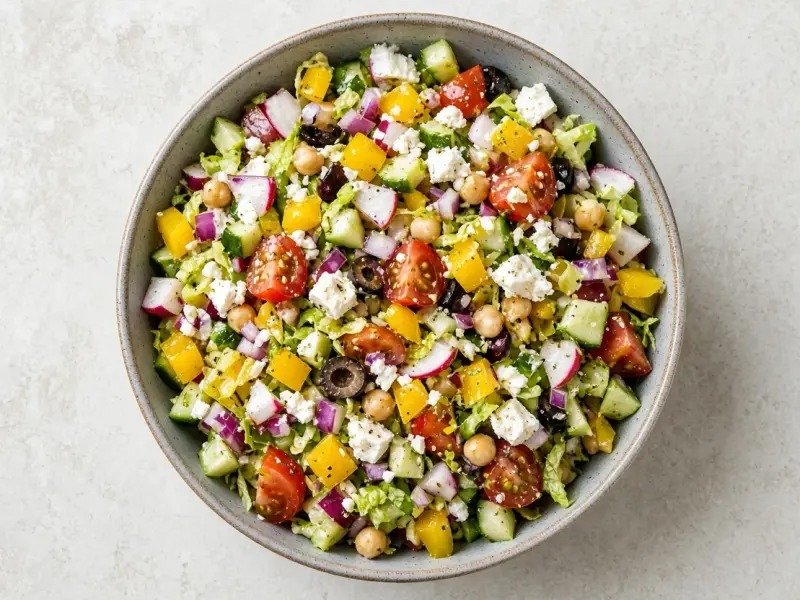 Chopped Salad
 American
 Side dishes
 Potatoes
 Vegan
 Vegetarian