Sauerkraut
Sauerkraut
Sauerkraut — sour cabbage.
Cabbage and carrot salted, packed down and left to ferment under its own brine until it turns sour and keeps.
- Prep
- 30 min
- Total
- 30 min
- Serves
- 20
- Revisions
- 5
Ingredients
Serves
Method
Pull two or three clean outer leaves off the cabbage and set them aside whole. They go on top at the end as a cap.
Quarter the cabbage, cut out the hard core and shred the leaves 2-3mm thick with a long knife or a mandolin.
Shred it fine and shred it evenly. Thick shreds give up their water slowly and unevenly, and a batch that never makes enough brine of its own is a batch that grows mould.
Put the shredded cabbage and the grated carrot in a very large bowl and weigh them together.
Weigh out salt at 2 per cent of that combined weight, which is the 44g given here for 2.2kg of vegetables.
Weigh the salt rather than measuring it by spoon. Below about 1.5 per cent, spoilage organisms outrun the lactic bacteria; above about 3 per cent the ferment stalls and you are left with salty raw cabbage that never sours.
Scatter the salt over and turn everything through with your hands.
Squeeze the cabbage hard in handfuls for 5-10 minutes, working right through the bowl.
Stop when it has slackened, dropped to about half its volume and a pool of liquid runs out when you press down on it.
Add no water at this stage. The salt is drawing the cabbage's own water out by osmosis, and that liquid is the brine the whole method depends on; anything poured in dilutes it.
Mix in the caraway seeds, peppercorns and bay leaves.
Pack the cabbage into a clean 2 litre jar or crock a fistful at a time.
Press each fistful down hard with your knuckles or the end of a wooden spoon, until liquid rises up over it, before adding the next.
Press the surface down firmly once it is all in, and check that the brine covers it by at least a centimetre.
Leave it half an hour and press again if the brine is short, since the cabbage goes on giving up water as it stands.
Top up with the 2 per cent brine only if it still will not cover after that.
Lay the reserved whole leaves over the surface and tuck them down the sides, then set a weight on top: a small jar of water or a sealed bag of brine.
Every shred must stay under the liquid. This is the whole safety of the method. Submerged cabbage ferments without air and the lactic acid preserves it, while anything standing above the brine grows mould, and mould is what ends most failed batches.
Cover the jar loosely or fit an airlock, and never seal it tight. Fermentation makes carbon dioxide, and a sealed jar builds pressure.
Stand the jar on a tray, out of direct sunlight, in a cool room at 18-20C/64-68F.
Expect bubbles rising through the brine from the second or third day and a clean sour smell within the week.
Skim off any flat white film that forms on the surface with a clean spoon. That is kahm yeast, and it is harmless.
Throw the whole batch out if you find fuzzy growth in blue, green, black or pink. That is mould, its threads run further down than you can see, and it is not worth the risk.
Start tasting from day 7 with a clean fork. It is ready when it tastes sourly of cabbage rather than of salt, has gone pale and slightly translucent, and still crunches.
Reckon on about a week at 20C/68F. A cold room takes three or four weeks and gives a rounder, less sharp result.
Transfer it to a clean jar once it tastes right, press it back under its brine, seal it and refrigerate. Fermentation slows almost to a stop below 5C/41F.
Keep it in the fridge for several months, accepting that it goes on souring slowly and softens over time.
Keep the brine when you drain it, since it seasons soups and salads on its own.
Do not rinse it before eating unless it is genuinely too sour to use. Rinsing washes off the lactic acid that is the entire point of it.
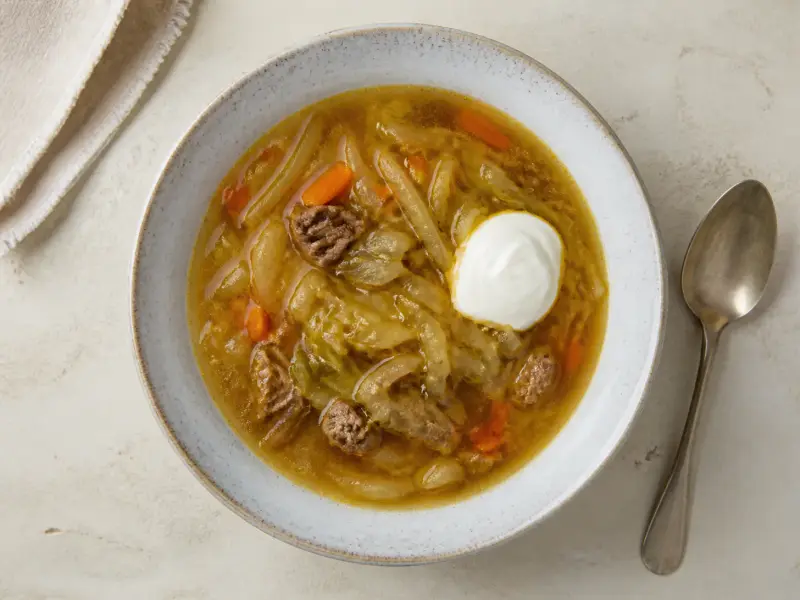
Use it raw in the vinegret in this collection, or stewed long and slow in its own pan for shchi, where it needs three quarters of an hour to soften before it meets the broth.
Nobody has rated this recipe yet.
Sign in to rate this recipe. One rating per person, and you can change it.
What to expect
- Taste
Sour, and it is a specific kind of sour that vinegar does not reproduce — lactic acid is rounder, softer and slightly cheesy where acetic acid is sharp and volatile. Under it, cabbage is sweeter than raw cabbage because fermentation has converted some of its sugars and softened its sulphurous edge. Salt is present throughout and should not dominate; kraut that tastes primarily of salt has not fermented long enough. Carrot adds sweetness. Caraway is the classic partner and is assertive — aniseed and rye-bread notes — and a small amount goes a long way. Over weeks the sourness deepens and the sweetness recedes.
- Aroma
Clean and sharply sour, and the word clean is the important one — a good ferment smells bright and appetising, and anything that smells rotten, cheesy in a bad way, or of solvent has gone wrong. The smell changes over the first week from cabbagey to distinctly sour, and that change is the most reliable progress indicator you have.
- Texture
Crunching, and that is the mark of a good one. Commercial pasteurised sauerkraut is usually soft, because heat treatment for shelf stability destroys the texture along with the live cultures. Home-fermented kraut kept cold retains a real bite for months.
- Sound
The jar makes noise, which is genuinely one of the pleasures of doing this. From day two or three you can hear it fizzing quietly, and lifting the weight releases a soft hiss. When the noise stops, the vigorous phase is over.
- How the flavour moves
Sourness first and immediately. Then salt, then the cabbage's own sweetness underneath. Caraway is aromatic rather than tasted and comes through the nose. The finish is clean and sharp and short, which is why it works as a foil rather than as a dish — it resets the mouth and gets out of the way.
- Serve it
Cold from the fridge, usually. It is also good at room temperature and is cooked in a great many dishes.
- Goes with
Fat, and it is one of the great foils for it. Roast pork, sausages, duck, goose. Rye bread and butter. Cheese. It is in shchi and in bigos and in choucroute garnie, and it is on a hot dog. Where it fails is next to anything delicate, and next to wine, which fermented acidity flattens.
Cook's notes
- Difficulty
Easy, and the only genuinely important thing is accuracy with the salt. Everything else is patience and keeping the cabbage under the brine.
- Cost
Almost nothing. Two kilos of white cabbage is one of the cheapest things in a shop.
- Equipment
A very large bowl, a two-litre jar or crock, a weight to hold the cabbage down, and digital scales. The scales are the one piece of equipment that matters.
- When to make it
Autumn traditionally, when cabbage is cheapest and best. Any time in practice.
- Best season
Cabbage is at its best and cheapest in late autumn and winter, which is exactly when this was traditionally made.
- You know it is done when
Bubbles rising through the brine within two or three days. The cabbage goes from opaque white-green to pale and slightly translucent. The brine goes cloudy, which is correct and is the bacteria doing their work.
- And it feels like
It should still crunch. Sauerkraut that has gone soft has usually been fermented too warm, or the salt was under 2 per cent.
- Food safety
This is the section that matters and it is worth reading properly. Everything must stay under the brine — submerged cabbage ferments anaerobically and the lactic acid that develops preserves it, while anything standing above the liquid is exposed to air and grows mould. A flat white film on the surface is kahm yeast: harmless, and skimmed off with a clean spoon. Fuzzy growth in blue, green, black or pink is mould, its threads run further into the jar than you can see, and the batch goes in the bin — it is not worth saving. Never seal the jar tightly; fermentation produces carbon dioxide and a sealed jar builds pressure. Use clean hands and clean utensils throughout. Properly made, the finished kraut is acidic enough to be genuinely safe, which is why this has been a preservation method for two thousand years.
- Where it goes wrong
Guessing the salt, which is the fault — below about 1.5 per cent spoilage organisms outrun the lactic bacteria, and above about 3 per cent the ferment stalls and you have salty raw cabbage. Adding water at the squeezing stage, which dilutes the brine. Not squeezing hard enough or long enough, so there is never enough liquid. Letting cabbage stand above the brine. Sealing the jar. And throwing out a batch over kahm yeast, which is harmless.
- If it does go wrong
Not enough brine after half an hour: press again, and only then top up with 2 per cent brine. White film: kahm yeast, skim it. Fuzzy coloured growth: mould, and the batch is finished. Soft and slimy: fermented too warm or under-salted. Not sour after a week: the room is cold — give it longer. Too sour: it is fine and it will only get more so; move it to the fridge, which slows it almost to a stop. Smells wrong rather than sour: trust that judgement and start again.
- Making it ahead
It is nothing but ahead. A jar in the fridge keeps for months.
- Keeping it
Once it tastes right, move it to the fridge with the brine and it keeps for months, slowly getting more sour. Always keep it submerged.
- Reheating
It can be cooked — that is what shchi does with it — and cooking kills the live cultures. Eaten raw it is a live food.
- Freezing
It freezes and the texture suffers. There is no reason to; it keeps for months.
- Leftovers
The brine is the useful leftover. It is a live culture and a spoonful will kick-start the next batch, and it is drunk on its own in some traditions.
- Scaling it
Freely, on the 2 per cent rule. Larger batches ferment slightly more slowly and are easier to keep submerged.
- Substitutions
Any firm cabbage works — white, green, or the pointed varieties. Red cabbage ferments perfectly well and turns a spectacular magenta, since its anthocyanins react to the acid the same way pickled onions do. Juniper berries, dill seed and garlic are all traditional additions somewhere.
- Dietary swaps
Vegan, vegetarian, dairy-free, gluten-free and nut-free, with nothing to adapt.
- Shopping for it
Firm, heavy, tightly packed white cabbage. Salt without anti-caking agents. A jar or crock large enough that the cabbage does not reach the rim, since it needs room for the weight and the brine.
- Keeping the cost down
Two kilos of cabbage costs very little and makes twenty servings, which puts homemade sauerkraut at a small fraction of the jarred price and makes it considerably better. Save a little brine to start the next batch.
- Sustainability
Excellent. A cheap seasonal vegetable turned into something that keeps for months without refrigeration, energy or packaging. It is the shape of eating that most of human history had.
- Nutrition
About 20 calories a serving. Unpasteurised sauerkraut is a live fermented food carrying lactic acid bacteria, and it retains the cabbage's vitamin C — a serving provides a meaningful fraction of a day's requirement, which is the whole reason it kept sailors alive. It is also high in sodium by nature.
- Worth it?
Worth it, and it is the most interesting thirty minutes in this collection. It costs about two pounds, requires no equipment but scales and a jar, and produces something better than anything you can buy — because almost all commercial sauerkraut is pasteurised and this is not. Weigh the salt, keep it under the brine, and taste it from day seven.
Where it comes from
- Origin
Central and eastern Europe for the tradition; the technique is far older and far more widespread than any single origin.
- Also called
Sauerkraut in German, choucroute in French, kapusta kiszona in Polish, kvashenaya kapusta in Russian.
- Said out loud
ZOW-er-krowt in German.
- What the name means
Sour cabbage, literally. The French choucroute is a Frenchification of the Alsatian dialect word for the same thing.
- History
Fermenting cabbage is ancient and pan-Eurasian. Roman agricultural writers describe preserving cabbage, and the practice is documented right across central and eastern Europe. The often-repeated story that it originated with labourers building the Great Wall of China, fermenting cabbage in rice wine, is repeated in a great many popular accounts and is not supported by evidence — Chinese fermented vegetables are genuinely ancient, and the specific chain of transmission to Europe is not documented. What is well documented is the science and one very famous application. The fermentation is a succession: salt at around 2 per cent creates conditions that favour lactic acid bacteria over spoilage organisms, and three species take over in turn as the acidity rises, each more acid-tolerant than the last. The result is preserved cabbage that retains its vitamin C, which is why Captain James Cook carried barrels of it on his Pacific voyages from 1768 and lost remarkably few men to scurvy — one of the clearest early demonstrations that diet prevented the disease, decades before anyone understood why.
- Why it matters
It is the food of the European winter, and its cultural weight in Germany, Poland, Russia and Alsace is enormous. It also carries one of the odder pieces of linguistic history: during the First World War, American anti-German feeling led to sauerkraut being renamed liberty cabbage, which is a genuine historical episode and an instructive one.
- When it is eaten
Winter, and constantly. It is a staple rather than an occasion food.
- The traditional way
Salting, pounding and weighting in a stoneware crock, often a very large one, made once a year at the autumn cabbage harvest for the whole winter. The scale was communal — a household ferment of thirty or forty kilos was normal.
- How it changed
Industrial sauerkraut is pasteurised for shelf stability, which kills the live cultures and softens the texture, and it is what most people have tasted. Refrigerated unpasteurised kraut has become widely available again in the last twenty years alongside a general revival of fermentation.
- Regional variations
Alsace and Germany use caraway and juniper. Poland ferments whole heads as well as shredded and uses it in bigos. Russia adds carrot and sometimes cranberries or apple. Korea's kimchi is the same principle applied with chilli, garlic and fish sauce and is a whole cuisine of its own.
- How this version differs
It includes carrot, which is the Russian and eastern European habit rather than the German one. It is unusually explicit about weighing the salt, which is the one thing that reliably decides whether a batch works.
- Sources and credit
None. The Cook scurvy account and the liberty cabbage episode are matters of record.
 Shchi
Shchi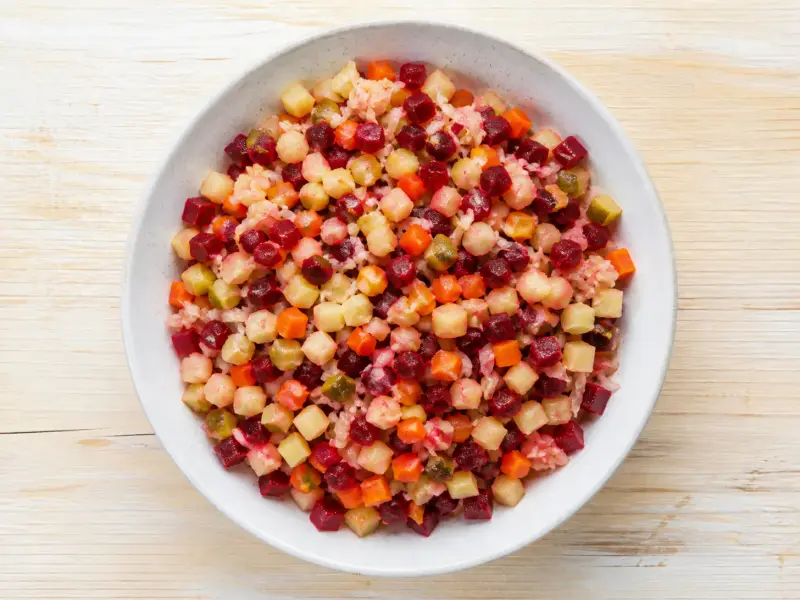 Vinegret
 Garlicky Greens
 Wet Brine for Chicken and Pork
 Garam Masala
 Basil Pesto
 Chickpea and Spinach Stew
 Egg Fried Rice