Shchi
Щи
Cabbage soup simmered in meat broth, made sour with sauerkraut in winter and with fresh cabbage in summer.
- Prep
- 25 min
- Cook
- 2 hr 45 min
- Resting
- 20 min
- Total
- 3 hr 30 min
- Serves
- 6
- Revisions
- 5
Allergens
- Milk
Named from the ingredients as written, including those carried in from sub-recipes. This is not a guarantee — check the labels on what you actually buy, and note that a product’s recipe can change.
Ingredients
Serves
Method
Put the beef in a large pan and pour over the 2.5 litres of cold water.
Bring it up slowly over about 20 minutes, until the first bubbles break the surface.
Skim the grey foam off as it gathers, and keep skimming until the surface stays clear.
Add the bay leaves and the whole peppercorns.
Simmer with the lid ajar for 2 hours, until the meat gives under a fork and pulls away in strands.
Taste a shred of the sauerkraut while the broth cooks.
Rinse it once under cold water and squeeze it dry if it is aggressively sour, and use it as it comes if it is mild. Jars and barrels differ enormously, and this is the only chance to correct for that.
Warm the oil in a wide pan over medium-low heat.
Cook the onion and carrot for 10 minutes, stirring now and then, until soft with no colour on them.
Stir in the tomato puree and cook for 1 minute, until it darkens to brick red and stops smelling raw.
Add the drained sauerkraut with a ladleful of the beef broth.
Cover and stew gently for 40-45 minutes, stirring occasionally, until the shreds are tender and no longer squeak against the teeth.
Give it the full stewing time in its own pan. Sauerkraut barely softens in a soup pot, and shchi made by tipping raw kraut into broth twenty minutes before serving is hot cabbage sitting in liquid.
Lift the beef out and strain the broth into a clean pan.
Shred the meat off the bone with two forks and discard the fat and gristle.
Bring the strained broth to a simmer and add the potatoes.
Cook for 12-15 minutes, until a knife tip slides into a cube with no resistance.
Get the potatoes soft before the sauerkraut goes in and never after. Acid firms starch and holds it there, and a potato dropped into a sour pot stays chalky for as long as you are willing to boil it.
Stir the stewed sauerkraut and the shredded meat into the pan.
Simmer for 10 minutes, until the broth tastes of cabbage rather than of beef with cabbage in it.
Stir in the garlic off the heat.
Taste, and sharpen it with the reserved sauerkraut brine a spoonful at a time if it reads flat.
Season with the ground peppercorns, then with fine salt. Leave the salt until now, because the kraut and its brine carry a great deal of it already.
Cover and stand the pan off the heat for 20 minutes before serving.
Ladle into warm bowls and scatter the dill and parsley over.
Put the smetana on the table and let people stir it in themselves. Boiled into a sour pot, soured cream splits into grains sitting in thin liquid.
Cool any left over in a shallow container, refrigerate within two hours and eat it within three days.
Reheat it to a simmer the next day, which is when Russian cooks reckon it is at its best.
Nobody has rated this recipe yet.
Sign in to rate this recipe. One rating per person, and you can change it.
What to expect
- Taste
Sour first and that is the whole identity of winter shchi. Sauerkraut is lactic-fermented, so its sourness is round and slightly cheesy rather than sharp like vinegar, and it runs through everything. Under it, two hours of beef on the bone gives a deep savoury broth with real body from the gelatine. Cabbage itself is sweet after forty-five minutes of stewing, which is a surprise to anybody who has only had it boiled. Onion and carrot add more sweetness; tomato purée, cooked out for its minute, adds umami and a little acidity of a different kind. Garlic goes in off the heat and stays sharp. Dill is the characteristic Russian herb and is more assertive than parsley — anise-like, grassy, and it defines the smell of the bowl. And then smetana, stirred in at the table, which changes the soup completely: it rounds the acid, adds fat, and turns something sharp into something comforting.
- Aroma
Sour cabbage above everything, and it is a strong smell that fills a house — there is a Russian expression about the shchi spirit in a peasant home and it is not a compliment or an insult, simply a fact. Under it, beef broth, and then dill at the end, which is the brightest note. It smells older and more fermented than most soups in this collection.
- Texture
Soft throughout, with the kraut retaining a slight fibrous chew that is correct and welcome — it should not be mush. Potatoes are floury and starting to break at the edges. The broth has body from the gelatine and coats the mouth slightly. Smetana adds thickness where it is stirred in.
- Sound
Almost nothing for three hours. The only sound worth listening for is at the start: a broth brought up slowly makes very little noise, and if it is boiling audibly the scum is being churned back in rather than rising to be skimmed.
- How the flavour moves
Sourness first, immediately. Then the beef broth's savoury depth underneath. Sweet cabbage and carrot through the middle. Garlic and dill at the finish, sharp and green. The aftertaste is long and sour and makes you want bread. Stirring smetana in changes the whole arc — everything softens and the sourness moves from the front to the middle.
- Serve it
Hot, and it holds heat well. It is winter food in a country that has real winters, and the twenty minutes of standing at the end is partly to let the flavours settle and partly because it comes off the heat scalding.
- Goes with
Dark rye bread, which is not optional in any practical sense. Smetana. Raw garlic rubbed on the bread, which is traditional and excellent. A shot of something cold and strong, in the Russian manner. Where it fails is next to anything else sour, and next to wine, which the fermented acidity destroys.
Cook's notes
- Difficulty
Easy and long. There is no technique here, only sequence, and the sequence is unusually consequential.
- Cost
Low. A cheap cut of beef on the bone, a jar of sauerkraut, and root vegetables.
- Equipment
A large pan for the broth and a wide pan for stewing the kraut. Two pans is the recipe rather than a convenience.
- When to make it
Winter, and the day before you want to eat it.
- Best season
Genuinely seasonal in origin: the sour version is winter food and the fresh-cabbage version is summer food, and that division is the whole shape of the dish.
- You know it is done when
The broth should be clear rather than cloudy, which is what the slow start and the skimming are for. The kraut shreds should be tender and translucent rather than white and squeaky. The finished soup is right when it tastes of cabbage rather than of beef with cabbage in it.
- And it feels like
Potato cubes should take a knife tip with no resistance. Kraut should not squeak against the teeth.
- Food safety
Nothing unusual. Cool leftovers in a shallow container and refrigerate within two hours, since a large deep pot of hot soup takes a very long time to cool through and spends that time in the range where bacteria multiply.
- Where it goes wrong
Tipping raw sauerkraut into the soup pot, which is the fault — it will not soften and you get hot cabbage in liquid. Adding the potatoes after the kraut, after which they never go soft. Boiling the smetana, which splits it into grains in thin liquid. Salting early, when the kraut and its brine are already carrying a great deal. And boiling the broth at the start, which clouds it permanently.
- If it does go wrong
Potatoes still chalky: they went in after the acid, and there is no fixing it — the pectin is set. Squeaky cabbage: not stewed long enough, and another twenty minutes in its own pan will help even at this stage. Flat: sharpen with the reserved kraut brine, a spoonful at a time, before reaching for salt. Too sour: more potato, or a little sugar, or serve with more smetana. Cloudy broth: it boiled; next time bring it up slowly and skim.
- Making it ahead
Strongly recommended and traditionally expected. Make it the day before. Day-old shchi is a named dish and is better than fresh.
- Keeping it
Three days in the fridge, and it is better on the second — see below.
- Reheating
To a simmer, and it is the intended use.
- Freezing
Three months and it survives well. Freeze without the smetana.
- Leftovers
The point. Day-old shchi has its own name in Russian — sutochnye shchi, twenty-four-hour shchi — and is regarded not as leftovers but as the dish properly finished. It is genuinely better.
- Scaling it
Doubles easily; it is a soup and the only constraint is pan size.
- Substitutions
Pork works in place of beef and gives a sweeter broth. Fresh cabbage instead of sauerkraut makes the summer version, which is a genuinely different soup — sweeter, lighter, and usually finished with a squeeze of something sour to compensate. Soured cream stands in for smetana, which is thicker and higher in fat. There is no substitute for the long broth.
- Dietary swaps
Not vegetarian as written. A version on mushroom broth is traditional for Lenten fasting and is very good — dried porcini give the depth the beef otherwise provides. Gluten-free and nut-free. Contains milk, declared, from the smetana, which is added at the table and can simply be left off.
- Shopping for it
Beef on the bone, brisket or shin. Sauerkraut from a jar or, better, a proper barrel-fermented one from an eastern European shop, which will be less sharp and more complex. Smetana if you can find it — it is thicker and higher in fat than soured cream and behaves better.
- Keeping the cost down
Brisket and shin are among the cheapest cuts and are the right ones here — an expensive cut is wasted in a two-hour broth. Making your own sauerkraut costs almost nothing and takes a fortnight of doing nothing, and there is a recipe for it in this collection.
- Sustainability
Good. A cheap cut of beef stretched across six portions, a fermented vegetable that keeps all winter, and root vegetables. It is the shape of eating that most traditional cooking has and most modern cooking does not.
- Nutrition
Around 380 calories a serving before smetana. Sauerkraut is a fermented food and, eaten uncooked, carries live cultures — cooked as it is here, those are gone, though the fibre and the vitamin C remain. Cabbage is unusually high in vitamin C for a vegetable that stores all winter, which is part of why it mattered so much historically.
- Worth it?
Worth it, and worth making the day before. Three and a half hours sounds like a lot until you notice that under an hour of it is work, and the result is a soup with a thousand years behind it that costs about the same as a sandwich. Stew the kraut separately, get the potatoes soft first, and keep the soured cream off the heat.
Where it comes from
- Origin
Russia, and it is about as old as Russian cooking gets.
- Also called
Shchi — щи. The winter version is kislye shchi, sour shchi; a summer version made with sorrel is zelenye shchi, green shchi; day-old shchi is sutochnye shchi.
- Said out loud
A single sound English does not have, roughly 'shchee' — the shch of 'fresh cheese' run together.
- What the name means
The etymology is uncertain and probably very old, which is itself informative about the dish's age.
- History
Cabbage reached Rus' around the ninth century and shchi is recorded from soon afterwards, which makes it one of the longest continuously cooked dishes in Europe. Its historical importance is hard to overstate: for most of a thousand years, for most Russian people, this and grain porridge were dinner. Two details are worth knowing. The first is fermentation — sauerkraut existed because it was the only way to eat cabbage through a five-month winter, and the sourness of winter shchi is not a flavour choice but a consequence of preservation. The second is that shchi travelled frozen: in Siberia it was cooked, poured into shallow moulds, frozen solid and carried on journeys as blocks, to be chipped off and reheated. That is documented and it is one of the more remarkable pieces of pre-refrigeration logistics in food history.
- Why it matters
It is the Russian national soup and the one every cook is judged on. The day-old version having its own name says something about how seriously the improvement is taken. It is also strongly associated with the Russian stove, the pech, in which a pot could sit at a falling temperature for many hours — which is exactly the cooking method the dish was designed around.
- When it is eaten
Every day, and in winter. There is nothing ceremonial about it.
- The traditional way
Stewing the sauerkraut separately before it joins the soup, and the very long slow cook. In a traditional Russian stove the whole thing would be left overnight at a declining heat, which is exactly what makes sutochnye shchi better.
- How it changed
Potatoes arrived, which is a nineteenth-century change — Russian cooking before the potato used grain or turnip. Tomato purée is more recent still. Neither is traditional in the long view and both are now standard.
- Regional variations
The fresh-cabbage summer version, the sorrel version, and a Lenten mushroom-broth version are all standard rather than variations. Some regions add a spoonful of buckwheat or barley. Wealthier versions historically included several meats at once.
- How this version differs
It uses potatoes and tomato purée, both modern. Where it is more explicit than most is the ordering — kraut stewed separately, potatoes before the acid, smetana off the heat — and each of those is a correction for a genuinely common mistake.
- Sources and credit
None. Traditional and unauthored.
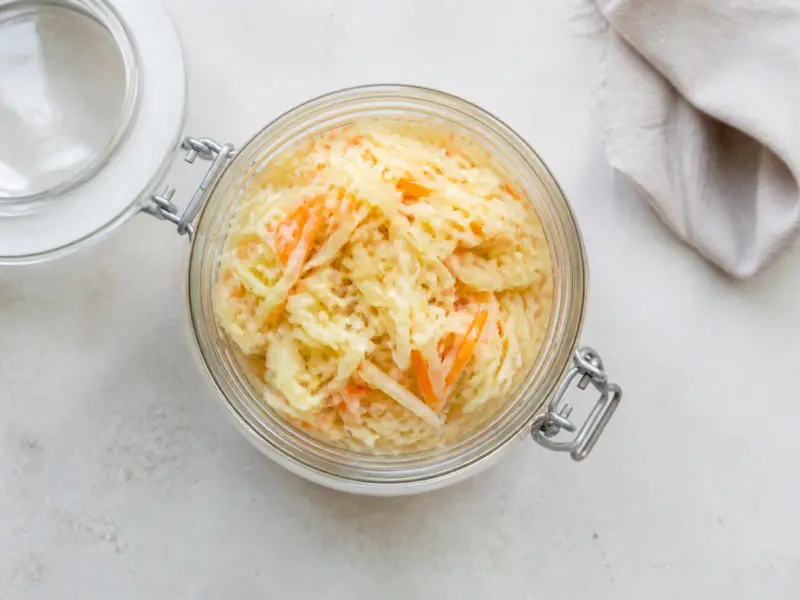 Sauerkraut
 Borscht
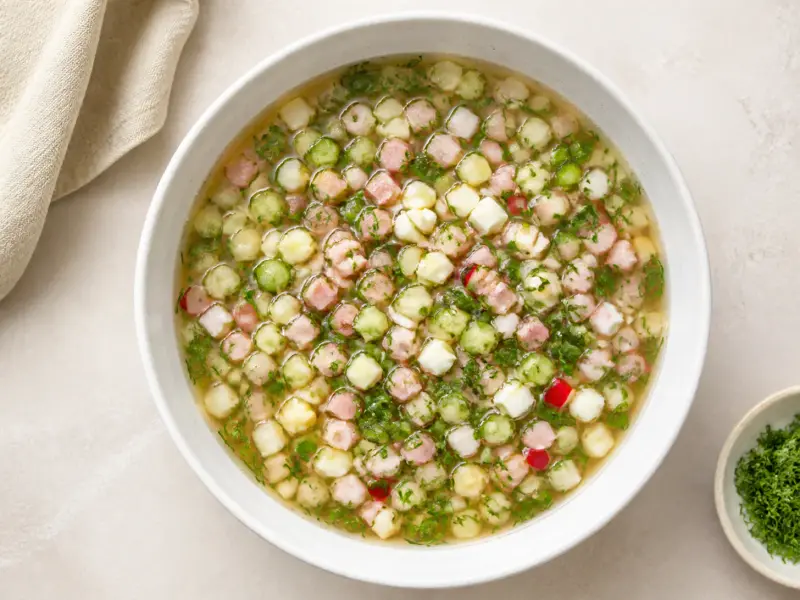 Okroshka
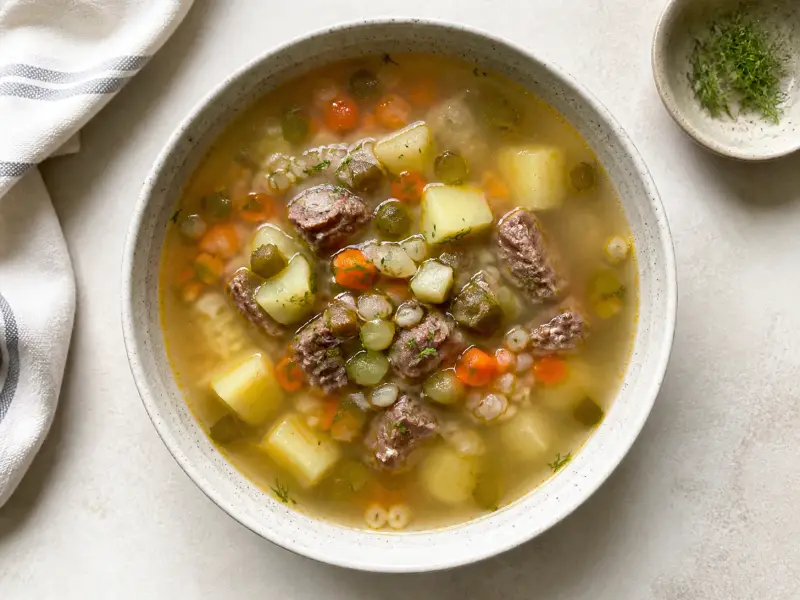 Rassolnik
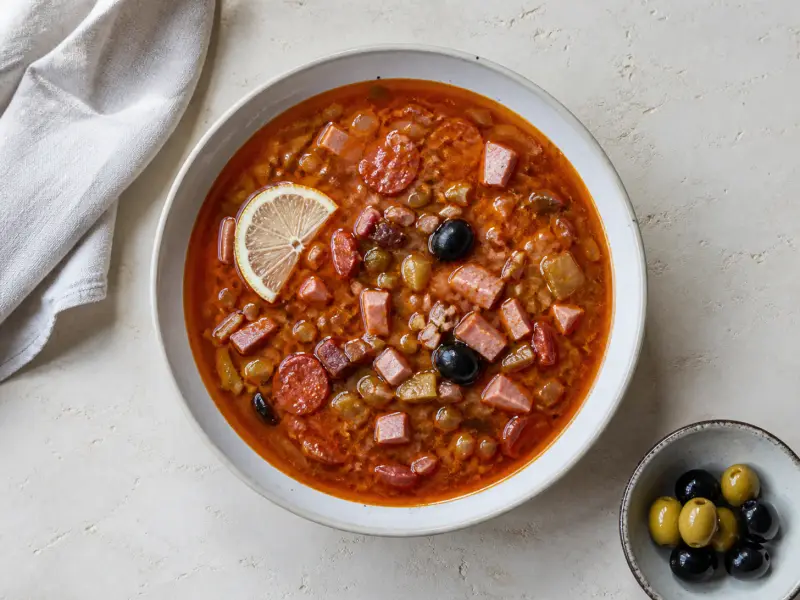 Solyanka
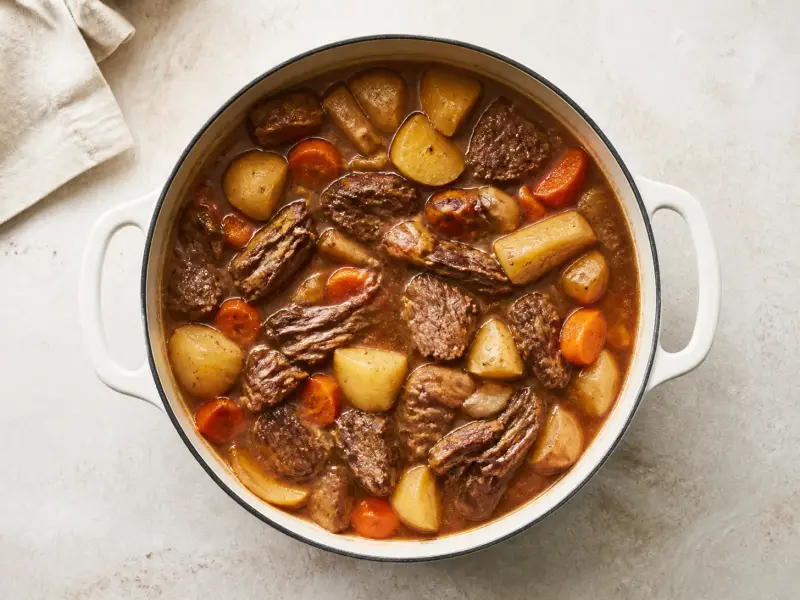 Zharkoye
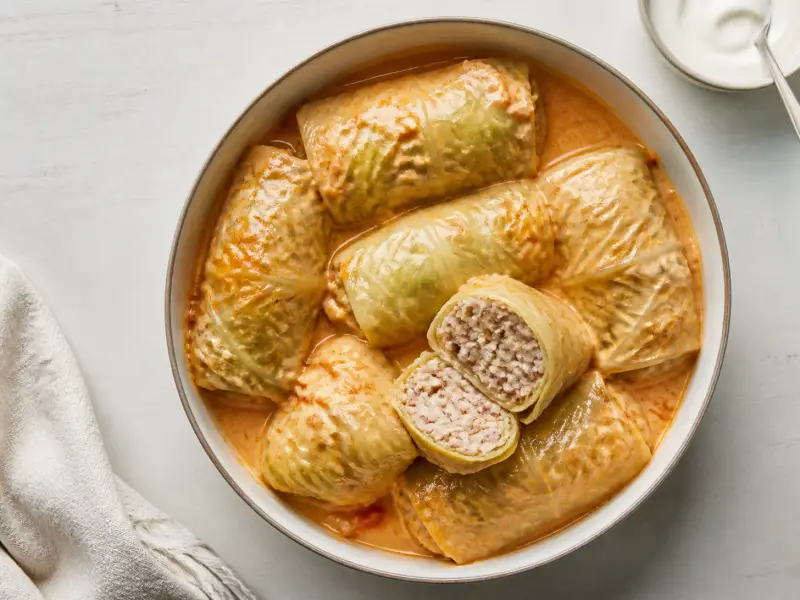 Golubtsy