Air Fryer Chicken Wings
Baking powder, half an hour uncovered in the fridge, then twelve minutes low and ten minutes hot. The skin crisps because it is dry and alkaline, not because of oil.
- Prep
- 10 min
- Cook
- 23 min
- Resting
- 30 min
- Total
- 1 hr 3 min
- Serves
- 4
- Revisions
- 1
Allergens
- Milk
Named from the ingredients as written, including those carried in from sub-recipes. This is not a guarantee — check the labels on what you actually buy, and note that a product’s recipe can change.
Ingredients
Serves
To finish
Method
Pat the wings as dry as you can with kitchen paper, working into the fold at the joint where water collects.
Toss them in a bowl with the baking powder, salt and pepper until every piece is evenly dusted and no white patches are left sitting anywhere.
Use baking powder and not bicarbonate of soda. Baking powder raises the pH of the skin, which speeds up browning and helps the surface proteins break down into a crisper shell; bicarbonate on its own at this quantity tastes soapy and metallic.
Spread the wings on a rack or a plate and leave them uncovered in the fridge for 30 minutes, or up to overnight. The fridge is a dehumidifier, and dry skin is most of the job done before the machine is switched on.
Heat the air fryer to 160C/320F.
Arrange the wings skin side up in a single layer with a gap between them, and cook in two batches if they will not all fit. A piled basket steams, and skin that has steamed will not crisp however long you run the machine afterwards.
Cook for 12 minutes at 160C/320F. This lower stage is for rendering the fat out from under the skin rather than for colour.
Raise the temperature to 200C/400F and cook for a further 10 to 13 minutes, turning the wings once halfway through.
They are ready when the skin is deep gold and blistered and the wings rattle rather than thud as you shake the basket. Internal temperature will be well past 74C/165F by then, which is what you want — wings eat better at 80C and above, where the connective tissue has finally softened.
Melt the butter in a wide bowl and whisk in the hot sauce and garlic granules.
Tip the hot wings into the bowl and toss for about 10 seconds, until each one is coated.
Serve immediately. Sauced skin starts softening from the moment it is coated, so this is the last thing you do rather than something you get ready in advance.
Nobody has rated this recipe yet.
Sign in to rate this recipe. One rating per person, and you can change it.
What to expect
- Taste
The wing itself is salt and roasted chicken skin, which is the most savoury part of the bird and the reason wings became bar food. The sauce arrives over the top of that as sharp before it is hot — a Louisiana-style hot sauce is mostly vinegar and fermented chilli mash, so the first thing it does is cut the fat. Butter rounds the vinegar off and gives the whole thing a coating richness. Underneath there is a faint mineral edge from the baking powder, which should be barely detectable; if it reads as soapy, too much was used or it was bicarbonate rather than baking powder.
- Aroma
Rendering chicken fat for the first twelve minutes, which is a plain, warm, fatty smell and not especially interesting. It changes sharply once the temperature goes up, into roasted skin. The sauce adds a hit of hot vinegar the moment it touches the wings, and that sharp acetic smell is the strongest single thing in the room.
- Texture
A thin, brittle shell that cracks audibly, then soft moist meat, then bone. There is no batter and no thickness to the crust — it is skin that has been dried and blistered, so it is much finer than a fried wing's coating and it softens faster. Sauced, the outside goes from crackling to tacky within a couple of minutes, which is a genuine trade-off rather than a fault.
- Sound
The best sensory cue this recipe has. A shaken basket of finished wings rattles like something hollow; the same basket at the fifteen-minute mark thuds. Biting into one cracks. This is the single most reliable doneness test in the recipe and it costs nothing to use.
- How the flavour moves
Vinegar and heat first, from the sauce sitting on the outside; then salt and fat from the skin; then the plain sweetness of the meat. The chilli heat builds across several wings rather than announcing itself on the first, so a plate is hotter at the end than at the start.
- Serve it
Hot enough to be slightly uncomfortable to pick up, which is when the fat under the skin is still liquid and the meat is at its most tender. They deteriorate steadily as they cool and are noticeably worse after ten minutes.
- Goes with
Something cold and blunt to eat against the vinegar — crunchy cabbage slaw, celery sticks, a blue cheese dip. Beer, and cold lager rather than anything with its own bitterness to add.
Cook's notes
- Difficulty
Easy, with one thing to get right: not crowding the basket.
- Cost
Cheap. Wings are among the least expensive parts of the bird and 1kg feeds four.
- Equipment
An air fryer, a large mixing bowl, and a rack or plate for the fridge stage. No thermometer needed — wings are cooked well past any safety threshold by the time they look right.
- When to make it
Game day, a party, or a Friday.
- Best season
None.
- You know it is done when
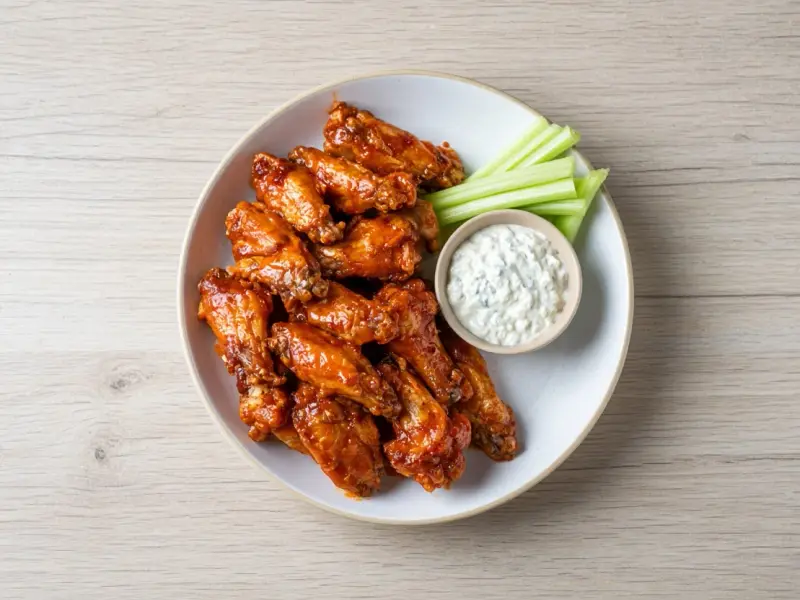
Deep, uneven gold with visible blistering and small dark points at the tips and along the ridge of the flat. The skin should look tight and slightly shrunken back from the bone at the narrow end. A pale, smooth, evenly coloured wing has steamed rather than crisped, whatever the timer says.
- And it feels like
The shell cracks rather than tears, and the meat pulls off the bone in one piece with light pressure. Wings are done for safety long before this and the target is texture, not temperature — the connective tissue only softens above about 80C.
- Food safety
Wings cooked to the described appearance are well past any safe threshold; the standard figures of 74C/165F (USDA) or 70C for two minutes / 75C instantaneously (UK Food Standards Agency) are exceeded comfortably by minute fifteen. The real hazards here are cross-contamination from the raw wings and the bowl they were tossed in, and the fact that the fridge stage means raw chicken sitting uncovered — put it on the bottom shelf, on a plate that catches drips, with nothing under it.
- Where it goes wrong
- Using bicarbonate of soda instead of baking powder, which tastes soapy and metallic.
- Crowding the basket. Wings release a lot of steam and a full basket cooks them in it.
- Skipping the uncovered fridge stage, which is where half the surface drying happens.
- Running one high temperature throughout, so the skin sets before the fat under it has rendered.
- Saucing early, or saucing wings that will not be eaten straight away.
- Not drying the fold at the joint, which stays wet and pale.
- If it does go wrong
Flabby skin: overcrowded basket, or the low stage was skipped. Soapy taste: bicarbonate of soda instead of baking powder, or too much of either. Burnt outside, chewy inside: the whole cook ran at 200C. Wings stuck to the basket: they went in before the machine was up to temperature. Sauce sliding straight off: the wings were too hot and the butter split — let them stand thirty seconds before tossing.
- Making it ahead
The powdering and the fridge stage are genuinely better done the night before. Cook and sauce at the last minute.
- Keeping it
Unsauced, three days covered in the fridge. Sauced wings do not keep well — the coating goes from wet to gluey.
- Reheating
Six minutes at 190C/375F in the air fryer recovers most of the crispness on unsauced wings, which is the argument for saucing only what will be eaten.
- Freezing
Cooked and unsauced they freeze for up to two months and reheat straight from frozen at 180C/350F for about twelve minutes.
- Leftovers
Cold wings are good, but the skin is gone; strip the meat for a sandwich rather than trying to revive it.
- Scaling it
By batch. A 4-litre basket takes about 500g in one layer, so 1kg is already two runs on most domestic machines; hold the first batch in a 120C oven and give it two minutes back at 200C at the end.
- Substitutions
Any vinegar-based hot sauce works in the butter, though a thick sweet chilli-style sauce does not — sugar plus hot skin makes something sticky rather than crisp. Whole wings can be used unsplit; they need about five minutes longer and colour less evenly. Marge or a dairy-free spread stands in for butter with some loss of body in the sauce.
- Dietary swaps
Contains milk from the butter. The wings themselves, before saucing, contain no declared allergens and are dairy free, gluten free, egg free and nut free — though most commercial hot sauces should be checked, since a few contain wheat or celery.
- Shopping for it
Larger wings crisp better than very small ones, which dry out before they colour. Frozen wings work if thawed completely and dried very thoroughly.
- Keeping the cost down
Buy wings whole and joint them yourself — the tip makes stock, and whole wings are usually cheaper per kilo than pre-split ones.
- Sustainability
Wings are an offcut, so cooking them is using a part of the bird that would otherwise be under-eaten.
- Nutrition
Fatty and salty, which is the point. The air fryer version has considerably less added fat than the deep-fried one, though the fat that matters most here was always in the skin.
- Worth it?
The one thing an air fryer does better than a domestic oven, clearly and repeatably.
Where it comes from
- Origin
Buffalo, New York, for the sauce. The method is an appliance technique with no origin worth claiming.
- Also called
Buffalo wings.
- What the name means
Named for the city, not the animal — a point of confusion frequent enough to be worth stating.
- History
The usual account puts the buffalo wing at the Anchor Bar in Buffalo, New York, in 1964, made by Teressa Bellissimo, and the bar has long promoted that version. It is not the only claim within the city and the details have shifted between tellings over sixty years, so it is best treated as the received story rather than a settled fact. What is clear is the trajectory: wings went from a cheap offcut to a national bar staple in the United States within a couple of decades, always deep fried, and the domestic versions — oven, then air fryer — are attempts to get close to that without a fryer.
- Why it matters
In the United States wings are game-day food, eaten in quantity with the hands, and one of the few dishes that is essentially communal. The air fryer version is what made them a plausible thing to cook at home on a weeknight.
- When it is eaten
Sport on television, parties, and anything eaten standing up.
- The traditional way
Deep frying at around 190C, then tossing in a butter-and-hot-sauce emulsion.
- How it changed
The fryer became an oven and then a basket. The baking powder trick is a domestic-cooking innovation that has no equivalent in the fried original, where the crust comes from the oil.
- Regional variations
Beyond buffalo there are dry-rubbed wings, soy-and-garlic wings across east Asia, and the double-fried Korean style with a thin glaze — all of which want different treatment from this method.
- How this version differs
Two temperature stages rather than one. Most air fryer wing recipes run a single high heat for twenty-odd minutes, which browns the skin before the fat beneath it has rendered out.
- Sources and credit
The baking powder technique for crisp chicken skin was popularised through American food-science recipe writing in the 2010s rather than invented in any one kitchen.
Related recipes
 Air Fryer Chicken Breast
 Air Fryer Chicken Thighs
 Air Fryer Whole Chicken
 Buffalo Wings
 Chicken à la King
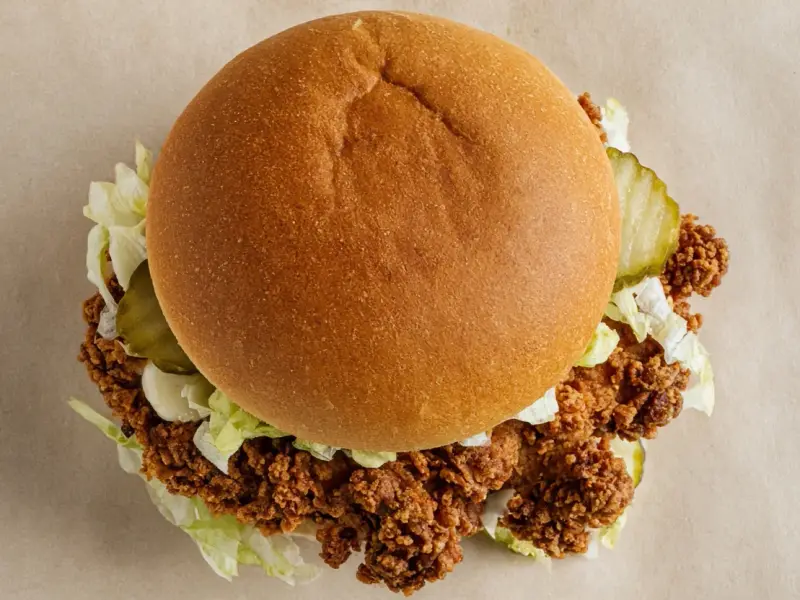 Chicken Burger
Categories
Cuisines
 American
Courses & dish types
 Main courses
Main ingredients
 Chicken
Techniques & equipment