Tvorog
Творог
Fresh curd cheese drained from gently warmed soured milk, the base several Russian sweet and baked dishes are built on.
- Prep
- 15 min
- Cook
- 40 min
- Resting
- 12 hr 20 min
- Total
- 13 hr 15 min
- Serves
- 6
- Revisions
- 5
Allergens
- Milk
Named from the ingredients as written, including those carried in from sub-recipes. This is not a guarantee — check the labels on what you actually buy, and note that a product’s recipe can change.
Ingredients
Serves
Method
Warm the milk in a heavy pan to 40C/105F, which is about blood heat and should feel neutral against the inside of your wrist.
Whisk in the buttermilk.
Cover the pan and leave it somewhere warm at 22-24C/72-75F for 12-18 hours.
It is soured and ready when it has set to a soft junket that pulls away from the side of the pan in a clean sheet, with a rim of clear yellowish whey around the edge.
Set the pan over the lowest heat you have, or stand it in a wider pan of hot water if your hob runs hot.
Bring it up very slowly to 40-45C/105-115F over 30-40 minutes, moving it once or twice with a spatula rather than stirring.
Watch for the curd to shrink into distinct soft lumps and for the whey to turn from milky to a clear greenish yellow.
Never let it reach a simmer, and take it off before 50C/120F if you are in doubt. Curd cooked hot tightens into rubbery squeaking grains that no amount of resting or mashing will soften again, and this is the single most common way home tvorog is ruined.
Take the pan off the heat and leave it undisturbed for 20 minutes so the curd firms.
Line a colander with a double layer of muslin and stand it over a deep bowl.
Ladle the curd in gently, keeping the lumps as whole as you can.
Gather the corners of the cloth loosely and hang it from a wooden spoon laid across the bowl, or simply leave it slumped in the colander.
Drain for 2-4 hours at cool room temperature, or overnight in the fridge for a drier curd.
Let gravity do all of it. Squeezing or twisting the cloth forces the fine curd out through the weave and compacts what stays behind into a dense putty, where drained tvorog should stay loose and crumbly.
Stop when the drips have slowed to one every few seconds and the curd holds its shape when the cloth is opened.
Turn it into a container and refrigerate.
Keep the whey. It is mildly acidic and makes a good liquid for oladyi, blini or bread.
Use the tvorog within three or four days, and be aware it goes on drying and sharpening in the fridge.
Where tvorog is not sold, full-fat cottage cheese drained in muslin for an hour and then pushed through a sieve is the closest common substitute; quark works too, but it is smoother and gives a denser result in baking.
Nobody has rated this recipe yet.
Sign in to rate this recipe. One rating per person, and you can change it.
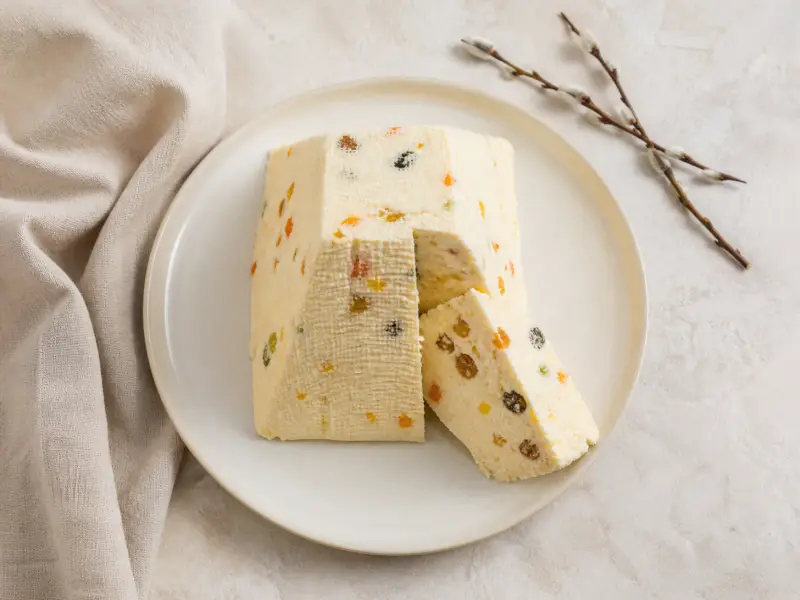 Paskha
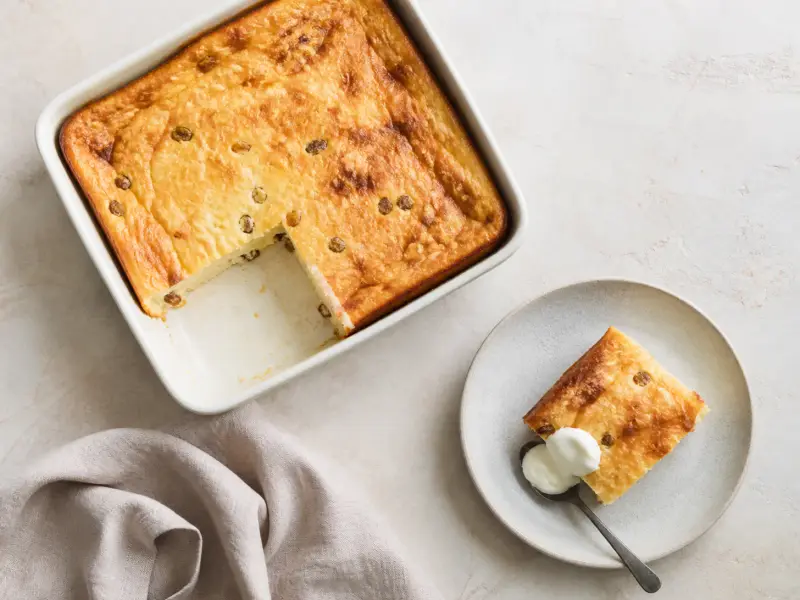 Zapekanka
 Buckwheat Kasha with Mushrooms
 Medovik
 Mushroom Julienne
 Oladyi
 Syrniki
 Vareniki