Pesto Pasta
Pesto is never cooked. It goes into a warm bowl with pasta water and the drained pasta, off the heat entirely, or the basil turns brown and bitter.
- Prep
- 5 min
- Cook
- 12 min
- Total
- 17 min
- Serves
- 4
- Revisions
- 1
Allergens
- Cereals containing gluten
- Milk
- Nuts
Named from the ingredients as written, including those carried in from sub-recipes. This is not a guarantee — check the labels on what you actually buy, and note that a product’s recipe can change.
Ingredients
Serves
Pasta
To finish
Method
Pasta
Bring a large pan of well-salted water to the boil.
If you are using them, add the diced potatoes and cook for 5 minutes before the pasta goes in.
Add the pasta, and the green beans for the last 4 minutes. Cooking all three in one pan is the Ligurian way of eating pesto and it is better than pasta alone.
Two minutes before draining, put the pesto in a large serving bowl and stand the bowl over the pan to warm through.
Save two mugfuls of the cooking water, then drain.
To finish
Loosen the pesto with 4 tablespoons of the hot water and stir it to a smooth, pourable cream.
Add the drained pasta and vegetables to the bowl and turn everything over until coated, adding more water a splash at a time until it is glossy rather than claggy.
The bowl never goes near the hob. Pesto heated in a pan goes from bright green to khaki within a minute, the basil turns bitter and the cheese in it splits; the heat of the pasta and the water is all it should ever get.
Serve at once with the Parmesan at the table.
Nobody has rated this recipe yet.
Sign in to rate this recipe. One rating per person, and you can change it.
What to expect
- Taste
Green, sharp and grassy, with garlic heat and the salt of the cheese behind it. Good pesto tastes strongly of raw basil; anything muted or sweet has been heated or is old.
- Aroma
Basil, and it should be the first thing you smell. If it smells mainly of cheese and oil, the pesto is past its best.
- Texture
Slightly grainy from the nuts and cheese, with the pasta firm, the potato soft and the beans still squeaking. Three textures, which is the argument for the Ligurian version.
- Sound
None. It is the quietest recipe here.
- How the flavour moves
Basil first and immediately, then garlic, then a salty savoury finish from the cheese. Very direct, with no long tail.
- Serve it
Warm rather than hot, which is correct — pesto served scalding has already lost.
- Goes with
Tomato salad, or nothing. A crisp white — a Vermentino if you want the region.
Cook's notes
- Difficulty
Beginner, with one rule.
- Cost
Low, or mid if the pine nuts are counted.
- Equipment
One large pan and a serving bowl big enough to toss in.
- When to make it
Any night, in the time the pasta takes.
- Best season
Basil is a summer herb and pesto made with it in August is a different sauce from one made in February.
- You know it is done when
The sauce should stay bright green. Any drift towards khaki or olive means it has been heated, and the flavour will have gone the same way.
- And it feels like
Glossy and coating, with nothing claggy. Pesto straight from the jar onto pasta is thick and pasty; loosened with water it becomes a sauce.
- Food safety
Nothing unusual.
- Where it goes wrong
- Heating the pesto, which turns it khaki and bitter within a minute.
- Adding it straight from the jar without loosening it, which gives a pasty coating rather than a sauce.
- Draining without saving water.
- Cooking the potatoes and pasta separately, which loses the starch and an extra pan for nothing.
- Adding salt. Pesto is already salty and jarred pesto much more so.
- If it does go wrong
Claggy: more hot water, added a splash at a time while tossing. Dull or khaki: it was heated, and there is no recovery. Flat: lemon juice, and black pepper. Too salty: more pasta, no more cheese.
- Making it ahead
The pesto, up to a week ahead under oil. Nothing else.
- Keeping it
Best eaten immediately. The pesto itself keeps a week in the fridge under a film of oil.
- Reheating
Not really. Cold pesto pasta is a legitimate salad; reheated pesto pasta is a khaki disappointment.
- Freezing
Pesto freezes well, in ice cube trays, without its cheese. The finished dish does not.
- Leftovers
Cold, with halved cherry tomatoes and more lemon, as a salad.
- Scaling it
Doubles easily, given a big enough pan and a big enough bowl to toss in.
- Substitutions
Trofie is the traditional shape and any short twisted pasta works. Linguine is the other traditional choice. A jarred pesto is fine and will need more loosening and probably some lemon; it is also usually much saltier, so taste before adding anything.
- Dietary swaps
Contains gluten, milk and nuts, the last two from the pesto rather than from anything else here. Vegetarian only if the pesto's hard cheese is rennet-free, which Parmigiano Reggiano is not. Egg free with dried pasta.
- Shopping for it
Basil in quantity is cheaper from a greengrocer or an international grocer than in supermarket pots. Buy a bunch rather than four plastic packets.
- Keeping the cost down
Pine nuts are the expensive ingredient in pesto by a wide margin; walnuts or almonds cost a fraction and make a good sauce.
- Sustainability
Nearly all plant-based and one of the lightest meals in this collection. The two things carrying real footprint are the cheese and the pine nuts, most of which are imported long distances and are among the more resource-intensive nuts. Walnuts, suggested above for cost, are also the lower-impact choice and are traditional in parts of Liguria. Basil bought as a bunch rather than in plastic pots cuts both packaging and the waste of a plant that dies in a week.
- Nutrition
The oil and cheese carry the fat. The potatoes make it more filling than pasta alone.
- Worth it?
Keep it off the heat and loosen it with pasta water. Two rules, thirty seconds, and it stops being green paste.
Where it comes from
- Origin
Genoa and the Ligurian coast.
- Also called
Pesto alla genovese; the full dish is often trofie al pesto.
- Said out loud
PEST-oh alla jen-oh-VAY-zeh.
- What the name means
From pestare, to pound or crush — a description of the mortar rather than of the ingredients. The same root gives pestle.
- History
Pounded sauces of herbs, garlic, oil and cheese are old across the Mediterranean, and the Genoese version with basil is documented from the mid-nineteenth century. Genoa's basil, particularly from Prà, is prized for being small-leaved and mild rather than aniseedy, and the DOP Genovese basil designation exists for that reason. The potatoes and green beans are traditional to the dish rather than a modern addition.
- Why it matters
One of a small number of Italian regional sauces that became globally ubiquitous, and one of the most frequently misrepresented — jarred pesto is a very different product from the pounded original.
- When it is eaten
Everyday food, and the fastest good meal in this collection.
- The traditional way
Pounding in a marble mortar with a wooden pestle, which bruises the basil rather than cutting it. A blender's blades heat and oxidise the leaves, which is why blended pesto darkens faster.
- How it changed
Mortar to blender to jar, with each step costing something. The dish itself has hardly changed at all.
- Regional variations
Pesto rosso from Sicily uses sun-dried tomatoes and almonds; pesto alla trapanese uses almonds and fresh tomato. Both are different sauces rather than variants.
- How this version differs
It uses the Basil Pesto recipe already on this site as a sub-recipe rather than repeating it, and it keeps the potatoes and beans, which most non-Italian versions drop.
- Sources and credit
No individual; Genoa collectively.
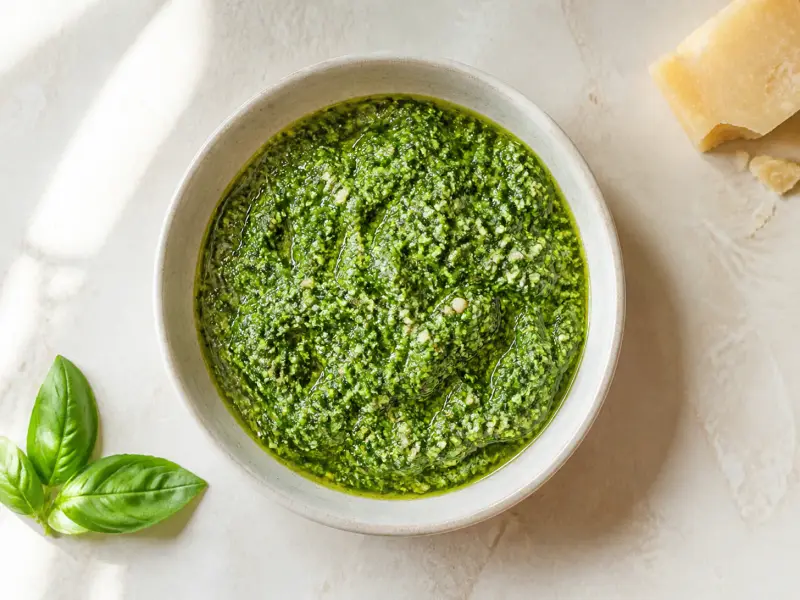 Basil Pesto
 Spaghetti Aglio e Olio
 Cacio e Pepe
 Pasta alla Norma
 Pasta e Fagioli
 Spaghetti Carbonara
 Baked Feta Pasta
 Italian
 Pasta
 Main courses
 Vegetarian
 15 minutes