Mushroom Risotto
Risotto ai funghi
Carnaroli rice cooked in stock a ladle at a time and beaten with butter at the end, so it spreads on the plate rather than sitting in a heap.
- Prep
- 15 min
- Cook
- 35 min
- Resting
- 20 min
- Total
- 1 hr 10 min
- Serves
- 4
- Revisions
- 6
Allergens
- Celery (via Chicken Stock)
- Milk
- Sulphites
Named from the ingredients as written, including those carried in from sub-recipes. This is not a guarantee — check the labels on what you actually buy, and note that a product’s recipe can change.
Ingredients
Serves
Method
Warm the stock in a pan and pour 250ml of it over the dried porcini in a bowl.
Soak the porcini for 20 minutes, until they are soft right through.
Lift the porcini out, squeeze them over the bowl and chop them roughly.
Pour the soaking liquid back into the stock through a fine sieve, leaving the last spoonful behind in the bowl. Dried mushrooms carry grit, and it settles at the bottom.
Hold the stock at a bare simmer on a back burner for the whole of the cooking. Cold stock ladled into hot rice drops the pan off the boil every time and the grains stop cooking while it climbs back.
Set a wide frying pan over high heat for 2-3 minutes, until a flick of water skitters and vanishes.
Add the olive oil, then the fresh mushrooms in a single layer with bare metal between the pieces, working in two batches if they will not fit. A crowded pan cannot let their water evaporate and they steam themselves grey, which the mushrooms on toast in this collection sets out at length.
Sear for 4-5 minutes, turning once, until deeply browned at the edges, then tip them onto a plate.
Melt the 20g of butter in a heavy, wide pan over medium-low heat.
Cook the diced onion for 6-8 minutes, stirring, until it is soft and translucent with no colour on it at all.
Add the rice and stir for 2-3 minutes, until the grains are hot to the touch, glassy at the edges with a white dot at the centre, and smell faintly toasted.
Do not skip that toasting. It firms the outside of each grain so it can take half an hour of stirring without breaking down into porridge.
Pour in the wine and stir until it has all but disappeared and the sharp smell has gone, about 1-2 minutes.
Add a ladleful of hot stock, roughly enough to just cover the rice, and the 4g of fine salt.
Stir until a spoon dragged across the base leaves a trench that holds for a second before the liquid closes over it, then add the next ladle.
Stir often but not frantically. The point of the stirring is agitation: rubbing the grains against each other and the pan is what pulls their starch out into the liquid, and that suspended starch is the whole sauce. A pan stirred every twenty seconds does as well as one stirred without pause, and a pan left alone gives you rice sitting in stock, then a scorched base.
Carry on ladle by ladle for 16-18 minutes, keeping the pan at a steady, gentle bubble rather than a hard boil.
Start tasting at 14 minutes. A grain should be tender all the way through with a firm point at the very centre, and no chalk in it.
Stop while it is a shade underdone and looser than you want to eat it, because it goes on cooking and tightening in its own heat between the pan and the table.
Take the pan off the heat and stand it for 1 minute.
Beat in the cold butter and the parmesan hard with a wooden spoon for 30-60 seconds, until the risotto turns glossy and comes together as one mass.
Loosen with a last splash of hot stock until a spoonful dropped back into the pan spreads slowly instead of holding its shape.
Fold through the seared mushrooms, the chopped porcini and the parsley.
Season with the ground peppercorns and taste for salt, bearing in mind how the stock was seasoned.
Serve into warm shallow bowls straight away. Risotto held for five minutes sets into a solid mound and no amount of stirring brings the wave back.
Note that the paella in this collection does the opposite at every step: same short-grain family, never stirred, and dry separate grains are the aim.
Nobody has rated this recipe yet.
Sign in to rate this recipe. One rating per person, and you can change it.
What to expect
- Taste
Deeply savoury and earthy from the combination of dried porcini's concentrated umami and the fresh seared mushrooms' own browned flavour, carried in a base of sweet, mellow onion and rice that's taken on the stock's own savouriness gradually over the course of cooking. The parmesan and butter beaten in at the end add a rounding richness and a faint saltiness that ties the whole dish together, with the white wine's acidity a background note rather than a forward one.
- Aroma
Deeply earthy and savoury from the moment the porcini are soaking, intensifying as the fresh mushrooms sear and brown; the finished dish smells rich and buttery on top of all of that, from the mantecatura stage.
- Texture
Creamy and fluid from the released rice starch, with each individual grain still holding a firm bite at the centre — the whole point of good risotto is this exact tension between a creamy suspension and grains that are individually still al dente. The seared mushrooms add a firmer, chewier contrast against the soft rice.
- Sound
A continuous, steady scrape of a wooden spoon against the pan through the whole cooking time, and a soft, wet sizzle each time a fresh ladle of stock goes in.
- How the flavour moves
The savoury, buttery richness of the mantecatura arrives first on the palate, the mild rice and stock flavour filling the middle, and the deep, earthy mushroom flavour building through the finish as the seared pieces are chewed rather than announcing themselves immediately.
- Serve it
Served immediately and very hot — risotto cools and stiffens quickly, and its whole textural appeal depends on eating it within moments of it leaving the pan.
- Goes with
A simple green salad to cut the richness, and nothing more elaborate — this is a dish that wants to be the centre of the plate rather than sharing it with a heavy main alongside.
Cook's notes
- Difficulty
Moderate. Nothing is technically hard, but it needs real, continuous attention for the better part of twenty minutes, and it cannot be left to look after itself.
- Cost
Moderate — dried porcini and parmesan are the two costlier ingredients, with the rice, fresh mushrooms and stock comparatively cheap.
- Equipment
A wide, heavy pan for the rice, a separate frying pan for searing the fresh mushrooms, and a ladle.
- When to make it
Any season, though it suits an autumn or winter meal particularly well given the mushrooms' character.
- Best season
Fresh mushrooms are available year-round, though wild varieties peak in autumn.
- You know it is done when
The finished risotto should look loose and glossy, spreading slowly when the pan or plate is tilted rather than holding a mounded shape.
- And it feels like
Tender all the way through with a firm point right at the centre of the grain and no chalky undercooked core; it should be a shade looser than you want to eat it when it comes off the heat, since it continues tightening as it stands.
- Food safety
Nothing beyond ordinary hygiene; dried mushrooms should be strained through a fine sieve since they often carry grit that settles at the base of the soaking liquid.
- Where it goes wrong
- Adding cold stock, which drops the pan's temperature and stalls the cooking every time.
- Crowding the fresh mushrooms in the pan, which steams rather than sears them.
- Stirring too little, which fails to release enough starch for a creamy result, or stirring so hard and constantly that the rice breaks down into porridge.
- Letting the finished risotto sit before serving, which sets it into a solid mound that cannot be loosened back to a proper wave.
- If it does go wrong
Too thick or gluey: it needed more stock stirred in, or it stood too long before serving. Undercooked, chalky centre: not enough total cooking time or the stock wasn't hot enough. Grey, steamed mushrooms: the searing pan was overcrowded.
- Making it ahead
Cannot really be made ahead and reheated successfully; the porcini can be soaked and the fresh mushrooms seared in advance, but the rice itself should be cooked to order.
- Keeping it
Not a dish that keeps or reheats especially well; it is best made and eaten in one sitting.
- Reheating
Loosen with a splash of hot stock or water and warm gently, accepting that the texture will never fully return to its original looseness.
- Freezing
Not recommended — the texture that defines a good risotto does not survive freezing and thawing.
- Leftovers
Cold leftover risotto is traditionally reshaped into arancini or supplì, fried rice balls, which is a genuinely better second use than trying to reheat it as risotto again.
- Scaling it
Doubling is possible but makes the stirring and temperature management considerably harder in one pan; it's often more reliable to cook two batches in parallel than one very large one.
- Substitutions
Arborio can substitute for carnaroli, though carnaroli holds its shape slightly better through the long stirring. Any mix of fresh mushrooms works in place of chestnut and oyster; dried porcini specifically is worth keeping for the depth it brings, though other dried mushrooms could stand in.
- Dietary swaps
Vegetable stock in place of chicken makes this vegetarian; a plant-based butter and cheese alternative would make it vegan, though the finish relies heavily on parmesan and butter for its characteristic richness and glossiness. Naturally gluten-free, since rice needs no flour anywhere in the method.
- Shopping for it
Carnaroli rice, where available, holds its structure through the stirring slightly better than arborio; good dried porcini, rather than a cheap, dusty bag, makes a real difference to the depth of the soaking liquid.
- Keeping the cost down
Dried porcini and parmesan are the priciest items but both go a long way in small quantities; the fresh mushrooms and rice are comparatively inexpensive.
- Sustainability
A largely plant-based main course when made with vegetable stock, with only a modest amount of dairy and no meat beyond the optional chicken stock.
- Nutrition
A rich, moderately substantial dish owing to the butter and parmesan finish, balanced by the vegetable content of the mushrooms.
- Worth it?
One of the most technique-dependent dishes in the collection, and one where the difference between a good and a mediocre result is almost entirely down to attention rather than ingredients.
Where it comes from
- Origin
Northern Italy — Lombardy, Piedmont and the Veneto — where short-grain rice has been grown since the 15th century.
- Also called
Risotto ai funghi.
- Said out loud
ree-ZOT-toh eye FOON-gee.
- What the name means
Risotto derives from riso, rice, with the diminutive suffix -otto; funghi is simply the Italian for mushrooms.
- History
Rice cultivation in the Po valley dates back to the 15th century, but risotto as a specific slow, stock-fed cooking method has no traceable single origin date; it appears in northern Italian cookery writing during the 19th century as an already-established technique.
- Why it matters
Everyday food across Lombardy, Piedmont and the Veneto, traditionally eaten as a first course (primo) rather than a main, and now a restaurant standard worldwide in a way that has somewhat shifted its role from a course within a larger Italian meal to a standalone dish elsewhere.
- When it is eaten
An everyday first course in its home regions; more often treated as a complete meal outside Italy.
- The traditional way
Toasting the rice briefly in fat before any liquid is added, then adding hot stock gradually, ladle by ladle, with frequent stirring to release the rice's surface starch, finished with a mantecatura of cold butter and cheese beaten in off the heat.
- How it changed
The much-repeated saffron origin story for risotto alla Milanese, involving a glassworker at Milan's Duomo, is a 19th-century legend rather than a documented historical event, and is generally treated as contested by food historians rather than settled fact.
- Regional variations
Risotto alla Milanese, coloured and flavoured with saffron, is the most famous single regional version; risotto al nero di seppia, coloured black with cuttlefish ink, is a Venetian variation; countless other versions follow whatever vegetable, meat or seafood is regionally available.
- How this version differs
This version uses both dried porcini, soaked to build depth into the cooking stock itself, and fresh mushrooms seared separately so their texture survives being folded in at the end, rather than relying on one or the other alone.
- Sources and credit
No individual can be credited with inventing risotto; it is a regional cooking method rather than a single composed dish, and the popular saffron-origin legend for one of its most famous variants is explicitly contested rather than verified.
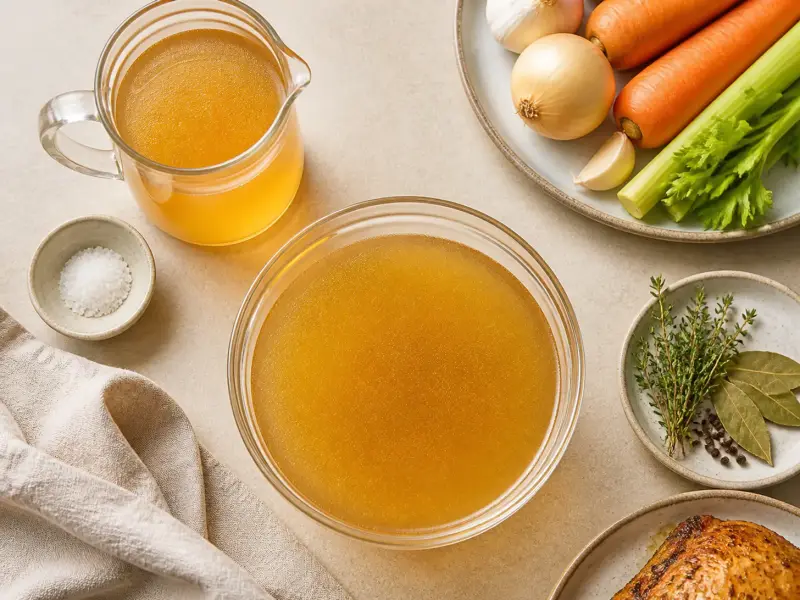 Chicken Stock
 Baked Lasagne
 Cacio e Pepe
 Classic Margherita Pizza
 Pork and Fennel Meatballs
 Potato Gnocchi with Sage Butter
 Spaghetti Carbonara