French Toast
Pain perdu
Pain perdu — lost bread, for the stale loaf it rescues.
Thick slices of stale bread soaked in an egg and milk custard, then fried in butter over medium heat so the centre sets without the crust burning.
- Prep
- 10 min
- Cook
- 20 min
- Resting
- 8 hr 20 min
- Total
- 8 hr 50 min
- Serves
- 4
- Revisions
- 5
Allergens
- Cereals containing gluten
- Eggs
- Milk
Named from the ingredients as written, including those carried in from sub-recipes. This is not a guarantee — check the labels on what you actually buy, and note that a product’s recipe can change.
Ingredients
Serves
Method
Use a loaf that is a day or two old, or cut the slices and leave them out uncovered overnight.
Do not treat stale bread as second best here. As a loaf stales its starch recrystallises and forces water out of the crumb, and that dry crumb is what draws the custard in — a fresh slice is already full of its own water, takes up almost none, and fries as buttery toast with a set skin on it.
Cut the slices a full 2.5cm thick. A thin slice has no middle to speak of and goes from raw to collapsed with nothing in between.
Beat the eggs in a large bowl until the yolks and whites are one colour with no ribbons of white left. Any white still in strands sets into rubbery threads on the surface of the finished slice, and there is no getting them off.
Whisk in the milk, caster sugar, vanilla, cinnamon and fine salt, until the sugar has dissolved.
Lay the slices in a large shallow dish or roasting tin in a single layer, without overlapping them, so every slice meets the custard at the same time.
Pour the custard over them.
Soak for 10 minutes.
Turn each slice over and soak for a further 10 minutes.
Judge the soak by the middle of the slice rather than the clock. Cut a corner off one if you are unsure: the custard should have reached the centre with no dry white core left, and the slice should feel heavy and sag a little when you lift it while still holding together.
Take them out at that point. Pulled early they fry into bread with a thin cooked skin over a dry crumb; left far past it the crumb dissolves and the slice breaks apart on the way to the pan.
Melt a third of the butter for frying with a little of the oil in a wide frying pan over medium heat. The oil raises the temperature the butter can take before its milk solids blacken.
Keep the pan at medium and no higher. The custard inside needs two or three minutes a side to set, and over a high flame the egg and sugar on the surface are dark brown within a minute with a raw wet middle behind them.
Lift three slices out of the custard, letting the excess run off, and lay them in the pan.
Fry for 3-4 minutes, until the underside is an even deep gold and the cut edge has stopped looking wet.
Turn each slice once with a fish slice.
Fry for a further 2-3 minutes, until the second side matches and the middle springs back under a finger rather than sinking.
Move the cooked slices to a rack in a 100C/212F oven while you fry the rest, rather than stacking them on a plate where their own steam softens the crust.
Wipe the pan out with kitchen paper between batches and add fresh butter and oil, since the milk solids left behind blacken and the next slices pick that up.
Cook the remaining slices the same way.
Stack two slices on each warm plate.
Set a knob of the cold butter on top of each stack and let it melt down between the slices.
Scatter the berries over.
Pour the maple syrup across.
Dust with icing sugar and serve straight away.
This is the vanilla custard in this collection in its plainest form, whole eggs instead of yolks, set inside the bread rather than thickened in a pan.
The everyday white tin loaf in this collection is the bread to cut it from. A close, tight crumb takes the soak and holds its shape, where a very open or airy loaf goes to pieces in the dish.
Nobody has rated this recipe yet.
Sign in to rate this recipe. One rating per person, and you can change it.
What to expect
- Taste
Sweet and eggy, with vanilla and cinnamon carrying most of the flavour through the custard, and the browned butter from frying adding a savoury, slightly nutty depth underneath the sweetness — a well-made version should taste distinctly of custard right through the slice rather than only at the surface.
- Aroma
A warm, sweet smell of vanilla and cinnamon as the custard cooks, with a rich, buttery aroma from the pan as the slices fry.
- Texture
A thin, evenly browned crust giving way to a custardy, almost bread-pudding-like interior that should still hold together as a slice rather than collapsing — the contrast between the crisp outside and the soft, saturated inside is the whole point of the dish.
- Sound
A steady, gentle sizzle as the slices fry, quieter than a hard sear since the pan is kept at only medium heat throughout.
- How the flavour moves
The browned butter's savoury note registers first from the crust, the custard's egg-and-vanilla sweetness follows through the soft interior, and the cinnamon lingers longest at the finish, especially where it has concentrated slightly at the surface during frying.
- Serve it
Served hot, straight from the pan or from the holding oven, since the custard centre firms up and loses some of its softness as it cools.
- Goes with
Maple syrup and butter are the classic pairing, with fresh berries adding acidity that cuts through the richness of the custard and butter both.
Cook's notes
- Difficulty
Easy, but genuinely dependent on the bread being properly stale and the soak being judged by feel rather than by the clock.
- Cost
Low — bread, eggs and milk are all inexpensive; the fruit and maple syrup served alongside are the main variable cost.
- Equipment
A large shallow dish for soaking, a wide frying pan, and a rack set in a low oven to hold cooked slices.
- When to make it
Breakfast or brunch, or as a simple pudding.
- Best season
Fresh berries are best in season through summer; frozen berries work reasonably well the rest of the year.
- You know it is done when
The soaked slice should feel heavy and sag slightly when lifted, without falling apart; the fried slice should be an even deep gold on both sides with no pale patches.
- And it feels like
The middle should spring back under a finger rather than sinking, which is the sign the custard inside has fully set rather than staying wet; a slice pulled from the custard too early fries with a thin cooked skin over a still-dry crumb, and one left too long in the soak falls apart on the way to the pan.
- Food safety
The custard contains raw egg before cooking, and the bread must be fried through fully so the egg inside is properly cooked rather than merely warmed — the springback test is specifically checking for this.
- Where it goes wrong
- Using fresh rather than stale bread, which is already full of its own water and takes up almost no custard.
- Cutting the slices too thin, which leaves no real centre for the custard to soak into.
- Frying over too high a heat, which browns the outside before the custard inside has set.
- Stacking freshly fried slices on a plate rather than holding them on a rack, which traps steam and softens the crust.
- If it does go wrong
Custard did not reach the centre: the bread was not stale enough, or the soak was too short — cut a corner off a slice to check before frying the whole batch. Outside burnt, middle still wet: the pan was too hot; turn it down and be patient, since this dish genuinely needs medium heat and a few minutes per side. Slices fell apart: they were left in the custard too long past the point the crumb could hold together.
- Making it ahead
The custard can be mixed ahead and refrigerated; staling the bread is itself a form of advance preparation, since it is deliberately done a day or more before cooking.
- Keeping it
Keeps in the fridge for a day or two, though the crisp fried surface softens considerably on storage.
- Reheating
Best reheated in a toaster or a dry pan rather than a microwave, which keeps more of the fried texture; a few minutes in a moderate oven also works well for reheating several slices at once.
- Freezing
Freezes well once fried, laid flat before stacking to prevent sticking; reheat directly from frozen in a toaster or oven.
- Leftovers
A genuinely good candidate for batch-cooking and freezing, since the reheat in a toaster recovers most of the original texture.
- Scaling it
Scales up easily by using more bread and more custard in the same ratio, cooking in batches and holding finished slices in a low oven while the rest are fried.
- Substitutions
Any sturdy white loaf can be used in place of the specific everyday white tin loaf referenced, provided it is genuinely stale — the staling, not the specific bread, is what makes the method work. Brioche or challah, richer in egg and fat already, are common restaurant choices because that existing richness helps hold the slice together through a long soak.
- Dietary swaps
Contains gluten, eggs and milk. Can be made dairy free with a plant milk in the custard, though the flavour and richness will change; not easily made egg free, since the eggs are what set the custard inside the bread.
- Shopping for it
A sturdy white loaf that can hold together through a long soak works better than a very soft, delicate one, which is more prone to falling apart.
- Keeping the cost down
This dish exists specifically to use up bread that would otherwise be thrown away once stale, making it one of the more naturally economical recipes in the collection.
- Sustainability
A genuinely good use for bread on the edge of being wasted, rather than a dish that requires buying anything specially.
- Nutrition
A good source of protein from the eggs and milk; the added butter, syrup and sugar contribute most of the richness and sweetness.
- Worth it?
A dish where patience with the soak, not the frying, makes the real difference between a thin, ordinary version and a genuinely custardy one.
Where it comes from
- Origin
No single origin; recorded across the late Roman world and medieval Europe independently, as a practical way to use bread too stale to eat plainly.
- Also called
Pain perdu, in French, literally lost bread.
- Said out loud
pan pair-DOO.
- What the name means
Pain perdu means lost bread — the dish exists specifically to rescue a loaf that has gone too dry to eat as it is, rather than describing any particular flavour or method.
- History
A version of bread soaked in milk and egg and fried appears in the Apicius collection from the late Roman period, and similar dishes under names meaning lost bread run through medieval European cookery, with no origin date or author documented for any of them. The English name French toast has no reliable documented explanation; a popular story crediting an American innkeeper named Joseph French with the name is widely repeated but rests on no supporting evidence and should be treated as folklore.
- Why it matters
Eaten at breakfast and as a pudding across Europe and the Americas, and closely tied in several places to specific times of year: torrijas in Spain during Holy Week, arme Ritter in Germany, and rabanadas in Portugal and Brazil at Christmas.
- When it is eaten
Breakfast and brunch generally, though several of its named regional versions are tied to specific religious or seasonal occasions rather than eaten year-round.
- The traditional way
Soaking stale, dried-out bread in an egg-and-milk custard long enough for it to reach the centre, then frying gently enough to set the custard without burning the crust.
- Regional variations
Torrijas in Spain, arme Ritter in Germany and rabanadas in Portugal and Brazil are all closely related dishes under different names, each tied to a specific occasion rather than eaten as a generic everyday breakfast; a savoury, spiced version also appears at Indian breakfast tables, a further departure from the generally sweet Western versions.
- Sources and credit
No individual is credited with inventing the dish; the Joseph French naming story is popular but unsupported by evidence.
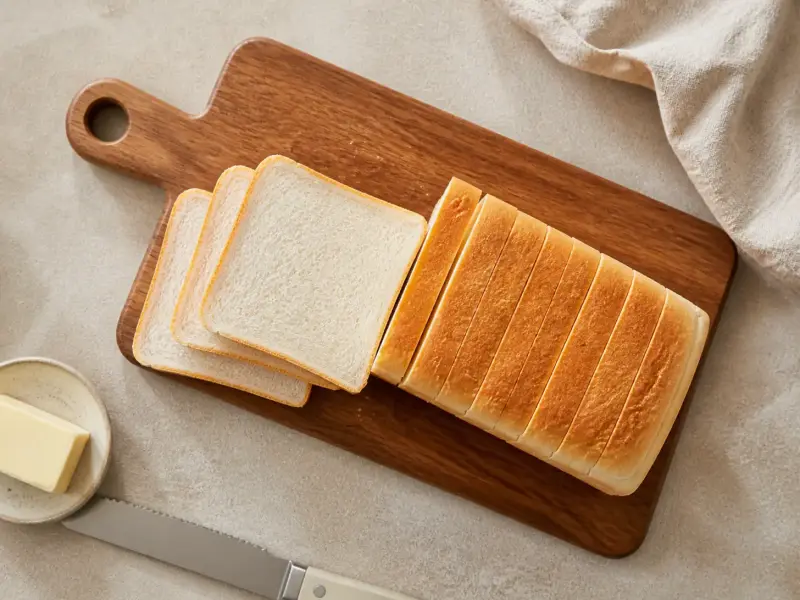 Everyday White Tin Loaf
 Classic French Omelette
 Apple and Almond Tart
 Buttermilk Pancakes
 Cinnamon Bun Concoction
 Creamy Oat Porridge
 Crème Caramel