Chocolate Chip Cookies
No browned butter and no overnight rest: creamed, scooped and baked within the hour, for a crisp edge against a soft chew in the middle.
- Prep
- 20 min
- Cook
- 12 min
- Resting
- 10 min
- Total
- 42 min
- Serves
- 24
- Revisions
- 1
Allergens
- Cereals containing gluten
- Eggs
- Milk
- Soya
Named from the ingredients as written, including those carried in from sub-recipes. This is not a guarantee — check the labels on what you actually buy, and note that a product’s recipe can change.
Ingredients
Serves
Method
Heat the oven to 180C/350F.
Line two baking trays with baking paper.
Beat the softened butter with both sugars for 2-3 minutes, until the mixture has lightened in colour and no longer feels grainy.
Use butter that gives under a finger but still holds its shape. Melted or half-melted butter is the single commonest reason cookies spread into one thin sheet, and there is no chill in this recipe to rescue it.
Beat in the whole egg until it disappears.
Beat in the egg yolk, then the vanilla.
The extra yolk is doing a job. It is fat and emulsifier with almost no water in it, so it keeps the middle chewy without adding the spread that a second white would bring.
Whisk the flour, bicarbonate of soda and fine salt together in a second bowl.
Fold the dry ingredients into the wet with a spatula until the last streak of flour goes.
Fold in the chocolate chips.
Roll the dough into 24 balls of about 40g and set them on the trays, twelve to a tray, leaving 5cm between them. They spread to roughly twice their width.
Bake one tray at a time on the middle shelf for 10-12 minutes, until the edges are set and golden and the middle 2cm still looks pale, puffed and underdone.
Take them out while the centres look raw. They go on cooking on the hot tray for several minutes, and a cookie that looks finished in the oven is dry and short by the time it has cooled.
Bang the tray down flat on the worktop once as it comes out. It collapses the puffed centres and gives the ridged, crinkled top.
Cool on the tray for 10 minutes, until the cookies are firm enough to move.
Lift them onto a rack to finish cooling.
Eat them the day they are baked, while the edge is still crisp against the chew. The brown butter chocolate chip cookies in this collection are the long way round the same idea: browned butter, chopped chocolate and a night in the fridge, for a darker and deeper biscuit that has to be started the day before.
Freeze the dough rolled into balls if you would rather bake a few at a time, and bake them from frozen with 2 minutes added.
Nobody has rated this recipe yet.
Sign in to rate this recipe. One rating per person, and you can change it.
What to expect
- Taste
Straightforwardly sweet and buttery, with brown sugar giving a light caramel and molasses note behind it and vanilla sitting across the top. The chocolate is the loudest single element and its character depends entirely on what went in — milk chips read as creamy and much sweeter, dark ones as bitter and more adult. Salt is high at 5g and it should be noticeable as definition rather than as saltiness; a cookie with too little salt tastes like sugar and nothing else. This is deliberately a simpler, sweeter flavour than the browned-butter version, which trades some of that directness for depth.
- Aroma
Butter, brown sugar and vanilla, arriving strongly in the last three minutes of baking. It is a shallower, sweeter smell than a browned-butter dough, which has a nutty, almost savoury edge this one does not.
- Texture
Two textures on purpose, and the contrast is the reason to eat one warm. The outer centimetre is crisp and slightly brittle; the middle is soft, dense and chewy and gives under the teeth without crumbling. The chips are soft and yielding while the cookie is warm and set and snappy once it is cold. The ridged top has a very slight sandiness to it from the sugar.
- Sound
A short crack at the edge when a warm cookie is pulled in half, and then nothing through the soft middle.
- How the flavour moves
Butter and sugar first and immediately, with no build-up at all — this is a cookie that gives everything in the first second, which is exactly what it is for. Chocolate arrives as soon as a chip is bitten and dominates the middle. Salt comes up behind it and cuts across. The finish is short, sweet and buttery and does not linger, which is precisely why a second cookie is as appealing as the first. The brown butter version in this collection reverses that: a longer, deeper, nuttier finish and less of an immediate hit.
- Serve it
Warm, about ten minutes out of the oven, when the chips are still soft and the middle has set just enough to hold. Cold it is a perfectly good biscuit and a noticeably less exciting one.
- Goes with
Cold milk, and it is not a joke — the fat and cold both cut the sugar. Coffee works. Nothing else is needed.
Cook's notes
- Difficulty
Easy. The only judgement in it is when to take the tray out, and the answer is earlier than looks right.
- Cost
Low.
- Equipment
Two baking trays, baking paper, a bowl and an electric whisk or wooden spoon. Scales, so the 40g balls come out the same size and bake at the same rate.
- When to make it
Any time, and specifically any time with under an hour available.
- Best season
None.
- You know it is done when
The edges are set and golden, and the middle 2cm still looks pale, puffed and visibly underbaked. It should not look ready. That is the cue.
- And it feels like
Soft and yielding in the middle straight from the oven, firm at the edge. The hot tray does several more minutes of cooking after it comes out, which is why the cookie is pulled early.
- Food safety
The dough contains raw egg and raw flour, neither of which should be eaten in quantity. Both are fully cooked in the finished cookie.
- Where it goes wrong
- Butter that is too soft or partly melted, which makes the cookies spread into a single sheet.
- Baking until the middle looks done, which gives a dry cookie once it has cooled.
- Baking two trays at once, which browns the lower one before the upper one has set.
- Scooping the balls by eye rather than weighing them, so half the tray is done before the other half.
- Moving them off the tray straight away, before they have set enough to hold together.
- If it does go wrong
Spread thin and flat, running into each other: the butter was too warm, or there was not enough flour, or the trays were still hot from the previous batch. Cool the trays between batches. Dry and short: overbaked. Cakey and pale: too much flour, or the butter and sugar were over-creamed so too much air went in. No crinkles on top: the tray was not banged down as it came out. Chocolate all sunk to the bottom of each cookie: the dough was too loose, which usually means warm butter again.
- Making it ahead
The dough freezes in balls and bakes from frozen, which turns this into a bake-two-cookies-on-a-weeknight recipe. That is more useful than making the finished cookies ahead.
- Keeping it
Airtight at room temperature for four days. They lose their crisp edge after the first day and become uniformly soft, which is not a fault so much as a different cookie.
- Reheating
Ten seconds in a microwave returns a cooled cookie to close to fresh and softens the chocolate again.
- Freezing
The dough freezes very well rolled into balls, in a bag, for three months, and is baked from frozen with 2 minutes added. This is the most useful thing to know about the recipe.
- Leftovers
Crumbled over ice cream, or sandwiched around it.
- Scaling it
Halves and doubles cleanly. A double batch is four trays baked in sequence and the trays must be cooled between batches, or the balls start spreading before they reach the oven.
- Substitutions
Chopped chocolate can be used instead of chips and gives pools and shards rather than distinct rounds, which is what the brown butter recipe here does deliberately. Chips are specified in this one because they hold their shape and this is the plain, familiar cookie. Light brown sugar can be dark for a heavier, chewier result.
- Dietary swaps
Contains cereals containing gluten, eggs, milk and soya, the last from the lecithin in most chocolate. Vegetarian, nut free as written, though chocolate chips frequently carry a may-contain-nuts warning and the packet should be checked for anyone with a real allergy.
- Shopping for it
Milk chips give the familiar, sweeter cookie of childhood; dark chips give a better balance against the two sugars. Either is legitimate and it changes the cookie considerably.
- Keeping the cost down
Own-brand chips are exactly right for this recipe. Unlike the brown butter version, where the chocolate is the feature, here it is one element among several and a premium bar is wasted.
- Sustainability
Cocoa certification is worth paying for and costs pennies per batch.
- Nutrition
A sweet biscuit. Twenty-four smaller cookies rather than twelve large ones is itself a portioning decision.
- Worth it?
The one to make when the point is having cookies rather than having the best possible cookie.
Where it comes from
- Origin
The United States, Whitman, Massachusetts.
- Also called
Toll House cookie, for the original 1938 recipe.
- What the name means
Named for the Toll House Inn, where Ruth Wakefield ran the kitchen.
- History
Ruth Wakefield published the recipe in 1938 and it appeared on Nestle chocolate packaging from 1939, an arrangement that made it one of the most widely distributed recipes ever printed. Her original called for a chopped semi-sweet chocolate bar; Nestle began selling purpose-made chips shortly afterwards, which is why the cookie is now named for a product that did not exist when it was invented. The frequently repeated story that Wakefield created the cookie by accident, expecting the chocolate to melt through the dough, is not supported by her own accounts and she described it as a deliberate recipe.
- Why it matters
Among the most made baked goods in the world and the default meaning of the word cookie in American English. The official state cookie of Massachusetts since 1997.
- When it is eaten
None. Everyday, lunchboxes, and the thing made when somebody wants something baked in the next hour.
- The traditional way
The creaming method, which is what Wakefield's original uses and what this recipe keeps.
- How it changed
Chips replaced chopped chocolate. Later refinements — browning the butter, resting the dough for a day or more, using bread flour, underbaking deliberately — came largely out of food writing in the 2000s and produced a distinct style of cookie rather than an improved version of this one.
- Regional variations
Endless, and mostly about ratios of brown to white sugar and how far the cookie is underbaked.
- How this version differs
It is deliberately the plain one. Against the brown butter chocolate chip cookies in this collection: no browning, no overnight rest, chips rather than chopped shards, a leaner 175g of butter to 275g of flour rather than 225g to 310g, one egg plus a yolk rather than two whole eggs, and 40g cookies rather than 60g. The result is a smaller, crisper-edged, sweeter, more immediate cookie that can be started and finished inside an hour. The two recipes should not be treated as versions of each other.
- Sources and credit
Ruth Wakefield, 1938, for the cookie itself.
Related recipes
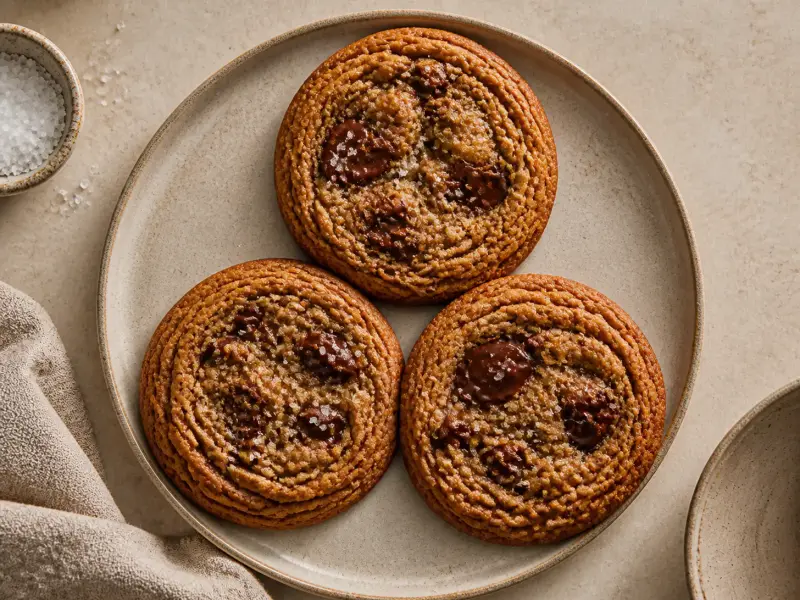 Brown Butter Chocolate Chip Cookies
 Chocolate Fudge Cake
 Dark Chocolate Brownies
 Millionaire's Shortbread
 Blueberry Muffins
 Carrot Cake
Categories
Cuisines
 American
Courses & dish types
 Baking
 Desserts
Main ingredients
 Chocolate
Diets
 Vegetarian