Bibimbap
Each vegetable seasoned and cooked separately, then arranged in its own section. The point is that everything tastes of itself until the moment it is stirred together.
- Prep
- 45 min
- Cook
- 30 min
- Total
- 1 hr 15 min
- Serves
- 4
- Revisions
- 1
Allergens
- Cereals containing gluten
- Eggs
- Sesame
- Soya
Named from the ingredients as written, including those carried in from sub-recipes. This is not a guarantee — check the labels on what you actually buy, and note that a product’s recipe can change.
Ingredients
Serves
Rice
Vegetables
To serve
Sauce
Method
Rice
Rinse the rice until the water runs clear, then cook it covered with 1.2 times its volume of water for 15 minutes and leave it covered off the heat for 10.
Vegetables
Wilt the spinach in boiling water for 30 seconds, drain, squeeze dry and dress with 1 tbsp sesame oil, a quarter of the garlic and a pinch of salt.
Blanch the beansprouts for 2 minutes, drain and dress the same way with sesame oil, garlic and salt.
Fry the carrot matchsticks in a little oil for 2 minutes with a pinch of salt and set aside.
Fry the shiitake with 1 tbsp soy sauce and a quarter of the garlic for 4 minutes until browned and set aside.
Fry the courgette for 2 minutes with a pinch of salt and set aside.
Season and cook each vegetable separately, and keep them separate. It looks like unnecessary work and it is the entire dish: bibimbap is not a stir fry, it is a set of individually seasoned components that meet for the first time in the bowl when the person eating it stirs them together. Cook them together and you have made something else.
Sauce
Mix all the sauce ingredients to a smooth pourable paste.
To serve
Fry the eggs in the neutral oil, spooning hot oil over the whites, so the whites are set with crisp lacy edges and the yolks are runny.
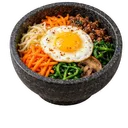
Divide the hot rice between four wide bowls and arrange the vegetables on top in separate sections around the edge, each keeping to its own wedge.
Sit an egg in the middle, scatter with sesame seeds, and serve with the sauce on the side for each person to add and stir in themselves.
Bibimbap means mixed rice, and the mixing is done at the table by whoever is eating it. Serving it pre-mixed removes the one moment the dish is named after.
Nobody has rated this recipe yet.
Sign in to rate this recipe. One rating per person, and you can change it.
What to expect
- Taste
Each mouthful is different before it is mixed and uniform after, which is the experience the dish is built around. Sesame runs through everything, the mushrooms are savoury and dark, the spinach is green and garlicky, and the gochujang brings sweet fermented heat.
- Aroma
Toasted sesame oil, which is the dominant smell and is used in almost every component.
- Texture
Crunchy beansprouts, soft spinach, tender carrot, chewy mushroom, sticky rice, runny yolk. Six textures on purpose.
- Sound
The egg frying, and nothing else.
- How the flavour moves
Before mixing, each wedge tastes of itself. After mixing, sesame, gochujang and egg yolk bind everything into one thing. That transition is the dish.
- Serve it
Hot rice, warm or room-temperature vegetables, hot egg. This is normal and correct — the vegetables are not meant to be served hot.
- Goes with
Kimchi, a clear soup, and barley tea. It is a complete meal.
Cook's notes
- Difficulty
Beginner in every step and long because there are many of them.
- Cost
Low.
- Equipment
A pan with a lid for the rice and a frying pan you will use six times.
- When to make it
A weekend, or a weekday if the vegetables were prepared in advance.
- Best season
None; the vegetables adapt to whatever is good.
- You know it is done when
Each vegetable keeping its own colour — bright green spinach, orange carrot, dark mushroom, pale green courgette, white beansprouts. If everything has gone the same colour they were cooked together.
- And it feels like
Vegetables tender but distinct, rice sticky enough to hold together when mixed.
- Food safety
The runny yolk is not fully cooked; anyone pregnant, very young, elderly or immunocompromised should use British Lion eggs or cook them firm. Cooked rice should be cooled quickly and refrigerated if kept, and eaten within a day.
- Where it goes wrong
- Cooking the vegetables together, which is the one mistake that changes the dish.
- Not squeezing the spinach, which waters the bowl.
- Long-grain rice, which will not hold together when mixed.
- Mixing it before serving, which removes the moment the dish is named after.
- Overdressing — each vegetable needs a teaspoon of sesame oil, not a tablespoon.
- A hard yolk, which is meant to be the sauce that binds everything.
- If it does go wrong
Watery: the spinach or beansprouts were not drained. Bland: each vegetable needs salt of its own; seasoning at the end does not reach them. Everything tastes the same: they were cooked together. Rice too dry to mix: it needed the covered rest, or a splash of water on reheating.
- Making it ahead
Excellent. The namul keep three days separately, so a weekend hour makes three weekday dinners.
- Keeping it
The dressed vegetables keep three days in the fridge separately, which makes this an excellent thing to prepare in advance.
- Reheating
The vegetables are good at room temperature and do not need reheating. The rice does.
- Freezing
No.
- Leftovers
The namul separately, as side dishes with anything.
- Scaling it
Linear, and easier at scale because the vegetables are done in sequence anyway.
- Substitutions
Any vegetables that can be individually seasoned — cucumber, radish, bracken fern in traditional versions. Short-grain rice matters: long-grain does not have the stickiness to hold a mixed bowl together.
- Dietary swaps
Contains soya, sesame, eggs and gluten from the soy sauce and most gochujang. Vegan without the egg. Tamari and a gluten-free gochujang make it gluten free. Nut free and dairy free.
- Shopping for it
Gochujang from a Korean or Asian grocer, where a tub costs a fraction of the supermarket price and lasts months in the fridge.
- Keeping the cost down
Cheap, and it is a good use of small amounts of several vegetables that need using.
- Sustainability
Almost entirely vegetables and rice, with one egg, which puts it among the lightest main courses in this collection. Its structure is genuinely useful for waste: it takes small quantities of whatever vegetables need using, seasoned the same way, and turns them into a composed dish rather than a scrape. Rice's own footprint from flooded paddies is the one real cost, and cooking the amount you will eat is the answer to that.
- Nutrition
Genuinely well balanced — a large quantity and variety of vegetables, rice, and an egg for protein.
- Worth it?
Six vegetables, six pans' worth of two minutes each, and none of them touching. It is the least efficient-looking recipe here and the reason it works.
Where it comes from
- Origin
Korea; Jeonju is the city most associated with it.
- Also called
Bibimbap.
- Said out loud
BEE-bim-bap.
- What the name means
Bibim means mixed and bap means cooked rice. The name is an instruction to the person eating it.
- History
Korean meals are built around rice with many small seasoned vegetable side dishes, banchan, and bibimbap is that structure collapsed into a single bowl. One long-standing account connects it to ancestral rites, where the food offered was afterwards mixed with rice and eaten; another to farmers eating from one bowl in the fields. Neither is firmly documented. Jeonju's version is the most famous and is a matter of considerable local pride, and dolsot bibimbap — served in a heated stone bowl that crisps the rice against the sides — is a restaurant variant rather than a household one.
- Why it matters
One of Korea's best-known dishes internationally and an everyday one at home, where it is often what happens to the week's leftover banchan.
- When it is eaten
An everyday meal, and specifically a way of using several small things at once.
- The traditional way
Namul — the individual seasoning of each vegetable, usually with sesame oil, garlic and salt — which is a whole category of Korean cooking rather than a step in this recipe.
- How it changed
Very little. The stone bowl version is the main modern addition.
- Regional variations
Jeonju bibimbap, with beef tartare and a distinctive set of vegetables. Dolsot bibimbap in a hot stone bowl.
- How this version differs
It is vegetarian and serves the sauce on the side, which is common in restaurants and lets each person judge the heat. The insistence on separate cooking is stated as the point rather than as a method note.
- Sources and credit
None.
 Air Fryer Tofu
 Cacio e Pepe
 Classic Margherita Pizza
 Korean Fried Chicken
 Pasta alla Norma
 Spaghetti Aglio e Olio
 Korean
 Main courses
 Dinner
 Vegetarian