Air Fryer Sausages
Sixteen minutes at 180C, turned twice, and a spoonful of water in the drawer underneath so the dripping fat cannot smoke you out of the kitchen.
- Prep
- 2 min
- Cook
- 16 min
- Total
- 18 min
- Serves
- 4
- Revisions
- 1
Allergens
- Cereals containing gluten
- Sulphites
Named from the ingredients as written, including those carried in from sub-recipes. This is not a guarantee — check the labels on what you actually buy, and note that a product’s recipe can change.
Ingredients
Serves
Method
Do not prick the sausages. The skin is what holds the fat and the juices in while the middle cooks, and a pricked sausage empties itself into the drawer and comes out shrunken and dry.
Pour the tablespoon of water into the drawer under the basket, where it cannot touch the food. Skip this if your model has a solid pan with no basket above it.
Fat drips through the basket onto hot metal and smokes there. A film of water underneath holds that surface below smoking point, and it is the whole difference between breakfast and a smoke alarm.
Heat the air fryer to 180C/350F.
Lay the sausages in a single layer with a gap between them, so the sides brown as well as the tops.
Cook for 6 minutes.
Roll each sausage a third of a turn with tongs and cook for 5 minutes.
Roll them again and cook for a final 3 to 5 minutes.
They are done when they are evenly browned all round, firm rather than yielding when squeezed with tongs, and a probe into the middle of the fattest one reads 75C/167F. Without a probe, halve one: the middle should be an even pale grey-brown, with no pink and nothing wet-looking at the centre.
Resist going hotter than 180C to save time. Above about 190C the skins split before the middles are cooked and everything worth eating runs out into the drawer.
Thin chipolatas are done at around 11 minutes and thick butcher's sausages can want 20, so treat 16 as the middle of a range rather than the answer.
Nobody has rated this recipe yet.
Sign in to rate this recipe. One rating per person, and you can change it.
What to expect
- Taste
Pork, salt and white pepper, in that order, with whatever the maker put in behind it — sage in a Lincolnshire, mace and nutmeg in a Cumberland, herbs and a coarser cut in most butcher's sausages. The fat carries most of the flavour and a lean sausage tastes noticeably duller. Browning adds a savoury, faintly caramelised note to the casing that boiled or oven-steamed sausages never develop, and that difference is most of the reason to bother with the turns.
- Aroma
The most recognisable smell in this collection and it arrives fast — within four minutes the kitchen smells like a fry-up. It changes character around ten minutes, from raw pork and fat to browned meat, and that shift is a usable cue.
- Texture
Snap, then coarse. A natural casing should resist for a moment and then give with a definite break; the interior should be dense and slightly coarse rather than smooth, with visible pieces of fat. A sausage cooked too hot has a split, leathery casing and a dry crumbly middle, and one cooked too gently is pale and soft all the way through with no snap at all.
- Sound
Genuinely loud for an air fryer. There is a sustained sizzle from about minute five, and occasional sharper spits as fat hits the drawer. If the sizzle turns into a continuous harsh crackle and the smell changes, that is the fat smoking and the drawer needs checking.
- How the flavour moves
Browned casing first, salty and savoury; then the fat, which fills the middle of the mouth and carries the pepper; then the meat itself, which is milder than the seasoning that surrounds it. The finish is fatty and long, which is why sausages want something sharp beside them — brown sauce, mustard, or a fried tomato.
- Serve it
Hot, immediately. Sausages hold heat well because of the fat, so they are more forgiving on the plate than most things in this batch.
- Goes with
Bacon, eggs and a bap. Mashed potato and onion gravy. Braised red cabbage. Mustard, and cheap strong tea.
Cook's notes
- Difficulty
The easiest recipe in this set. Two ingredients and three turns.
- Cost
Low, and entirely determined by what you pay for the sausages.
- Equipment
An air fryer with a basket sitting inside a drawer, which is the common domestic design and the one the water trick requires. Tongs. A probe thermometer if you have one.
- When to make it
Breakfast, or a weeknight with mash.
- Best season
None.
- You know it is done when
Evenly browned on every face, including the two sides that were not facing up at any point — which is what the third-turns are for. The casing should be taut and slightly wrinkled rather than smooth, and there should be no grey patches where a sausage was touching its neighbour. Cut through the fattest one and the middle should be uniformly pale grey-brown with no pink and nothing wet-looking.
- And it feels like
Firm rather than yielding when squeezed with tongs, with a slight springiness. A sausage that still feels soft in the middle is not there. The casing should have some snap to it if it is a natural one.
- Food safety
Pork sausages are minced meat, so surface bacteria have been distributed all the way through and the centre must be properly cooked — unlike a whole cut of pork, where the inside starts sterile. 75C/167F at the centre is a comfortable target and no colour test is as reliable. The other hazard here is the one the recipe is built around: fat smoking in a small enclosed chamber, which sets off alarms and, unchecked, is genuinely a fire risk in a machine with a full drawer of old fat.
- Where it goes wrong
- Pricking them, which empties them into the drawer.
- Running the machine hotter to save time, which splits the casings before the middles cook.
- Cooking them touching each other, so the contact faces stay grey and soft.
- Not turning them, which gives two browned faces and two pale ones.
- Cooking into a drawer that already has fat in it from last time, which is where most smoking incidents actually start.
- Trusting a published time across sausage thicknesses that vary by a factor of two.
- If it does go wrong
Machine smoking: no water in the drawer, or old fat in it. Split casings: too hot. Pale sides: not turned, or too close together. Pink in the middle: not long enough — go by temperature rather than time, since sausage thickness varies enormously. Dry and shrunken: they were pricked, or cooked at 200C.
- Making it ahead
Nothing to prepare. Cooked sausages reheat better than almost anything else in this batch, so batch cooking is genuinely worthwhile.
- Keeping it
Three days covered in the fridge.
- Reheating
Four minutes at 180C/350F in the air fryer, and they are almost as good as they were.
- Freezing
Cooked sausages freeze for up to two months and reheat from frozen at 180C in about ten minutes.
- Leftovers
Sliced cold into a salad, chopped into a Monday pasta, or split and fried into a sandwich.
- Scaling it
Eight standard sausages fit a 5-litre basket in one layer with gaps. More than that needs two runs — and gaps matter more here than in most recipes, because the sides need browning as much as the tops.
- Substitutions
Any sausage works, with the time changing by thickness rather than by variety: thin chipolatas around eleven minutes, standard sausages sixteen, thick butcher's sausages up to twenty. Chicken and vegetarian sausages both cook faster and render far less fat, so the water in the drawer matters less. Frozen sausages can be cooked from frozen at 180C for about twenty-two minutes, separated with a knife as soon as they loosen.
- Dietary swaps
Most British sausages contain wheat rusk and sulphite preservatives, and both are declared on the packet — read it rather than assuming, because the variation between brands is large. Gluten-free sausages are widely available and behave identically here.
- Shopping for it
A butcher's sausage with a high meat percentage browns better and shrinks less. Check the meat content on the packet, which is legally declared.
- Keeping the cost down
Cheap sausages have more rusk and water and shrink more; the difference in cooked weight narrows the price gap considerably, which is worth knowing before assuming the expensive ones are an indulgence.
- Sustainability
Sausages are a use for trimmings and lesser cuts, which is one of the better arguments for eating them.
- Nutrition
High in fat and salt, and this method removes a meaningful amount of the fat by letting it drip away, which frying in a pan does not.
- Worth it?
Better than a pan, with no spitting and no washing up, provided the drawer has water in it.
Where it comes from
- Origin
Britain, for this style of sausage.
- Also called
Bangers, colloquially — a wartime nickname earned by sausages with a high water content, which burst noisily in a hot pan.
- What the name means
Sausage comes from the Latin for salted. The nickname 'banger' is usually attributed to the First or Second World War, when rationing pushed cereal and water content up and the sausages genuinely did burst; the attribution is plausible and widely repeated rather than firmly documented.
- History
Sausages in some form are older than written cooking and exist across most food cultures as a way of using trimmings and extending meat. The modern British sausage — coarse-cut pork bound with rusk, seasoned regionally — took its current form over the nineteenth and twentieth centuries, and the rusk is the reason most British sausages declare wheat where many continental sausages do not. Named regional styles such as Cumberland and Lincolnshire carry their own seasoning conventions.
- Why it matters
Part of the full breakfast, of sausage and mash, and of toad in the hole — three of the most recognisable dishes in British home cooking. In an air fryer it is probably the single most-cooked thing in the country.
- When it is eaten
Breakfast, and any weeknight where dinner needs to be decided in two minutes.
- The traditional way
A pan over medium heat, turned often, for fifteen or twenty minutes. The air fryer does the same job with less attention and browns the sides more evenly.
- Regional variations
Cumberland is coiled, coarse and peppery; Lincolnshire is sage-forward; Gloucester Old Spot, Toulouse, bratwurst and dozens of others each want slightly different handling, though all of them cook in this machine.
- How this version differs
The water in the drawer, which most published air fryer sausage recipes do not mention, and which is the difference between this being pleasant and being the reason somebody stops using their air fryer indoors.
- Sources and credit
The water-in-the-drawer trick circulates widely among air fryer users rather than originating anywhere identifiable.
Related recipes
 Air Fryer Bacon
 Bacon and Egg Muffins
 Breakfast Burrito
 Creamy Oat Porridge
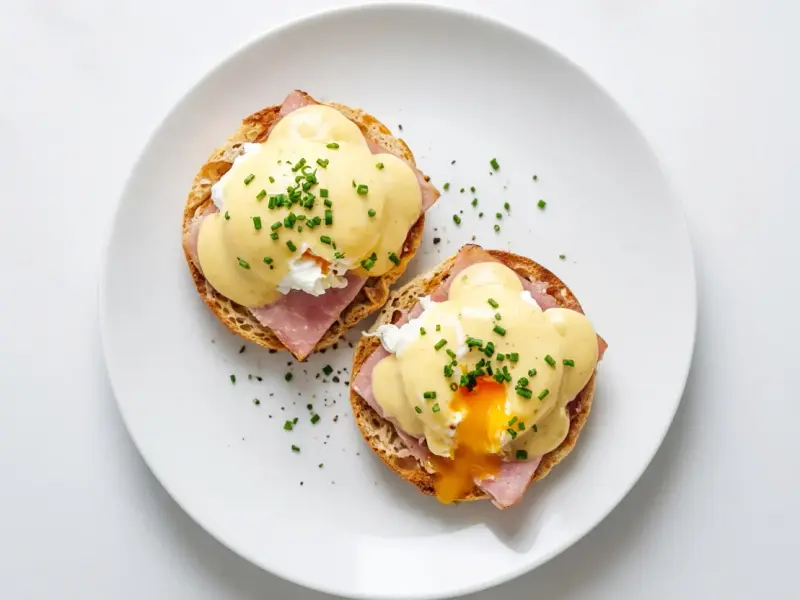 Eggs Benedict
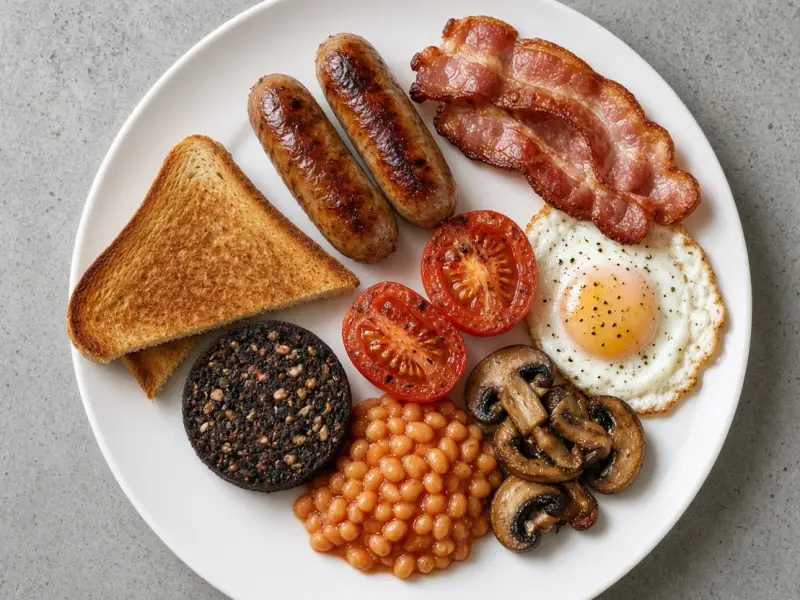 Full English Breakfast
Categories
Cuisines
 British
Courses & dish types
 Breakfast
Main ingredients
 Pork
Techniques & equipment
Time & effort
 30 minutes