Crème Caramel
Crème caramel
A baked custard turned out under its own caramel, cooked in a water bath at a low temperature so it sets smooth rather than pitted.
- Prep
- 25 min
- Cook
- 55 min
- Resting
- 4 hr 15 min
- Total
- 5 hr 35 min
- Serves
- 6
- Revisions
- 5
Allergens
- Eggs
- Milk
Named from the ingredients as written, including those carried in from sub-recipes. This is not a guarantee — check the labels on what you actually buy, and note that a product’s recipe can change.
Ingredients
Serves
Method
Put the 200g of caster sugar and the 60ml of water into a heavy pan and stir once to wet the sugar evenly.
Set the pan over medium heat and leave it alone.
Do not stir it again. A spoon dragged through boiling sugar syrup seeds it with crystals and the whole pan goes back to wet grit.
Brush any sugar off the sides of the pan with a wet pastry brush as it comes to the boil.
Boil for 6-8 minutes, until the syrup is the colour of dark honey and smells faintly bitter.
Judge it by colour rather than by the clock. Caramel goes from amber to black in about fifteen seconds, and it carries on darkening in the pan after the heat is off.
Pour the caramel straight into six 150ml ramekins and tilt each one to coat the base.
Work quickly and keep bare forearms clear of it. It sets within a minute and it is far hotter than boiling water, and it sticks to skin.
Heat the oven to 150C/300F.
Put the milk, cream and the vanilla seeds and pod into a pan.
Warm over medium heat for 4-5 minutes, until the surface trembles and steam comes off it.
Take the pan off the heat before it boils and leave it to infuse for 15 minutes.
Whisk the eggs, egg yolks, the 80g of caster sugar and the fine salt together until just smooth, stirring rather than beating. Foam whisked in now bakes as a layer of holes across what will be the top of the turned-out custard.
Pour the warm milk into the eggs in a thin stream, whisking constantly. That is tempering, which the vanilla custard in this collection sets out at length.
Strain the mixture through a fine sieve into a jug.
Skim any foam off the surface with a spoon.
Pour the custard into the ramekins over the set caramel.
Stand the ramekins in a deep roasting tin.
Pour the boiling water into the tin, around the ramekins, to come halfway up their sides. The water holds the outside of each custard at boiling point or below however hot the oven air gets.
Bake for 35-45 minutes, until the custards are set at the edge and wobble as one mass in the middle when you tap the side of a ramekin.
Check at 35 minutes. A baked custard taken past its point is pitted with holes and weeps water onto the plate, and there is no way back from it.
Lift the ramekins out of the water with a cloth and cool them on a rack for an hour.
Refrigerate for at least 4 hours, and overnight if you can, which is what turns the set caramel into a sauce.
Run a small knife around the inside of each ramekin.
Set a lipped plate over the top and invert the two together.
Lift the ramekin off and let the caramel run down over the custard.
Use a plate with a rim. There is more liquid caramel than you expect, and a flat plate sends it onto the table.
Keep the three egg whites this leaves in a covered container in the fridge for up to a week. The pavlova in this collection wants four.
Nobody has rated this recipe yet.
Sign in to rate this recipe. One rating per person, and you can change it.
What to expect
- Taste
Caramel first and it is bitter as much as sweet — sugar taken to dark honey has developed hundreds of compounds that raw sugar does not have, including genuinely bitter ones, and that bitterness is what stops the dessert being cloying. Then the custard, which is rich, eggy and only mildly sweet at 80g of sugar across six. Vanilla is the aromatic and a real pod gives a depth and a slight floral note that extract does not. Salt at 1g is invisible and load-bearing. The balance is between a very sweet, faintly burnt sauce and a barely sweet, savoury-edged custard, and the two halves need each other.
- Aroma
Caramel while it cooks, which goes through several stages in eight minutes — first plain sweetness, then a nutty toffee, then something distinctly burnt-sugar and faintly acrid, which is the moment to take it off. Then warm milk and vanilla during the infusion. The finished dessert is quiet and smells mostly of vanilla and cream.
- Texture
Smooth, dense and completely uniform, with no graininess and no bubbles. It should quiver as a single mass when the plate is moved and collapse entirely under a spoon. That combination — holding a shape and giving instantly — is the whole target and it is why the temperature control matters so much. Against it, the caramel is thin and liquid.
- Sound
Almost nothing. The caramel boils quietly and the only useful cue is visual. The dessert makes one sound and it is the small suck as the ramekin lifts off the turned-out custard, which is how you know it released cleanly.
- How the flavour moves
Caramel first — sweet, then bitter. Then the custard's richness spreading and softening it. Vanilla comes through the middle. The finish is eggy and faintly bitter, and it clears, which is what makes the second spoonful appealing. Across the whole ramekin the caramel gradually mixes in and the bitterness recedes.
- Serve it
Cold, from the fridge, and the caramel is at its most liquid then. Straight from the oven it is loose and cannot be turned out; at room temperature it is soft and sweeter-tasting, since cold suppresses sweetness perception.
- Goes with
Nothing, ideally. It is a complete dessert and adding cream or ice cream makes it heavy. A small strong coffee. A glass of something sweet and cold — a Sauternes, a Moscatel — if you want one. Where it fails is next to anything else creamy or caramelised, and after a very rich meal.
Cook's notes
- Difficulty
Two techniques, each easy and each with a narrow window: a caramel that goes from right to ruined in fifteen seconds, and a custard that goes from set to pitted in five minutes. Neither is hard and both need watching.
- Cost
Low. Sugar, milk, cream and eggs. A vanilla pod is the only real expense.
- Equipment
A heavy pan for the caramel, six 150ml ramekins, a deep roasting tin, and a fine sieve. The sieve is not optional — it catches the chalazae and any cooked egg and is the difference between smooth and not.
- When to make it
Any time of year. It is a good hot-weather dessert because it is served cold.
- Best season
None.
- You know it is done when
The caramel is the colour of dark honey and smells faintly bitter — and it keeps darkening off the heat, so pull it a shade early. The custard is done when it is set at the edge and the middle wobbles as one mass when the ramekin is tapped. A middle that ripples in waves is not set; a middle that does not move at all is overcooked.
- And it feels like
Smooth, dense and yielding, with no holes. A turned-out custard should hold a sharp edge and give completely under a spoon.
- Food safety
The custard is cooked and there is no raw-egg concern. Molten caramel is the genuine hazard here and it deserves plain language: it is at around 175°C, far hotter than boiling water, and it sticks to skin rather than running off. Keep forearms clear, do not let children near the pan, and never add water to hot caramel.
- Where it goes wrong
Stirring the caramel, which crystallises it. Taking the caramel too far, which happens in about fifteen seconds and gives a bitter, acrid sauce. Beating rather than stirring the eggs, which incorporates air that bakes as a layer of holes across what becomes the top of the dessert. Skipping the strain. Baking too hot or too long, which curdles the protein and gives a pitted, weeping custard. And turning it out too soon, before the caramel has had time to liquefy.
- If it does go wrong
Caramel gone grainy: it crystallised — add a splash of water, melt it down and start again, which works. Caramel bitter and black: too far, and nothing recovers it. Custard pitted with holes and sitting in water: overbaked; check at thirty-five minutes next time. Custard will not set: underbaked, or too much milk in proportion to egg — put it back in the oven. Will not release: run the knife round again and dip the base of the ramekin in hot water for ten seconds. Not enough sauce: it needed longer in the fridge.
- Making it ahead
It must be. Four hours minimum and overnight is better, because the caramel needs that time to turn into sauce. Three days in the fridge.
- Keeping it
Three days in the fridge in their ramekins. The caramel continues to liquefy, which is only an improvement.
- Reheating
Never. It is a cold dessert.
- Freezing
No — freezing ruptures the protein network and it weeps on thawing.
- Leftovers
Three egg whites, which is the real leftover and worth planning for. They keep a week covered in the fridge and freeze well. Meringues, a pavlova, or a whisky sour.
- Scaling it
Freely, limited by the size of your roasting tin and how many ramekins fit in it without touching.
- Substitutions
Vanilla extract instead of a pod: use two teaspoons, added off the heat. All milk instead of milk and cream makes a lighter, more Spanish-style flan. A strip of orange or lemon peel infused in the milk is traditional in Spain and very good. Nothing substitutes for the eggs, which are the set.
- Dietary swaps
Vegetarian. Not vegan and not adaptable — the whole dish is an egg protein set. Gluten-free and nut-free. Contains eggs and milk, both declared.
- Shopping for it
A real vanilla pod, split, and the pod itself dried afterwards and buried in sugar. Good eggs, since there are six of them in six servings and they are the flavour. Nothing else needs thought.
- Keeping the cost down
It is already cheap. A vanilla pod is the one extravagance and vanilla bean paste is a reasonable and much cheaper substitute that still gives the seeds. Save and use the egg whites rather than binning them.
- Sustainability
Low impact. Eggs and dairy in modest quantity, and no waste if the whites are used.
- Nutrition
Around 340 calories a serving. It is eggs, milk, cream and sugar and the sugar is the largest single component — roughly 45g per portion across the caramel and the custard. Against that there is real protein from six eggs across six servings.
- Worth it?
Worth it, and worth making the day before — which is not a concession but the actual requirement, since the caramel has to dissolve. It is cheap, it is finished hours before anybody sits down, and the two techniques in it — a caramel and a water-bath custard — are among the most transferable things in this collection. Watch the caramel and check the custard early.
Where it comes from
- Origin
France for this form; baked custards are much older and pan-European.
- Also called
Crème renversée au caramel in classical French — 'reversed cream', which describes the turning out. Flan in Spain, Latin America and the Philippines; crema caramella or crème caramel in Italy; purin in Japan.
- Said out loud
krem ka-ra-MEL.
- What the name means
Caramel cream. The Spanish flan is from the Old French flaon and originally meant a flat cake or custard tart, which is why a flan in Britain is a very different object.
- History
Egg custards baked in a mould are medieval European and appear in cookery manuscripts from the fourteenth century onwards. Caramel — sugar cooked past melting — became practical when refined sugar became affordable, and the combination is a product of French pâtisserie's systematisation in the eighteenth and nineteenth centuries. The dish then travelled extremely widely: Spanish colonial influence carried it to Latin America and the Philippines, where flan is a national dessert in several countries; it reached Japan in the Meiji period and became purin, a fixture of convenience stores. Very few desserts are eaten across as many cultures under as many names.
- Why it matters
In France it is bistro food and school food, which is a fair description of its register — unpretentious, universally recognised, and quietly difficult to do well. In Latin America and the Philippines flan carries far more ceremonial weight and is a celebration dessert.
- When it is eaten
Any time. It is a make-ahead dessert and belongs to dinners where the cook wants nothing to do at the end.
- The traditional way
The bain-marie, which is a genuinely important piece of kitchen physics rather than a fussy step, and which is used for exactly the same reason in hollandaise, in melting chocolate and in cooking terrines.
- How it changed
Very little. What has changed is the proportion of cream to milk, which has crept up over the last century — older French recipes are all milk and are lighter and more obviously eggy.
- Regional variations
Spanish and Latin American flan is usually all milk, or made with condensed and evaporated milk, and is denser and much sweeter. Filipino leche flan uses yolks only and is extremely rich. Japanese purin is softer and lighter. Vietnamese bánh flan is often made with coffee.
- How this version differs
It uses cream alongside milk, which is the richer modern French style, and whole eggs plus yolks for a set that turns out cleanly and still collapses under a spoon.
- Sources and credit
None. Classical and unauthored.
 Apple and Almond Tart
 Dark Chocolate Mousse
 Lemon Tart
 Raspberry Sorbet
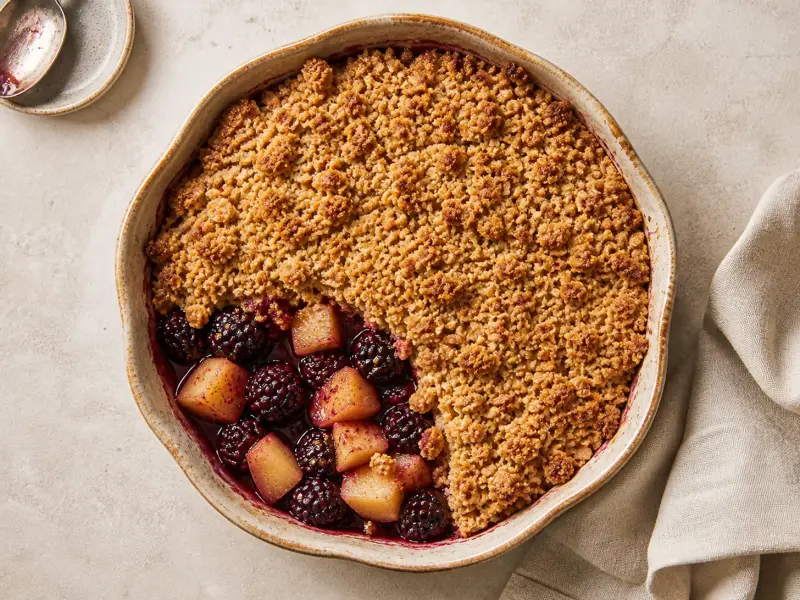 Apple and Blackberry Crumble
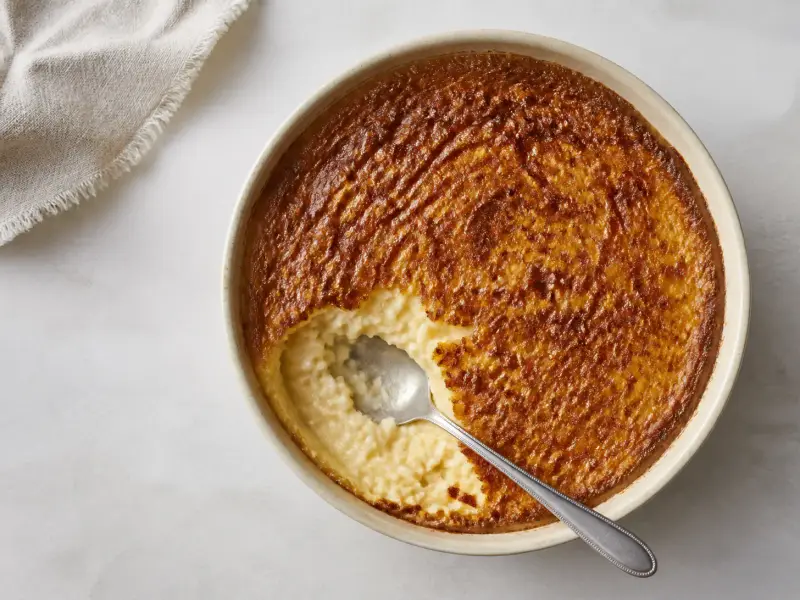 Baked Rice Pudding